


What if that sharp, stabbing sensation in your heel every morning isn’t something you simply have to “live with” or manage with endless rest? It’s incredibly frustrating to feel like your recovery has stalled, especially when you’re eager to get back to your weekend sport or simply enjoy a walk around the local park. Many people we see in our Liverpool and Bankstown clinics feel stuck between the fear of invasive surgery and the temporary relief of cortisone injections. Understanding the clinical roles of Shockwave Therapy and Prolotherapy is often the first step toward finding a solution that actually works for your body.
In this article, we’ll explain how the combined strengths of these treatments can resolve stubborn heel pain and ligament injuries when traditional treatments fail. We understand that every foot is unique, so we favour a thorough breakdown of the specific benefits of each approach. You’ll discover how these modern, non-invasive therapies work to stimulate natural repair and provide long-term stability. By the end, you’ll have a clear understanding of which clinical pathway matches your specific injury, helping you move forward with confidence and ease.
Key Takeaways
- Learn how Shockwave Therapy uses acoustic waves to break down scar tissue while Prolotherapy Injections trigger natural tissue regeneration.
- Discover why the dual-action power of Shockwave Therapy and Prolotherapy provides a more effective path to recovery for chronic heel pain than traditional methods.
- Understand the specific roles of mechanical stimulation and chemical signals in repairing damaged ligaments and stubborn arch pain.
- Explore the benefits of local specialist care in Liverpool and Bankstown for residents seeking non-surgical alternatives to cortisone or invasive procedures.
- Gain clarity on how these advanced therapies can be integrated into your personalised recovery plan to help you return to walking and sport sooner.
Understanding the Science of Shockwave Therapy and Prolotherapy
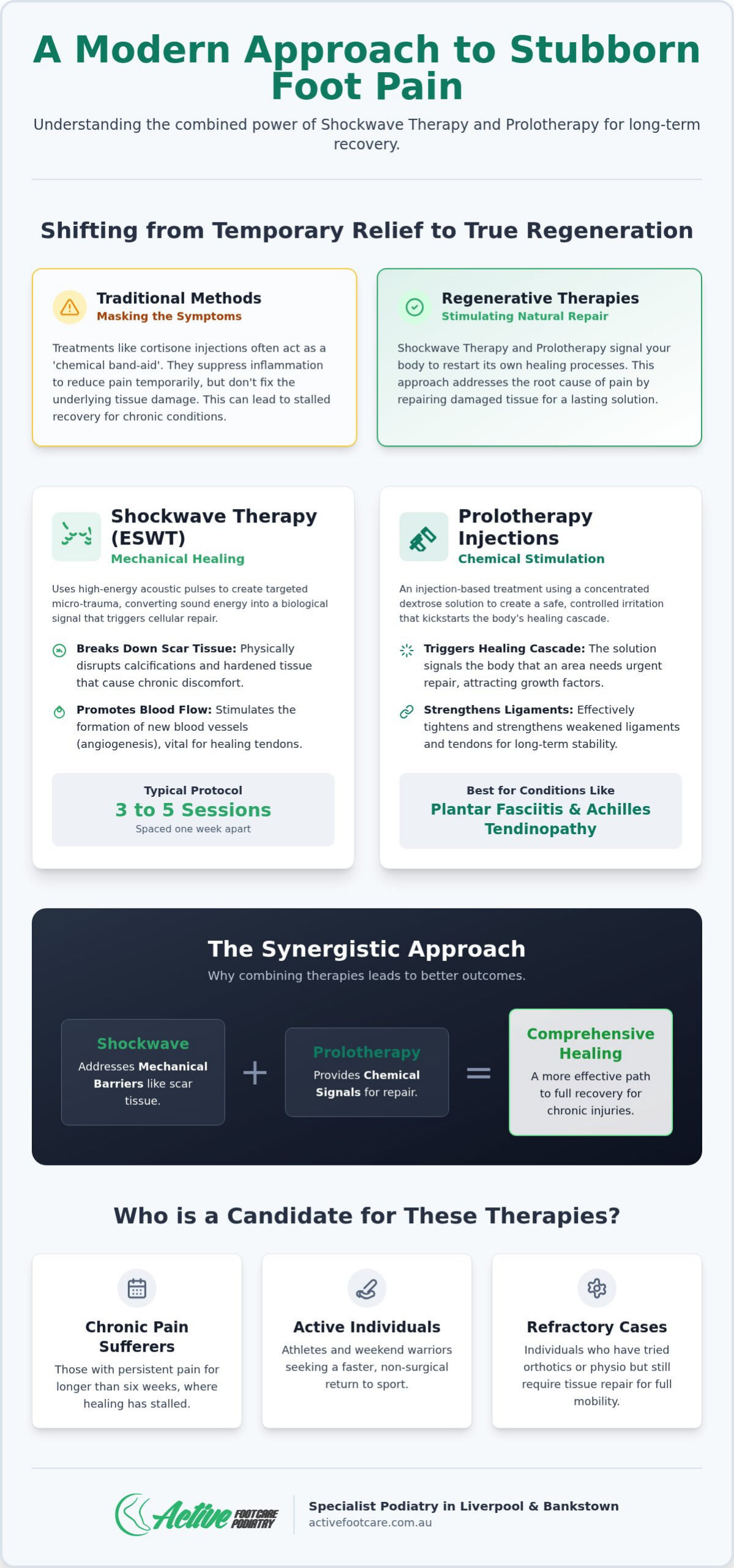
When you’re dealing with persistent foot pain, the goal isn’t just to feel better for a few days; it’s to fix the underlying tissue damage. Traditional treatments like cortisone injections often act as a chemical band-aid, masking symptoms by suppressing inflammation. In contrast, Shockwave Therapy and Prolotherapy are regenerative treatments. They don’t hide the problem. Instead, they signal your body to restart its natural repair processes. This approach is particularly effective for stubborn conditions like Plantar Fasciitis, Achilles Tendinopathy, and chronic ligament laxity.
Extracorporeal Shockwave Therapy (ESWT) uses mechanical acoustic waves to create targeted micro-trauma in damaged tissues. This sound energy stimulates blood flow and cellular repair. On the other hand, Prolotherapy is an injection-based treatment that uses a concentrated dextrose solution to safely irritate the local area. This controlled irritation triggers a healing cascade, effectively strengthening weakened ligaments and tendons. Using Shockwave Therapy and Prolotherapy together allows us to address both the structural and chemical aspects of your recovery.
The Shift from Passive to Active Recovery
For a long time, the standard advice for injuries was “RICE”—Rest, Ice, Compression, and Elevation. While this helps during the first few days of an injury, it often fails in chronic cases. If your pain has lasted for months, your body has likely entered a stalled state where healing has stopped. Regenerative medicine effectively restarts the body’s natural healing response by moving from passive rest to active stimulation. Before we begin any treatment, a professional biomechanical assessment is vital. We need to understand the way you move to ensure the treatment provides a long-term solution rather than a temporary fix.
Who is a Candidate for These Advanced Therapies?
We often recommend these treatments for patients who have reached a plateau in their recovery. You might be a candidate if you fall into these categories:
- Chronic Pain Sufferers: If you’ve been experiencing persistent pain for longer than six weeks, your injury has likely moved into a chronic phase that requires more than just rest.
- Active Individuals: Athletes and weekend warriors who need a faster return to sport without the risks of surgical intervention often benefit from these protocols.
- Refractory Cases: This includes individuals who have already tried custom orthotics or physical therapy but still require additional tissue repair to reach full mobility.
By focusing on restoration rather than just relief, we help our patients in Liverpool and Bankstown reclaim their active lifestyles. We see these therapies as a partnership between our clinical expertise and your body’s incredible ability to heal itself when given the right stimulus.
Extracorporeal Shockwave Therapy (ESWT): Mechanical Healing
Shockwave therapy works by sending high-energy acoustic pulses directly into the damaged area of your foot. This process, known as mechanotransduction, involves converting sound energy into a biological signal that triggers cellular repair. It’s a highly effective way to kickstart the healing process in tissues that have become stagnant or stuck in a cycle of chronic pain. By using Shockwave Therapy and Prolotherapy, we can address both the physical barriers to healing and the chemical environment of the injury.
One of the primary benefits of these acoustic waves is their ability to break down calcifications and stubborn scar tissue in the heel and arch. Over time, chronic injuries can lead to hardened deposits that cause persistent discomfort. Shockwave therapy physically disrupts these structures while simultaneously promoting angiogenesis, which is the formation of new blood vessels. This increase in blood circulation is vital for tendons, which naturally have a poor blood supply and often struggle to repair themselves without intervention. As highlighted by the Mayo Clinic on ESWT, this technology is a powerful tool for managing complex musculoskeletal diagnoses. For most patients, a standard protocol involves three to five sessions, typically spaced one week apart. The versatility of acoustic wave technology means it is increasingly used across different medical specialities; for example, FullMast applies similar regenerative science in their men’s health clinics to support physical wellbeing.
What Happens During a Shockwave Session?
We begin by applying a cool coupling gel to your skin. This gel is essential because it ensures the acoustic waves travel efficiently into your tissue rather than reflecting off the surface. During the procedure, you’ll feel a rhythmic tapping sensation. While this can feel intense, we always communicate with you to adjust the settings for your comfort. The entire process is remarkably efficient; a session usually takes under 15 minutes per foot. This makes it a convenient option for residents in Liverpool or Bankstown who need to return to their daily routine quickly.
Expected Outcomes and Recovery Milestones
Many of our patients report an immediate “analgesic effect” following their first session. This temporary numbing of the pain can provide significant relief, but the real work happens beneath the surface over the following months. The peak healing period generally occurs between 6 and 12 weeks after your final treatment as your body builds new, healthy tissue. It’s crucial to avoid anti-inflammatory medications like ibuprofen during this time. These drugs can interfere with the controlled inflammatory response we are trying to create to repair your injury. If you’re ready to move past temporary fixes, you can discuss your options during a clinical consultation with our team.
Prolotherapy Injections: Chemically Stimulating Tissue Repair
While shockwave therapy addresses the mechanical breakdown of tissue, Prolotherapy Injections focus on the chemical environment of the injury. The term “prolotherapy” is short for proliferative therapy. It works by creating a controlled, purposeful inflammatory response in the area of damage. By injecting a concentrated dextrose solution, we signal the body that a specific site requires urgent attention. This process triggers the release of growth factors and promotes the production of new collagen, which is the building block of healthy tendons and ligaments. For patients who haven’t found a complete resolution with other methods, the combined protocol of Shockwave Therapy and Prolotherapy offers a comprehensive way to rebuild strength from the inside out.
This approach is particularly valuable for stabilising “loose” joints or a weakened plantar fascia. When ligaments become overstretched or damaged, they lose their ability to support the foot’s complex structure. Prolotherapy helps to tighten these structures, providing the stability needed for pain-free movement. You can explore a more detailed breakdown of this process in our guide to regenerative healing.
The Role of Injections in Foot and Ankle Stability
We specifically target the enthesis, which is the precise point where a tendon or ligament attaches to the bone. This area often has a limited blood supply, making it prone to chronic wear and tear. Common injection sites include the calcaneal attachment at the heel and the mid-foot ligaments that support the arch. This targeted approach makes prolotherapy a preferred clinical option for treating heel inside pain, where structural instability is often the root cause of the discomfort. By reinforcing these attachment points, we help restore the natural mechanics of your foot.
Safety, Comfort, and Post-Injection Care
It’s natural to feel a bit apprehensive about injections, but we prioritise your comfort throughout the procedure. We typically use a small amount of local anaesthetic to ensure the process is as painless as possible. After the treatment, you might notice a sensation of “fullness” or a mild, dull ache in the foot. This is a positive sign; it means the healing cascade has begun. We recommend gentle movement in the first 48 hours to help circulate the solution, but it’s important to avoid high-impact sports or heavy lifting during this brief window. Most patients find they can return to their normal daily activities almost immediately, provided they listen to their body’s signals and allow the regenerative process to take hold.
The Synergistic Approach: Why Combine Shockwave and Prolotherapy?
Many patients who visit our Liverpool and Bankstown clinics ask whether they should choose one treatment over the other. While both are powerful regenerative tools, they perform very different roles. In our clinical experience, the most successful outcomes for chronic injuries often come from a combined approach. By using Shockwave Therapy and Prolotherapy together, we can address the injury from both a mechanical and a chemical perspective, leading to more resilient results.
Think of Shockwave as the “clean-up” crew. Its mechanical energy breaks down the stubborn scar tissue and calcified deposits that often prevent a tendon from healing. This process also increases local blood flow, which effectively “preps” the tissue. Once the mechanical barriers are cleared, Prolotherapy acts as the “construction” crew. The injection triggers a targeted chemical signal that recruits growth factors to the area, reinforcing the structural integrity of the ligaments. This dual-action method is particularly effective for “recalcitrant” plantar fasciitis. These are the cases where a patient has failed single-modality care elsewhere and feels their recovery has completely stalled. By attacking the problem from two angles, we often find we can reduce the total number of sessions required to achieve long-term pain resolution.
Comparing the Benefits: At-a-Glance
- Shockwave: This is the ideal choice for stiff, calcified tendons and provides a rapid analgesic effect for immediate pain relief.
- Prolotherapy: This is best suited for addressing ligament laxity, joint instability, and facilitating deep, long-term structural repair.
Combining ESWT and Prolotherapy ensures both the removal of pathological tissue and the reinforcement of healthy fibres.
Customising Your Treatment Plan
At Active Footcare, Dr. Maher Said and our clinical team don’t believe in a one-size-fits-all protocol. We carefully determine the sequence of your therapies based on your unique presentation. Several factors influence this decision, including your age, your daily activity level, and your broader medical history. For instance, patients managing conditions like diabetes require a more specialised approach to ensure their vascular health supports the regenerative process.
We also look beyond the site of pain to understand why the injury occurred. This is where a professional gait analysis becomes essential. By identifying biomechanical inefficiencies in the way you walk or run, we can ensure that your regenerative treatments are supported by proper foot function. If you’re tired of managing symptoms and want to address the root cause of your discomfort, we invite you to book a consultation at one of our Western Sydney clinics to discuss a personalised recovery plan.
Accessing Advanced Podiatry in Liverpool and Western Sydney
Finding a local specialist who understands the specific needs of Western Sydney residents is the first step toward a successful recovery. At Active Footcare, led by Principal Podiatrist Dr. Maher Said, we focus on providing a supportive environment where you feel understood rather than just diagnosed. Choosing a local clinic in Liverpool or Bankstown for your recovery makes the process significantly more manageable, especially when you require a series of weekly sessions. By offering both Shockwave Therapy and Prolotherapy in our local centres, we help our patients avoid the stress of long commutes while receiving the highest standard of modern, non-invasive care.
We believe that continuity of care is vital for long-term success. From your initial diagnosis through to your final rehabilitation exercises, our clinical team remains your dedicated partner. This consistency ensures that your progress is monitored closely and your treatment plan is adjusted based on how your body is responding. We’ve also integrated our advanced services with NDIS podiatry and aged care home visits, ensuring that high-quality foot care is accessible to every member of our community, regardless of their mobility levels.
Clinic and Home-Based Care Options
Our primary clinical hubs in Liverpool and Moorebank are fully equipped with the latest technology for shockwave sessions. For those living in Campbelltown or the broader Sydney south-west region, these locations offer a convenient and professional alternative to hospital-based care. If you are an NDIS participant or an older Australian who prefers the comfort of your own home, our mobile podiatry team can conduct thorough specialised foot assessments. We bring our clinical expertise to you, discussing how regenerative options can be safely incorporated into your personalised care plan to improve your daily mobility. While our focus is on foot health in Sydney, this model of mobile care is gaining traction globally; for instance, you can discover REVĪV to see how regenerative medicine is delivered in-home for spine and joint pain.
Starting Your Journey to Pain-Free Movement
Your first appointment is the foundation of your recovery journey. To help us get a complete picture of your foot health, we recommend bringing along any relevant items such as recent X-rays, ultrasounds, or the footwear you use for daily exercise. Our clinical assessment process is methodical and steady; we don’t just look at the site of pain, but investigate the biomechanical reasons why the injury occurred in the first place. We’ll walk you through each step of the proposed treatment, ensuring you feel informed and confident in the path ahead. If you’re ready to resolve stubborn pain and return to the activities you love, book your assessment with Active Footcare today.
Reclaiming Your Mobility with Regenerative Care
Chronic foot pain doesn’t have to be your permanent reality. By understanding the specific roles of Shockwave Therapy and Prolotherapy, you can move away from temporary fixes and toward genuine tissue restoration. We’ve explored how mechanical waves break down stubborn scar tissue while targeted injections provide the chemical signals needed for long-term structural repair. This dual-action approach is a cornerstone of our practice in Western Sydney, offering a powerful alternative for those who wish to avoid invasive surgery or the side effects of cortisone.
Led by Principal Podiatrist Dr. Maher Said, our clinical team specialises in these non-surgical regenerative therapies. We’re proud to serve the Liverpool, Bankstown, and Sydney South West communities with modern, evidence-based care. Whether you’re an athlete eager to return to the field or simply want to enjoy a morning walk without pain, we’re here to support your recovery. It’s time to stop managing symptoms and start your journey back to physical ease. Book Your Advanced Foot Pain Assessment with Active Footcare today and take the first step toward lasting relief.
Frequently Asked Questions
Is Shockwave Therapy painful?
Shockwave therapy is generally described as a rhythmic tapping or pulsing sensation that can be uncomfortable but should not be intensely painful. Our clinical team monitors your feedback throughout the procedure to adjust the intensity of the acoustic waves for your comfort. Most patients find the sensation quite manageable, especially since the treatment usually lasts less than 15 minutes. After the session, the area often feels slightly numb, providing a temporary analgesic effect.
How many sessions of Prolotherapy will I need before I feel a difference?
Most patients begin to notice a significant improvement in stability and a reduction in pain after three to four sessions. While some individuals feel a difference sooner, the regenerative process is cumulative. Each injection builds on the previous one to strengthen weakened ligaments and tendons. We typically space these sessions several weeks apart to allow your body’s natural healing cascade to produce new, healthy collagen fibres and restore structural integrity.
Can I drive home after receiving Prolotherapy injections in my foot?
Yes, you can typically drive yourself home following your appointment at our Liverpool or Bankstown clinics. We often include a small amount of local anaesthetic for your comfort, which may cause a temporary feeling of “fullness” or mild numbness in the treated area. However, this rarely affects your ability to operate a vehicle safely. If you feel any unusual discomfort, we recommend resting in our waiting area until you feel fully confident to drive.
Are these treatments covered by NDIS or private health insurance?
Coverage for these advanced therapies varies depending on your specific private health insurance provider and your level of “extras” cover. We recommend contacting your insurer to confirm your eligibility for specialised podiatry procedures. For our NDIS participants, these treatments can often be included as part of a managed care plan if they relate directly to your mobility goals. Our team can provide the necessary clinical documentation to support your claims and assessments.
What is the success rate of combining Shockwave and Prolotherapy?
Clinical observations suggest that the synergistic use of Shockwave Therapy and Prolotherapy provides higher resolution rates for chronic injuries than using either treatment alone. By combining mechanical stimulation to break down scar tissue with chemical signals to restart healing, we address the injury from multiple angles. This comprehensive approach is particularly effective for “recalcitrant” cases where patients have previously failed to find relief through standard stretching, rest, or basic custom orthotics.
Can I continue to exercise while undergoing these treatments?
We generally encourage gentle movement and low-impact activities to maintain circulation, but you should avoid high-impact sports during the initial healing phase. Specifically, we advise resting from heavy loading for at least 48 hours following a prolotherapy injection. Our podiatrists provide a tailored rehabilitation plan that gradually reintroduces activity based on your progress. This ensures you don’t overload the new, developing tissue before it has gained sufficient structural strength to support your weight.
How does Prolotherapy differ from a cortisone injection?
Prolotherapy is a regenerative treatment, whereas cortisone is an anti-inflammatory medication designed to suppress symptoms. Cortisone works by masking pain and reducing swelling, but it can sometimes weaken the tissue over time if used repeatedly. In contrast, Prolotherapy Injections use a dextrose solution to safely irritate the tissue, triggering a natural healing response that actually strengthens the ligaments. It is a shift from merely hiding the pain to fixing the underlying structural damage.
Are there any side effects I should be aware of for Shockwave Therapy?
Side effects from shockwave therapy are typically mild and temporary. You may experience some slight redness, swelling, or a dull ache in the treated area for a day or two after the session. Some patients also report a “bruised” sensation, though actual skin bruising is uncommon. These reactions are actually a positive sign that your body is responding to the mechanical stimulus and beginning the necessary repair work in your heel, arch, or tendon.