


Did you know that nearly one in two Australians wake up with foot pain at least once a week? It is a staggering figure that highlights just how many people are struggling with persistent heel or arch discomfort that simply won’t go away. If you have been feeling confused about whether you need custom orthotics or just a better pair of shoes, you are certainly not alone. It is common to worry that visiting a clinic might lead to being sold a product rather than receiving a genuine medical diagnosis.
We believe you deserve a partner in your health who prioritises understanding your unique needs over making a quick sale. Undergoing a professional gait analysis in Sydney serves as a vital diagnostic tool, acting as a window into the precise mechanics of your walking pattern to find the root cause of your pain. This guide provides a 2026 checklist to help you choose a podiatrist who utilises modern technology and provides a personalised treatment plan. You will learn how to move forward with the confidence that comes from a clear, data-driven path toward lasting relief and improved mobility.
Key Takeaways
- Understand how a systematic assessment identifies the mechanical root causes of pain in your feet and knees rather than simply addressing surface symptoms.
- Learn the essential elements of a professional checklist, from checking joint range of motion to evaluating how your arches behave under pressure.
- Discover the advanced technology used for gait analysis in Sydney, such as digital pressure mapping, and how it provides a precise blueprint for your recovery.
- Prepare for your appointment with practical advice on the best footwear and clothing to bring for an accurate biomechanical evaluation.
- Gain the confidence to choose a podiatrist who blends modern clinical data with a warm, patient-focused approach to your long-term mobility.
Understanding Gait Analysis: Why Every Sydney Podiatrist Recommends It
When you visit a clinic for persistent foot or leg discomfort, you might expect a quick look at your arches. However, a professional gait analysis in Sydney goes much deeper than a simple visual check. At its core, a comprehensive overview of gait analysis reveals it is the systematic study of human locomotion, combining clinical observation with modern technology to see how your body moves as a single, integrated unit. While a standard consultation focuses on where it hurts right now, this assessment identifies the hidden causes of pain that often ripple upward from the feet to the ankles, knees, and even the hips.
For active Sydney-siders who enjoy weekend coastal walks or morning runs through the local park, this level of detail is a game-changer. It is far superior to a basic check-up because it captures data while you are in motion, rather than just sitting in a chair. By understanding these mechanics, your podiatrist can help prevent future injuries before they sideline your lifestyle, ensuring your movement remains fluid and pain-free.
The Science of Your Stride
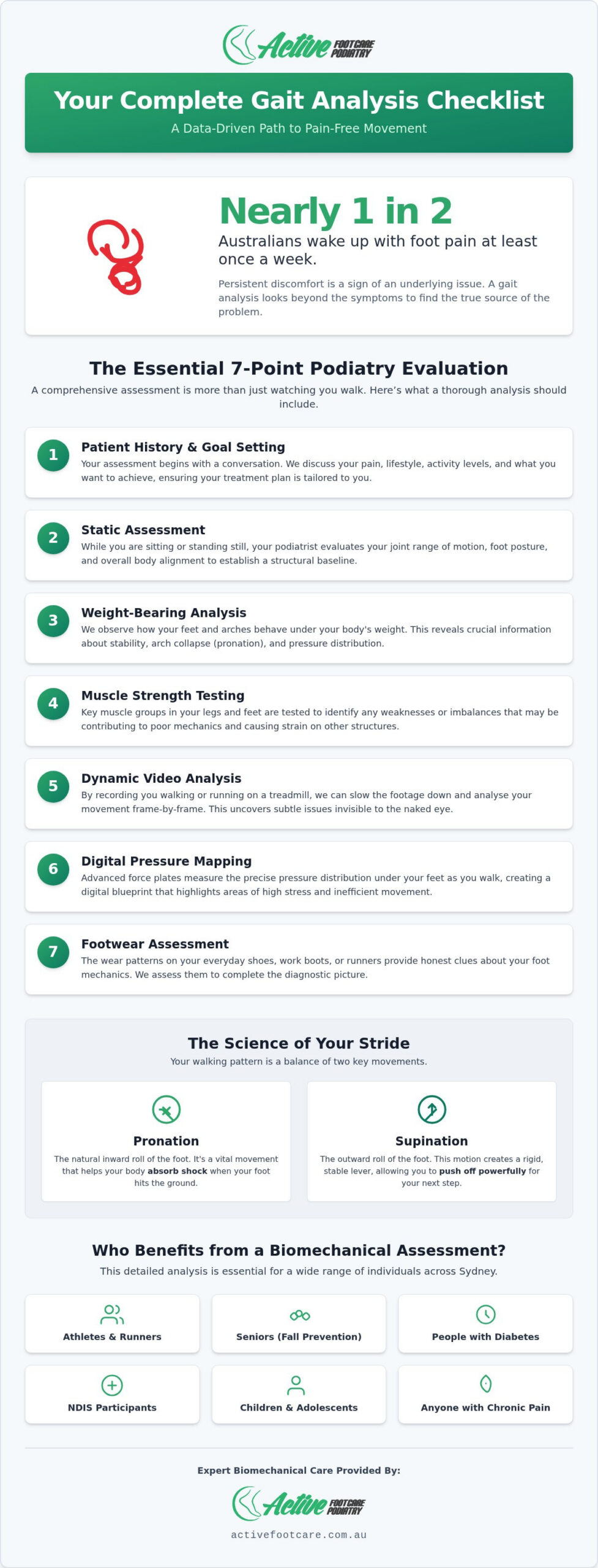
Your walking pattern is divided into two main stages: the stance phase, where your foot is in contact with the ground, and the swing phase, where it moves through the air. During the stance phase, your foot naturally performs two vital movements. Pronation occurs as your foot rolls slightly inward to absorb the shock of the pavement. Supination happens when the foot rolls outward to create a rigid lever, allowing you to push off effectively for the next step.
If these movements are out of sync, it creates unnecessary stress on your joints and soft tissues. In many cases, we find that nerve pain in foot symptoms can be traced back to these poor mechanics, where an unbalanced stride puts pressure on delicate structures. Correcting these subtle shifts is often the key to lasting relief.
Who Needs a Biomechanical Assessment?
This assessment isn’t just for elite athletes. While runners certainly benefit from fine-tuning their form, many different groups across Western Sydney find it essential for their daily wellbeing. Seniors often require an assessment to improve stability and reduce the risk of falls—an objective shared by platforms like Healthy Seventy that focus on wellbeing for older adults—while individuals living with diabetes use it to ensure their walking pattern isn’t creating dangerous pressure points on their feet.
We also work closely with NDIS participants who may need a detailed gait analysis in Sydney to support approvals for specialised mobility equipment or custom footwear. Additionally, parents often seek our guidance for children who appear to have flat feet or unusual walking patterns. Identifying these mechanical issues early allows us to support healthy development as they grow, giving you peace of mind about your family’s foot health.
The Essential Gait Analysis Checklist: 7 Things Your Podiatrist Should Evaluate
When you book a session for gait analysis in Sydney, the process should feel like a collaborative investigation into your movement. It isn’t a “one size fits all” look at your feet. Instead, it is a structured evaluation designed to pinpoint why you are experiencing discomfort. To get the most out of your appointment, it helps to know what a comprehensive assessment actually looks like beyond just walking across a room.
A thorough checklist starts with a static assessment. We examine your joint range of motion while you are sitting or standing still to understand your baseline physical structure. We then move to a weight-bearing analysis, where we evaluate how your arches behave under the direct pressure of your body weight. These are vital clinical facts about gait analysis that help us build a complete picture of your foot function before you even take a step.
Dynamic video analysis is the next critical phase. By recording your walk on a treadmill, we can review your movement frame-by-frame to spot subtle misalignments. Finally, a proper footwear review is essential. We assess the wear patterns on your current work shoes or joggers, as these provide honest clues about your gait that your feet alone might not reveal.
The Physical Exam Components
During the physical exam, we perform muscle strength testing to identify imbalances between your left and right legs. If one side is significantly weaker, the other side often overcompensates, leading to strain. We also check for leg length discrepancies, which are a common cause of persistent lower back pain. Proprioception is your body’s ability to sense its position in space. Testing this helps us understand how well your brain and feet are communicating to maintain balance and stability.
Technological Requirements
Modern podiatry relies on precision data. We use digital pressure mats to map high-pressure zones under the foot that are invisible to the naked eye. We also utilise slow-motion video software to capture the exact moment a joint might be rolling too far inward or outward. This data is the foundation for creating custom orthotics that are truly tailored to your unique foot structure. If you have been struggling with persistent pain, you can reach out to our Sydney clinic to discuss a personalised plan for your recovery.
Comparing Gait Analysis Technologies: Which Method is Right for You?
When you begin looking for gait analysis in Sydney, you will quickly realise that not all assessments are the same. Some clinics rely purely on the practitioner’s eye, while others use an array of digital sensors. We believe the most effective approach combines traditional clinical wisdom with modern diagnostic tools. This ensures we don’t just see how you move, but we understand the “why” behind every step you take.
Visual clinical observation is the “watch and learn” method used by experienced podiatrists. It allows us to see your body as a whole, noting how your hips, knees, and even your shoulders react when your feet hit the pavement. To add precision, we use digital pressure mapping. This technology visualises exactly where your foot strikes the ground, revealing “hot spots” of high pressure that are invisible to the naked eye. For those requiring intervention, 3D laser scanning creates a perfect digital model of your foot, ensuring any manufactured aids are a flawless fit for your unique anatomy.
We also consider the environment of the test. Treadmill analysis allows us to observe your stride over a sustained period in a controlled setting, which is excellent for spotting fatigue-related issues. Over-ground analysis, on the other hand, can sometimes provide more natural data for patients who find walking on a treadmill feels slightly “artificial.” Both have their place in a comprehensive biomechanical workup.
Traditional vs. Modern Methods
A combination of “old-fashioned” clinical experience and new technology works best for a reliable diagnosis. You might have seen “free” gait scans offered in retail shoe stores, but it is vital to understand the difference. A retail scan is often a simplified sales tool designed to recommend a specific brand of shoe. In contrast, a Sydney podiatrist is a university-trained medical professional. We are qualified to interpret complex biomechanical data and identify underlying pathologies that a salesperson simply cannot see. We look past the screen to understand your medical history and lifestyle needs.
Linking Results to Treatment
The true value of high-tech data lies in how it shapes your recovery plan. For example, if your gait analysis in Sydney reveals chronic mechanical overloading that has caused tissue damage, we might recommend shockwave therapy for heel pain to kickstart the body’s natural healing process. If the data shows that your stride is unstable due to ligament laxity, prolotherapy for heel pain can be an effective way to strengthen those supporting structures. Even your therapy for plantar fascia is personalised based on your walk. The data tells us whether your specific case requires more focus on flexibility and stretching or if you need a program built around targeted muscle strengthening. For patients whose assessment reveals excessive tension on the plantar fascia, understanding the difference between orthotics for plantar fasciitis — custom versus off-the-shelf options becomes an essential next step in choosing the right structural support.
Consultation Guide for Western Sydney Residents
Preparing for your gait analysis in Sydney is a straightforward process, but a little bit of preparation ensures we gather the most accurate data for your recovery. When you visit our clinic, we don’t just look at your feet in isolation. We look at how your entire body functions as a unit. To do this effectively, we need to see you move in the clothes and shoes you use most often in your daily life.
We ask that you pack two specific types of footwear for your appointment: your most-worn work shoes and your exercise joggers. Your work shoes reveal how you spend the majority of your day, while your joggers show us how your feet handle higher impact. Wear shorts or leggings that sit above the knee so we can clearly observe the alignment of your hips, knees, and ankles during the assessment. This visibility is vital for spotting subtle rotations that might be contributing to your discomfort.
It is also helpful to document your history before arriving. Note down exactly when your pain started and which specific activities make it worse. Whether it is a sharp pain during your morning run or a dull ache after a day at the office, these details help us connect your clinical data to your real-world experience. Regarding the financial side of your care, we recommend checking with your private health fund to see if they cover “Biomechanical Assessment” under Item 118, which is the standard code for this service.
What to Bring to Your Liverpool or Bankstown Appointment
To help us provide the most thorough care possible, please bring any previous X-rays or ultrasounds related to your foot or leg pain. If you are living with diabetes or circulatory issues, a list of your current medications is essential for our clinical records. For our NDIS participants, having your plan details ready allows us to streamline the process for mobility equipment or custom orthotics in Sydney approvals, ensuring you receive the support you need without unnecessary delays.
The Consultation Timeline
We value your time and follow a methodical structure to ensure every concern is addressed. Your session typically follows this progression:
- Initial interview (10 mins): We discuss your pain history, lifestyle, and what you hope to achieve, whether that is returning to sport or walking pain-free.
- Physical assessment (15 mins): Our team performs hands-on testing of your joints, muscle strength, and reflexes to check for imbalances.
- Gait analysis (15 mins): This is the data collection phase where you will walk or run while we utilise our diagnostic technology.
- Report of findings (10 mins): We review the results together, explaining what the data shows and agreeing on a personalised treatment plan.
If you are ready to identify the root cause of your discomfort, you can book your gait analysis in Sydney with our experienced clinical team today.
Expert Biomechanical Care: Why Active Footcare is the Preferred Choice in Sydney
Principal Podiatrist Dr. Maher Said leads our clinical team with a clear mission: to provide the families of Western Sydney with world-class foot health care. We understand that finding a reliable partner for your health is about more than just finding the latest technology. It is about feeling heard, understood, and supported throughout your journey. This is why we focus on “Compassionate Expertise.” We blend high-tech gait analysis in Sydney with the friendly, attentive service you would expect from a local practitioner who truly cares about your wellbeing.
Our approach is methodical and patient-focused. We don’t view a biomechanical assessment as a quick fix or a means to sell a product. Instead, we integrate the data gathered into a holistic recovery plan. This might involve a combination of strengthening exercises, footwear changes, or advanced clinical therapies tailored to your specific needs. By looking at the bigger picture, we ensure that the root cause of your pain is addressed, providing you with a long-term solution rather than a temporary patch.
Tailored Solutions for Every Suburb
We are proud to serve the diverse needs of the Bankstown and Liverpool communities. We recognise that for some, visiting a clinic in person isn’t always possible due to mobility challenges or busy schedules. To ensure everyone has access to professional care, we offer a podiatrist home visit sydney service. This mobile option is particularly valuable for seniors and NDIS participants in areas like Moorebank and Campbelltown, bringing our clinical expertise directly to your doorstep.
Our reputation in the community is built on reliable results and trust. We take great pride in helping our patients return to the activities they love. Whether your goal is to get back to weekend sport, enjoy a coastal walk with friends, or simply move through your day without constant discomfort, our team is dedicated to making that happen through precision care and personal attention.
Book Your Sydney Gait Analysis Today
Taking the first step toward a pain-free life is often the hardest part, but we have made our booking process as simple as possible. Whether you prefer an in-clinic session or require a home consultation, our team is ready to assist you. You don’t have to live with persistent foot pain or settle for “just getting by” with discomfort. By choosing our professional gait analysis in Sydney, you are choosing a path toward clarity and restoration. We are here to help you find the cause, treat the pain, and regain your confidence in every step you take.
Step Confidently Toward a Pain-Free Future
Your journey toward comfortable movement starts with understanding the hidden mechanics of your stride. By following our 2026 checklist, you can move past the confusion of choosing footwear and find the genuine root cause of your discomfort. A professional gait analysis in Sydney serves as the foundation for a recovery plan that is as unique as your footprint, moving beyond quick fixes to achieve lasting stability and relief.
At Active Footcare, Principal Podiatrist Dr. Maher Said and our clinical team are dedicated to providing this level of precision care across Western Sydney. We utilise advanced diagnostic technology to ensure you feel understood and supported, whether you visit us in-clinic or require our specialised NDIS and mobile podiatry services. You don’t have to navigate persistent heel or arch pain on your own; our team is here to guide you back to the activities you love.
Book your expert gait analysis with Active Footcare today and take the first step toward a more active, mobile life. We look forward to helping you walk with ease once again.
Frequently Asked Questions
Is gait analysis only for professional athletes?
Gait analysis is certainly not restricted to elite athletes. While it helps runners improve performance, we use it daily for seniors wanting to improve balance, children with walking concerns, and individuals managing chronic conditions like diabetes. It is a fundamental tool for anyone experiencing persistent foot or leg pain during their normal daily routine, providing a clear path toward moving with greater ease.
Will I need to run on a treadmill during the assessment?
You don’t necessarily have to run or even use a treadmill if it doesn’t suit your physical needs. While treadmill sessions allow us to collect data over a sustained period, we also perform over-ground walking assessments for those who prefer it. We tailor the process to your comfort level and current mobility, ensuring we gather accurate information without causing you any unnecessary stress or discomfort.
Does Medicare cover the cost of gait analysis in Sydney?
Medicare typically does not cover the cost of a private podiatry consultation or gait analysis in sydney unless you have a specific referral. If your GP has placed you on a Chronic Disease Management (EPC) plan, you may be eligible for a partial rebate for a set number of sessions. Most patients use their private health insurance extras cover to reduce the out-of-pocket expense for these clinical services.
How long does a professional gait analysis session take?
A comprehensive session usually takes between 45 and 60 minutes to complete properly. This timeframe allows us to conduct a thorough initial interview, perform a physical assessment of your joints and muscles, and then record the actual movement data. We take this time to ensure the diagnosis is precise and that you have a clear understanding of your personalised treatment plan before leaving the clinic.
Can gait analysis help with my chronic back or hip pain?
Yes, identifying issues in your walking pattern often provides the key to resolving chronic back or hip pain. Because your feet are the foundation of your body, any misalignment during your stride can cause a chain reaction that puts strain on your higher joints. By correcting your foot mechanics, we can often reduce the compensatory movements that lead to persistent discomfort in your hips and lower back.
What is the difference between a gait scan in a shoe shop and at a podiatrist?
The primary difference lies in the clinical expertise and the purpose of the scan. Retail scans are often simplified sales tools used to recommend a specific brand of footwear. A podiatrist, however, is a university-trained medical professional who uses gait analysis in sydney to diagnose underlying pathologies. We look at your full medical history and biomechanics to create a clinical treatment plan rather than just making a retail suggestion.
Do I need a GP referral to see a Sydney podiatrist for gait analysis?
You do not need a GP referral to book an appointment for a biomechanical assessment. Most of our patients book directly to address their foot or leg concerns as soon as they arise. A referral is only necessary if you are seeking to claim a rebate through a Medicare Chronic Disease Management plan or if you are attending as part of a DVA or workers’ compensation claim.
For those navigating broader occupational health requirements or injury management, Persona Health offers detailed resources on pre-employment medicals to ensure workers are physically prepared for their specific roles.
How often should I have my gait re-evaluated?
Re-evaluation timing depends on your specific condition and your lifestyle goals. For many patients, we perform a follow-up after a few months to ensure a new treatment plan or orthotics for plantar fasciitis are working effectively. For long-term maintenance, a check-up every 12 to 24 months is often recommended to account for natural changes in your body, activity levels, or footwear wear patterns. If you are considering whether custom orthotics in Sydney’s Liverpool and Bankstown areas may be right for you, a re-evaluation appointment is an ideal time to discuss your options with our podiatry team.