


What if that sharp, stabbing sensation you feel with your very first step each morning isn’t a permanent fixture of your life, but a signal that your body needs a biological “reset” to complete its healing? Many of our patients at Active Footcare arrive feeling frustrated by chronic discomfort that hasn’t responded to simple rest or ice. You might worry that your only options left are steroid injections with potential side effects or the daunting downtime of the operating theatre. It’s exhausting to miss out on your daily walks or local sport because your heel simply won’t cooperate.
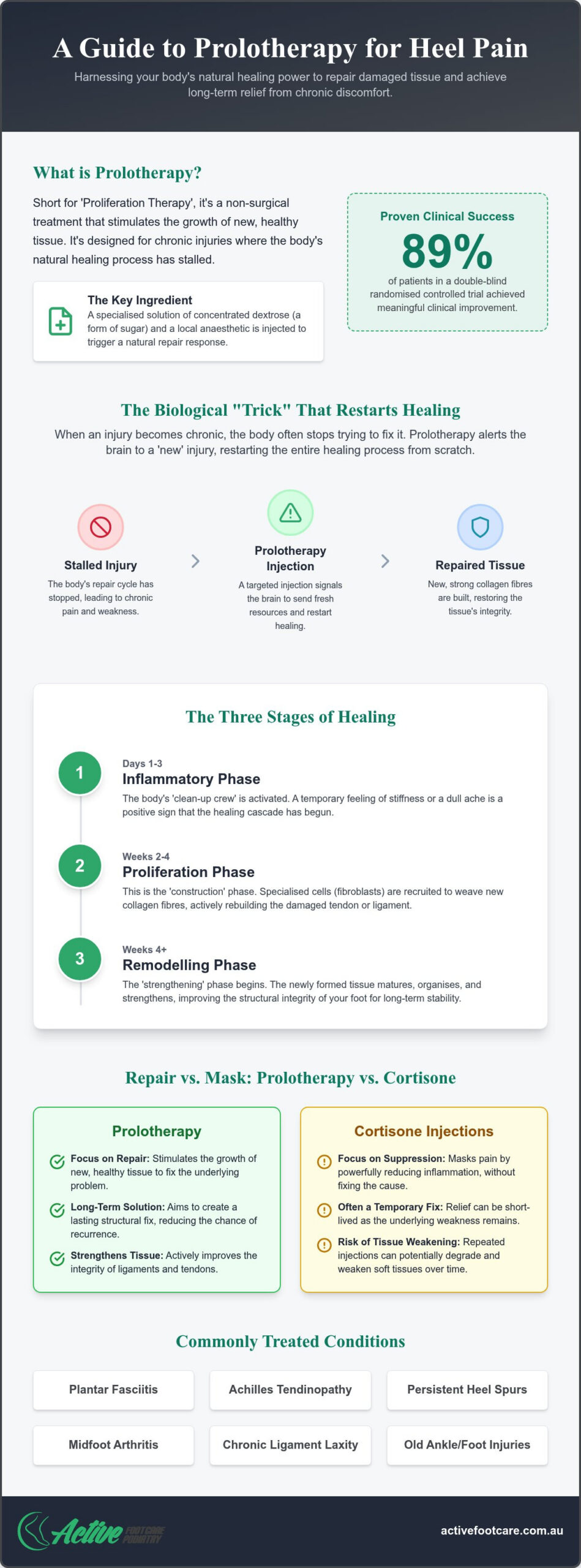
We understand that you’re looking for more than just a way to mask the symptoms; you want a long-term solution that restores the integrity of your tissue. This is where prolotherapy for heel pain becomes a game-changer. Clinical research is encouraging, with one double-blind randomised controlled trial showing that 89% of prolotherapy patients achieved meaningful clinical improvement. By triggering a targeted, natural inflammatory response, we can encourage your body to repair damaged ligaments and tendons rather than just silencing the pain.
In this FAQ guide, we’ll explain how this specialised treatment works, what the recovery process looks like, and how it fits into a personalised plan to get you back to your active lifestyle with confidence.
Key Takeaways
- Learn how prolotherapy for heel pain uses a specialised dextrose solution to stimulate your body’s innate ability to grow new, healthy tissue.
- Understand the biological “trick” that alerts your brain to restart the healing process in chronic injuries that have previously stalled.
- Discover why choosing a repair-focused treatment can be a more sustainable, long-term alternative to the temporary masking effect of cortisone injections.
- Find out what to expect during a clinical consultation, including how a biomechanical assessment ensures the treatment is tailored to your unique foot structure.
- Identify if you are a suitable candidate for this non-surgical approach if traditional methods like rest and ice have failed to provide lasting relief.
Understanding Prolotherapy for Chronic Heel Pain
If you’ve spent months or even years managing stubborn foot discomfort, you might have heard the term ‘prolotherapy’ mentioned by a specialist. Short for ‘proliferation therapy,’ this clinical procedure is specifically designed to stimulate the growth of new, healthy tissue in areas where the body’s natural healing process has stalled. Unlike treatments that simply suppress inflammation, prolotherapy for heel pain uses a targeted injection to restart the repair cycle. We typically use a specialised solution of concentrated dextrose, which is a form of sugar, mixed with a local anaesthetic to ensure your comfort during the procedure. It is a minimally invasive, non-surgical option that bridges the gap between basic conservative care and the operating theatre.
The History and Safety of PHI Therapy
While it might sound like a modern innovation, the foundations of this treatment date back to the 1940s. Understanding What is Prolotherapy? involves looking at decades of clinical use that establish its long-term safety profile. Because the primary ingredient is glucose, many patients view it as a natural alternative to synthetic drugs or corticosteroid injections. Using concentrated sugar in the foot is remarkably safe; it mimics the body’s own energy source and acts as a local catalyst for repair without the risk of tissue weakening often associated with repeated steroid use.
Common Conditions Treated in our Sydney Clinics
At our Liverpool and Bankstown clinics, we frequently see patients whose plantar fasciitis has become a chronic condition. This often happens because the plantar fascia has a relatively poor blood supply, making it difficult for the body to heal tiny tears on its own. Prolotherapy provides the necessary “nudge” to get that healing back on track. We also find this method highly effective for Achilles tendinopathy, where the large tendon at the back of your heel has become thickened or painful over time.
Beyond these common issues, we utilise prolotherapy to support patients dealing with:
- Persistent heel spurs that cause localised irritation.
- Midfoot arthritis where joint stability has been compromised.
- Chronic ligament laxity following old ankle or foot injuries.
Our Principal Podiatrist, Dr. Maher Said, assesses each case individually to determine if your specific condition will benefit from this regenerative approach. By integrating this into a tailor-made solution, we help you move away from temporary fixes toward genuine tissue restoration. Whether you are an athlete or someone simply wanting to enjoy a morning walk, this procedure offers a path back to mobility without the need for invasive surgery.
How Prolotherapy Stimulates Natural Tissue Repair
It’s a common misconception that all inflammation is harmful to your recovery. While chronic inflammation is like a low-grade fire that slowly degrades your tendons, the acute inflammation triggered by prolotherapy for heel pain is actually the body’s natural construction crew. When an injury becomes chronic, the healing process has often stalled or simply given up. By introducing a mild irritant solution to the site, we effectively perform a biological ‘trick’ that alerts the brain to a new, acute injury. This signal restarts the healing cascade, commanding the body to send fresh resources to an area it had previously ignored.
The stars of this repair process are fibroblasts, which are specialised cells responsible for the production of collagen. As these cells are recruited to the heel, they begin weaving new fibres that thicken and strengthen the plantar fascia or Achilles tendon. This doesn’t just mask the discomfort; it actively strengthens the foundation of your foot. By improving the structural integrity of these soft tissues, we help stabilise the joints of the foot, which often reduces the mechanical strain that caused the pain in the first place.
The Three Stages of Healing Post-Injection
The journey toward long-term relief follows a predictable path. Stage 1 is the Inflammatory Phase, occurring in the first one to three days. During this time, you might feel some temporary stiffness or a dull ache, which is a positive sign that the ‘clean-up’ crew has arrived. Stage 2 is the Proliferation Phase, lasting from week two to week four, where your body begins laying down those essential new collagen fibres. Finally, Stage 3 is the Remodelling Phase, which can continue for up to six months. During this period, the new tissue matures and organises itself into a strong, functional matrix. If you’re ready to move past temporary fixes, you can book a consultation at our Western Sydney clinics to see if this regenerative approach is right for you.
Why Dextrose? The Science of the Solution
The solution we use works through a process called the osmotic effect. By creating a high-concentration environment around the damaged cells, the solution causes them to lose water, which acts as a powerful signal for the body to release natural growth factors. In most podiatric clinical settings, the dextrose concentration typically ranges between 12.5% and 25% to effectively stimulate the desired tissue response. We also include a local anaesthetic, usually lignocaine, in the mix. This provides immediate, though temporary, relief and serves as a vital diagnostic tool. If your pain vanishes instantly after the injection, it confirms that we’ve accurately targeted the exact source of your discomfort.
Prolotherapy vs. Cortisone and Shockwave: Which is Best?
When you are dealing with persistent discomfort, it’s natural to search for a “silver bullet” that will provide instant relief. However, every foot is unique, and the best approach often involves a combination of therapies tailored to your specific biomechanics. Before we ever recommend prolotherapy for heel pain, our team at Active Footcare conducts a thorough Gait Analysis. This allows us to see exactly how your foot moves and whether mechanical issues are contributing to your injury. Often, we find that combining regenerative injections with Custom Orthotics provides the most stable, long-term result by supporting the foot while the tissue repairs itself.
Prolotherapy vs. Cortisone Injections
Cortisone has been the traditional go-to for many years because it is an incredibly powerful anti-inflammatory. If you need to “mask” pain for an upcoming event, cortisone provides that rapid, temporary window of relief. The downside is that steroids don’t actually fix the underlying damage. In fact, research suggests that repeated cortisone injections can lead to serious complications, such as plantar fascia rupture or fat pad atrophy, where the natural cushioning under your heel begins to waste away. Prolotherapy takes the opposite approach; it is a “building” therapy. Rather than silencing the pain signal, it uses the body’s natural inflammatory response to create new, stronger tissue. It’s the difference between painting over a crack in a wall and actually reinforcing the foundation.
Prolotherapy vs. Shockwave Therapy
Shockwave Therapy is another excellent non-invasive option we offer in our Liverpool and Bankstown clinics. The primary difference lies in the method of stimulation. Shockwave uses mechanical acoustic waves to create micro-trauma and stimulate healing, whereas prolotherapy uses a chemical stimulus via the dextrose solution. For patients who are particularly needle-phobic, Shockwave is often the preferred starting point because it requires no injections. It’s a highly effective way to treat many cases of plantar fasciitis and Achilles tendinopathy without breaking the skin.
For more stubborn or chronic cases, our podiatrists might recommend a dual approach. We’ve seen significant success in combining both therapies, using Shockwave to break down calcifications and prolotherapy to provide the biological “reset” needed for tissue regeneration. By looking at your medical history and the results of your biomechanical assessment, we can help you choose the path that offers the highest chance of returning to your favourite activities without the risk of surgical downtime.
The Patient Journey: What to Expect During Treatment
Your path to recovery begins with a comprehensive initial consultation that goes far beyond a simple physical exam. We don’t just look at where it hurts; we look at why the injury occurred in the first place. This involves a detailed medical history review and the biomechanical assessment we touched on earlier to ensure your foot structure can support the healing process. Once we confirm that prolotherapy for heel pain is the most appropriate solution for your condition, the procedure itself is relatively straightforward. We begin by thoroughly cleaning the skin at the injection site, then carefully administer the dextrose solution into the specific ligaments or tendons that require repair.
Healing is a gradual process rather than an overnight event. For optimal results, most patients require a series of three to six treatments, typically spaced two to four weeks apart. It is also vital to prepare for the “flare” response. Because the treatment intentionally triggers an inflammatory cascade to stimulate repair, you may experience a temporary increase in soreness or stiffness for two to three days. This is actually an encouraging sign that your body’s natural construction crew has arrived and is actively working on the damaged tissue.
Preparing for Your First Appointment
To get the most out of your session, you should avoid taking anti-inflammatory medications (NSAIDs) such as ibuprofen or aspirin for at least 48 to 72 hours before your visit. These medications suppress the inflammatory response we are trying to create. We recommend wearing comfortable, loose-fitting trousers and shoes that are easy to slip on after the procedure. While most people feel capable of driving home after a foot injection, if you are feeling anxious or have a long commute back from our Liverpool or Bankstown clinics, it is a sensible idea to organise transport for your first appointment.
Post-Treatment Care and Activity Levels
The first 48 hours after your injection are the most important for the healing cascade. We recommend a strict “48-hour rule” where you rest the foot and avoid any high-impact exercise or gym sessions. While gentle movement around your home is perfectly fine, you should wait for our specific guidance before returning to your regular sport or long-distance walking. Creating a comfortable recovery space is also beneficial; for instance, managing light and privacy with custom solutions from Aussie Online Blinds can make your downtime much more relaxing. If you feel any discomfort during this time, you may use a heat pack for relief, but you must avoid using ice. Ice constricts blood vessels and reduces the very inflammation that is driving your recovery.
If you are ready to stop masking your symptoms and start building stronger, healthier tissue, reach out to our professional team today to schedule your initial assessment.
Is Prolotherapy Right for You? Expert Care in Sydney
Determining whether you are a suitable candidate for this regenerative approach is a vital step in your recovery journey. Generally, the ideal candidate for prolotherapy for heel pain is someone dealing with chronic discomfort that has persisted for more than three months despite trying standard conservative care like rest, ice, or basic stretching. Because the treatment relies on your body’s innate ability to repair itself, having a relatively healthy immune system is beneficial for achieving the best results. If you feel as though you’ve hit a plateau with traditional methods, this procedure offers a logical next step toward genuine tissue restoration. It is also worth noting that some patients present with accompanying nerve pain in foot symptoms such as burning or tingling, which our team will assess separately to ensure your treatment plan addresses every aspect of your discomfort.
At Active Footcare, our approach is defined by a blend of clinical authority and empathetic reassurance. We understand that chronic pain is exhausting, so we ensure every patient feels heard and understood rather than just diagnosed. Our team, led by Principal Podiatrist Dr. Maher Said, provides thorough assessments at our Liverpool, Bankstown, and Moorebank clinic locations. We pride ourselves on being modern traditionalists; we utilise the latest advancements in podiatric medicine while maintaining the old-fashioned values of attentive, friendly service. We believe that professional integrity is vital in every field, much like the expertise offered by Massingill Attorneys & Counselors at Law for those navigating the complexities of business formation. For those with limited mobility who find it difficult to travel for an initial assessment, our mobile podiatry service brings our expertise directly to your door in Western Sydney.
NDIS and Financial Considerations
As an NDIS Registered Provider, we are committed to helping participants manage mobility-related heel pain through specialised care. We understand that navigating funding can be complex, so we work closely with you to ensure your treatment plan aligns with your goals for physical ease and improved movement. When considering the cost, it’s helpful to look at the long-term value of regenerative therapy. While temporary fixes might seem cheaper in the short term, resolving the underlying tissue damage can reduce the need for frequent orthotic replacements or ongoing palliative care. We also recommend checking with your private health fund, as many “extras” policies provide coverage for podiatry clinical procedures, which can significantly offset the cost of your sessions.
Book Your Assessment at Active Footcare
We don’t believe in one-size-fits-all solutions for complex foot health issues. Every patient who walks into our Liverpool or Bankstown clinics receives a plan that is specifically tailored to their lifestyle, biomechanics, and recovery goals. Whether you’re a local resident or travelling from across Western Sydney, our goal is to act as your partner in the journey toward pain-free movement. We’ll guide you through every step, from the first injection to your return to daily walks or sport. If you’re ready to explore a non-surgical path to relief, book your heel pain assessment at Active Footcare today and take the first step toward lasting comfort.
Take the First Step Toward Lasting Heel Relief
Chronic heel pain doesn’t have to be a permanent fixture in your life. By choosing prolotherapy for heel pain, you are opting for a biological reset that encourages genuine tissue restoration rather than just masking your symptoms. This regenerative approach bridges the gap between failed conservative care and the operating theatre, providing a reliable path back to the activities you love.
Our team is here to support you with professional expertise and empathetic care. Principal Podiatrist Dr. Maher Said leads all clinical procedures at our modern clinics, ensuring your treatment is grounded in medical excellence. With accessible locations in Liverpool, Bankstown, and Moorebank, plus our status as a registered NDIS provider, we’re proud to serve the Western Sydney community. You don’t have to settle for another morning of sharp “first-step” pain.
Book your expert heel pain consultation at Active Footcare today. We are ready to help you reclaim your mobility and walk with confidence once again.
Frequently Asked Questions
Is prolotherapy for heel pain painful?
You may feel a mild pinching sensation during the procedure, but we mix the dextrose solution with a local anaesthetic to ensure your comfort. Most patients describe the feeling as a temporary pressure rather than sharp pain. While the area can feel a bit tender for a few days afterward, this is usually much easier to manage than the chronic discomfort you’ve been enduring.
How many sessions of prolotherapy will I need for my plantar fasciitis?
Most patients require a series of three to six sessions to achieve the best results for chronic plantar fasciitis. While you might notice some incremental improvement after the first or second visit, a full series is necessary to ensure the new collagen fibres are strong and well-organised. We typically space these appointments two to four weeks apart to align with your body’s natural healing cycle.
Can I walk normally immediately after the injection?
You can certainly walk out of the clinic, but we advise you to take it very easy for the first 48 hours. It’s important to avoid high-impact exercise, long treks, or gym sessions during this initial window. Staying on your feet for light, everyday activities around the home is fine, but resting the area allows the targeted inflammatory response to work most effectively on your tissue repair.
Is prolotherapy better than cortisone for long-term relief?
For patients seeking a permanent solution rather than a temporary fix, prolotherapy for heel pain is often the superior choice. Cortisone is an anti-inflammatory that masks pain by silencing the signal, but it doesn’t repair the underlying damage and can even weaken tendons over time. Prolotherapy is a regenerative treatment that actively rebuilds the foundation of your foot for lasting functional strength.
Are there any side effects or risks associated with foot injections?
The most common side effect is a “flare” response, which is a temporary increase in soreness or stiffness that lasts for about two to three days. This is a normal part of the healing process and shows the treatment is working. Other rare risks include minor bruising at the site or a very low risk of local infection, which we mitigate through strict clinical hygiene and professional care.
How long does it take to see results from prolotherapy?
Healing is a gradual process, and most patients begin to notice a steady reduction in their morning pain levels after their second or third session. While the initial inflammatory phase happens quickly, the full remodelling of new, healthy tissue can take three to six months. This slow and steady progress is a sign that your body is genuinely repairing the damage rather than just hiding it.
Does NDIS cover prolotherapy for heel pain?
Yes, NDIS can cover these specialised injections if they are deemed reasonable and necessary to meet your mobility or independence goals. Active Footcare is a registered NDIS provider, and we regularly work with participants to incorporate regenerative therapies into their broader care plans. We recommend discussing your specific goals with our team during your initial consultation to ensure the best outcome for your plan.
Can I use anti-inflammatory medication (like Nurofen) after treatment?
You should avoid all anti-inflammatory medications, including Nurofen and Voltaren, for at least one week after your treatment. These drugs work by stopping the inflammatory process, which would effectively cancel out the healing cascade we’ve just triggered. If you need relief for the post-injection flare, paracetamol is a perfectly safe alternative as it manages pain without interfering with the tissue repair.