


Have you ever wondered if you’re investing your NDIS budget in the right professional, or if you’re simply treating a symptom while ignoring the structural cause? When it comes to ndis podiatry vs physiotherapy, many participants in Liverpool and Bankstown feel pressured to choose just one service to stay within their funding limits. It is a common frustration to feel that your mobility isn’t improving as quickly as you’d like, leaving you unsure if your “Capacity Building” funds are being used effectively.
We understand that managing a plan can feel like a balancing act, especially when you want to achieve lasting relief and better stability. This article will clarify the distinct roles of each discipline so you can allocate your funding with complete confidence. We will examine the specific scope of practice for both podiatrists and physiotherapists, explain how the 2026 unbundled pricing schedule affects your claims, and show you how these services work together to restore your independence and reduce chronic pain. By the end, you’ll have a clear roadmap for choosing the support that best aligns with your personal mobility goals.
Key Takeaways
- Recognise how allied health supports are categorised within your NDIS plan to ensure your ‘Capacity Building’ funds are utilised for the most effective treatments.
- Understand the specialised role of podiatry as your “structural foundation,” focusing on how foot health directly influences your balance and long-term mobility.
- Explore the “whole-body” methodology of physiotherapy and how it complements foot-specific care by improving posture, strength, and coordination.
- Compare the unique entry points of ndis podiatry vs physiotherapy to identify which professional is best suited to address your specific gait or movement challenges.
- Learn how to request a collaborative approach in your next NDIS plan review to achieve the best possible outcomes for your physical health and independence.
Understanding Allied Health Supports in Your NDIS Plan
Allied health within the NDIS refers to a broad group of university-qualified health professionals who work independently of the traditional medical and nursing model. These practitioners are the specialists who help you build the practical skills needed for a more independent life. When you look at your NDIS plan, you’ll find these services are usually funded under the ‘Capacity Building – Improved Daily Living’ category. This specific budget isn’t just for “getting better” in a medical sense; it’s designed to help you learn new techniques or improve your physical function so you can participate more fully in your community.
The decision regarding ndis podiatry vs physiotherapy is one of the most common hurdles for participants. To choose the right path, you need to understand What is Physiotherapy and how its focus on the body’s movement systems differs from the structural, foot-focused expertise of a podiatrist. These two disciplines, often joined by occupational therapy, create a “mobility trio” that addresses your physical health from the ground up. Professional assessments are vital here. They don’t just identify your needs; they provide the clinical evidence the NDIA requires to justify your funding in future plan reviews. Without these reports, proving that a service is “reasonable and necessary” becomes much harder.
Capacity Building vs. Core Supports
Therapy hours almost always sit within your Capacity Building budget because the focus is on long-term skill development and functional improvement. Core Supports are different; they are designed for your immediate, everyday needs, such as hiring a support worker for personal care or transport. While Core helps you manage your current situation, Capacity Building therapy aims to reduce your reliance on support over time by improving your physical capabilities. When weighing up ndis podiatry vs physiotherapy, remember that both services are goal-directed rather than just maintenance-focused. The NDIA reviews your progress against your specific goals before approving these therapy types, making regular progress reports from your providers a non-negotiable part of the process.
The Role of the NDIS Quality and Safeguards Commission
Choosing a registered provider like Active Footcare ensures you receive care that meets national safety and quality standards. The NDIS Commission is an independent agency that regulates providers, ensuring they adhere to a strict Code of Conduct that protects your rights and safety. For participants in Liverpool and Bankstown, working with a registered provider offers peace of mind that the clinical staff are properly screened and qualified. You can easily verify a provider’s status through the NDIS website, ensuring your choice of support is backed by the highest levels of professional accountability and clinical care. This oversight is what keeps the standard of allied health high across the scheme.
The Specialist Role of an NDIS Podiatrist: Focusing on Your Foundation
Podiatry is the specialist branch of medicine dedicated to the health and function of the foot, ankle, and lower limb. We often describe it as the structural foundation of your physical health. If your feet are misaligned or painful, the rest of your body must compensate, which frequently leads to secondary issues in the knees, hips, and spine. This structural focus is a key distinction when comparing ndis podiatry vs physiotherapy. While both disciplines aim to improve your quality of life, a podiatrist addresses the mechanical base upon which all other movement is built. As recognised by Allied Health Professions Australia, podiatrists are essential university-qualified professionals who manage everything from skin and nail pathologies to complex biomechanical dysfunctions.
At Active Footcare, we take a clinical approach that encompasses biomechanics, minor surgery, and advanced wound care. Our team, led by Dr. Maher Said, functions as a “Compassionate Expert,” ensuring that you receive high-level medical care in a way that feels supportive and personal. We don’t just treat a symptom; we partner with you to improve your daily comfort and long-term stability. This clinical depth allows us to address issues that might otherwise limit your ability to engage in the broader exercises prescribed by other therapists.
Biomechanical Assessments and Custom Orthotics
Gait analysis is our primary tool for identifying why you might be experiencing pain or instability while walking. By observing your movement patterns in real-time, we can pinpoint exactly where your foundation is failing and how it impacts your balance. For many NDIS participants, this assessment leads to the prescription of custom orthotics. Custom orthotics are individually tailored medical devices designed to correct biomechanical misalignments. These precision tools help distribute weight evenly across your feet, which significantly reduces the risk of dangerous falls and helps you achieve your mobility goals with greater ease. If you want to understand how to secure funding for these devices, our detailed guide on NDIS funding for orthotics explains exactly how to align your clinical assessments with the “reasonable and necessary” criteria.
High-Risk Foot Care and Diabetes Management
Managing high-risk conditions is a vital part of maintaining independence. NDIS participants living with diabetes require regular neurovascular foot assessments to monitor circulation and nerve sensation, which is essential for preventing ulcers and other serious complications. We also provide professional management for complex issues like chronic ingrown toenails and fungal infections that can become debilitating if left untreated. To ensure every participant can access this level of care, we offer a Podiatrist Home Visit for residents in Liverpool and Bankstown who find it difficult to travel to a clinic. This mobile service ensures your foot health is never compromised by transport challenges.
The Role of an NDIS Physiotherapist: Managing Body Movement and Function
Physiotherapy is the clinical management of the body’s entire movement system. While a podiatrist specialises in the intricate mechanics of the foot and ankle, a physiotherapist looks at the broader picture of how your muscles, joints, and nerves work together to facilitate motion. For those seeking expert clinical insights, Physiotherapy Liverpool at Functional Movement Physio offers specialised movement assessments that serve as a model for effective rehabilitation. Their primary focus is on restoration, helping you regain physical function through evidence-based rehabilitation and targeted pain management strategies. In the context of ndis podiatry vs physiotherapy, the physiotherapist is often the professional who addresses the “engine” of the body, ensuring that your core strength and gross motor skills are sufficient to support your daily activities.
Your physiotherapist will design personalised exercise programmes that aim to improve your posture and overall stability. These interventions are specifically tailored to help you meet the goals outlined in your NDIS plan, whether that involves walking longer distances or simply being able to stand comfortably. By utilising manual therapy and guided movement, they help you overcome physical barriers that might be preventing you from engaging in the community. This holistic approach ensures that your body is moving as efficiently as possible, reducing the strain on any single joint or muscle group.
Gross Motor Skill Development and Rehabilitation
A significant portion of a physiotherapist’s work involves gross motor skill development. This is particularly important for participants managing chronic neurological conditions or those recovering from a major injury. The focus here is on large muscle groups that control balance and coordination. For many, this means learning or re-learning how to navigate their environment safely. A physiotherapist provides the practical training needed for essential transfers, such as moving safely from a bed to a chair or navigating the transition into a wheelchair. These skills are fundamental to maintaining your dignity and independence at home.
Pain Management and Physical Therapy
Chronic pain can be a major obstacle to achieving your NDIS goals. Physiotherapists use various techniques to manage this, including hydrotherapy or clinical Pilates, which allow for movement in a low-impact environment. They also play a vital role in prescribing assistive equipment, such as walkers or specialised frames, to ensure you can move with confidence. This often involves close collaboration with NDIS Occupational Therapists, especially when home modifications are required to accommodate new equipment. By integrating these different therapies, you can ensure your physical environment and your body’s capabilities are perfectly aligned.
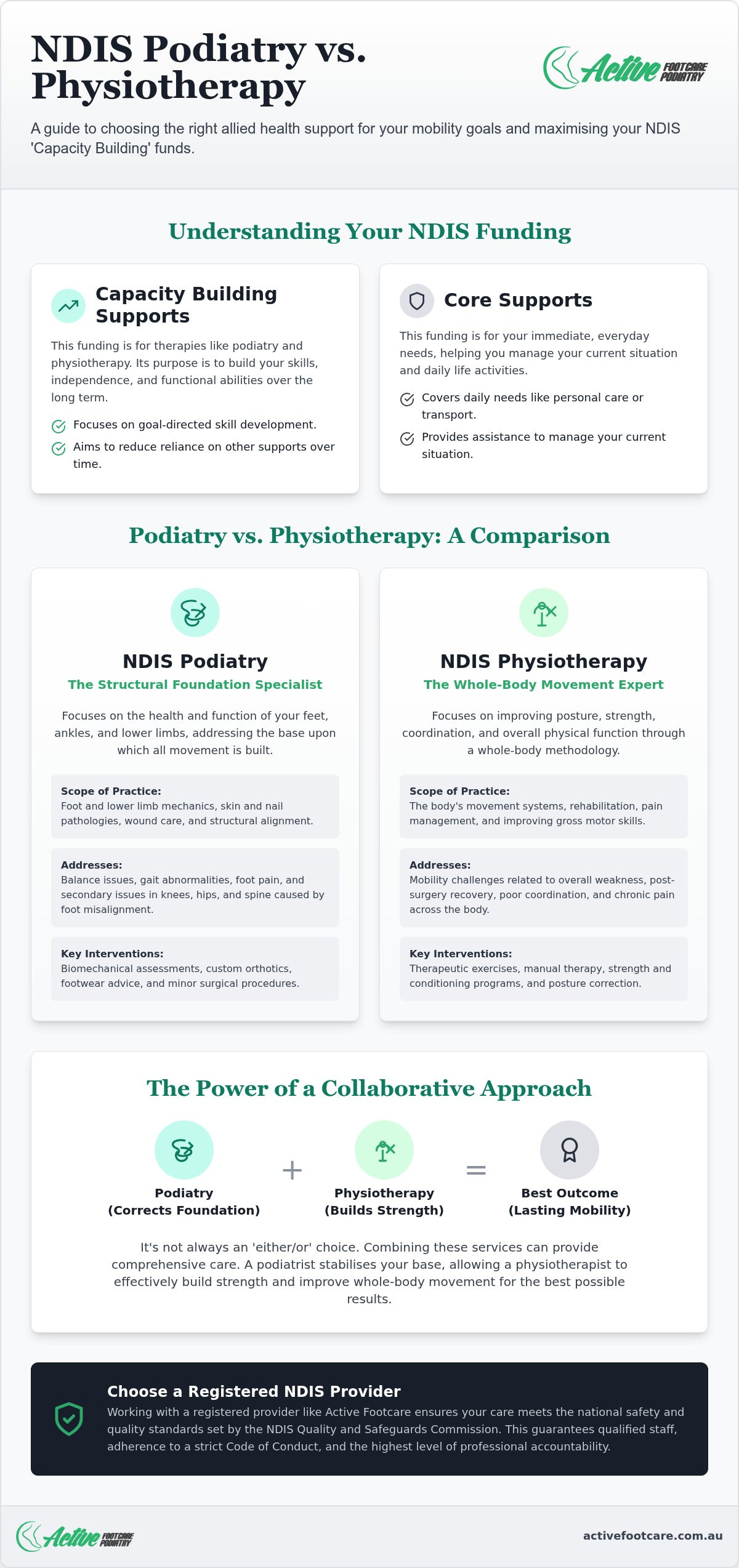
Podiatry vs Physiotherapy: A Comparison of NDIS Mobility Supports
Choosing between ndis podiatry vs physiotherapy doesn’t have to be a binary decision; rather, it’s about identifying where your mobility barrier begins. A common misconception is that a physiotherapist is the only professional who handles walking issues. While they are experts in movement systems, they often rely on the structural stability provided by a podiatrist to achieve the best results. Think of it as the difference between a builder ensuring a house foundation is level and an electrician ensuring the power runs smoothly. If the foundation is uneven, even the best wiring won’t prevent the structure from leaning.
The entry points for these two professions are fundamentally different. Podiatry uses a “foot-up” approach, focusing on the mechanical base of the body. Physiotherapy uses a “body-down” approach, focusing on the muscles and nerves that drive movement. When these two disciplines are integrated, your progress is often much faster. For instance, a podiatrist can use gait analysis to correct a foot strike issue, which then allows your physiotherapist to strengthen your hips and core without you experiencing secondary foot pain. If you’re experiencing localised pain that makes every step a challenge, you should book an NDIS podiatry assessment to secure your physical foundation.
When to See a Podiatrist First
You should prioritises a podiatry consultation if your primary barrier to movement is located specifically in the feet, toes, or ankles. This includes sharp or dull pain when your foot hits the ground, as well as skin or nail issues that make wearing shoes uncomfortable. Participants living with diabetes or peripheral neuropathy must see a podiatrist first to manage high-risk foot health and prevent complications. If your NDIS goal involves needing specialised footwear or custom orthotics to stay upright and balanced, the podiatrist is your essential first point of contact. For participants in the Bankstown area, our dedicated guide to finding an NDIS podiatrist in Bankstown explains how to access local mobility support and navigate the 2026 funding changes. Understanding the process of securing NDIS funding for orthotics before your appointment will help you arrive prepared with the right evidence to support your claim.
When to See a Physiotherapist First
A physiotherapist should be your first port of call if your mobility issues are related to general muscle weakness, poor balance, or recovery from major events like a stroke or surgery. They are the experts to see when your goal is to improve overall physical fitness or gross motor coordination. If you require a prescription for a walking frame or a wheelchair, a physiotherapist will conduct the necessary functional tests to find the right equipment. Their work focuses on the larger systems that allow you to navigate your home and community safely.
The Role of the NDIS Occupational Therapist
An Occupational Therapist (OT) differs from both roles by focusing specifically on “activities of daily living.” While a podiatrist helps you walk and a physio helps you move, an OT helps you cook, dress, and shower independently. There is a significant overlap in fall prevention; a podiatrist ensures your feet are stable, while an OT ensures your home environment is safe. For participants in Western Sydney, a multidisciplinary approach that includes all three professionals is often the most effective way to ensure your NDIS plan supports every aspect of your daily life.
How to Maximise Your NDIS Plan with Integrated Allied Health Care
Integrating your healthcare providers is the most effective way to ensure your ‘Capacity Building’ budget delivers tangible results. When you evaluate ndis podiatry vs physiotherapy, it’s helpful to see them as a unified team rather than competing services. While your physiotherapist works on your overall strength and coordination, your podiatrist ensures that your feet are structurally capable of supporting that increased activity. This integrated approach reduces the risk of injury and ensures that your mobility goals are met from every angle. By addressing both the structural foundation and the movement system, you create a sustainable path toward improved physical function.
To secure funding for both disciplines, you should prepare for your plan meeting by highlighting how each professional addresses a specific part of your mobility goal. For example, if your goal is to “access the community independently,” you can explain that you need a podiatrist for gait analysis and custom orthotics to manage foot pain, and a physiotherapist for the gross motor training required to navigate uneven surfaces. Under the 2026 NDIS Pricing Schedule, therapy services are unbundled into distinct items like direct service, non-face-to-face time, and provider travel. This transparency makes it easier to show the NDIA exactly how your funds are being utilised across your multidisciplinary team to achieve your outcomes.
Collaborating with Your Support Coordinator
Your Support Coordinator plays a vital role in synchronising your care. We recommend ensuring that your therapists communicate regularly to avoid any duplication of services or conflicting advice. Clear ‘Service Agreements’ and detailed ‘Progress Reports’ are essential for the NDIA to see the value you’re receiving and to justify future funding. For participants in Moorebank and Campbelltown, finding reliable, local providers who are willing to collaborate is the key to a stress-free plan. This coordination ensures that every hour of therapy is purposeful and directly contributes to your long-term independence.
Booking Your NDIS Podiatry Assessment with Active Footcare
Starting your journey with Active Footcare is a straightforward process designed with your convenience in mind. We understand that travelling to a clinic can be a significant barrier for many participants with complex disability needs. That is why we provide a specialised Podiatrist Home Visit across Western Sydney, including Liverpool and Bankstown. Our team brings modern clinical care directly to your door, offering a friendly and professional service that respects your home environment and your personal schedule.
Dr. Maher Said and the team act as proactive partners in your NDIS journey, providing the clinical evidence and high-quality care needed to support your mobility. Whether you need a comprehensive diabetes foot assessment or advanced biomechanical gait analysis, we are here to help you move with confidence. Organise your NDIS podiatry home visit with Active Footcare today and take the first step toward a more stable and pain-free future.
Securing Your Physical Future with Informed Support
Understanding the nuances of ndis podiatry vs physiotherapy is the first step toward reclaiming your physical independence. While physiotherapy focuses on the mechanics of body movement and core strength, podiatry provides the essential structural foundation through gait analysis and custom orthotics. By coordinating these supports, you can ensure your NDIS budget is working as hard as you are to reduce pain and improve stability. Each discipline offers unique tools that, when combined, create a more comprehensive path toward your long-term mobility goals.
As an NDIS Registered Provider, Active Footcare is dedicated to delivering clinical excellence directly to your door. Led by Principal Podiatrist Dr. Maher Said, our team offers professional mobile home visits across Sydney, ensuring that your location never stands in the way of high-quality care. We invite you to Book your NDIS Podiatry Assessment with Active Footcare today to begin your journey toward a more stable and active life. You have the power to choose supports that truly understand your needs; let’s work together to make every step easier.
Frequently Asked Questions
Can I use my NDIS funding for both a podiatrist and a physiotherapist?
Yes, you can certainly utilise your NDIS funding for both a podiatrist and a physiotherapist simultaneously. These services are typically funded through the ‘Capacity Building’ category of your plan. Because they address different aspects of your physical health, the NDIA recognises the value of a multidisciplinary approach. Using both ensures that your structural foot health and your overall body movement are managed together, helping you reach your mobility goals more effectively.
Does the NDIS cover the cost of custom orthotics from a podiatrist?
The NDIS does cover the cost of custom orthotics when they are professionally prescribed by a podiatrist to meet your specific goals. Depending on the complexity and cost, these medical devices are usually funded under ‘Assistive Technology’ or ‘Consumables’. Your podiatrist will provide a clinical report explaining why the orthotics are a reasonable and necessary support for improving your balance, reducing pain, or preventing falls in your daily life. For a step-by-step breakdown of this process, our comprehensive guide to NDIS funding for orthotics in 2026 walks you through the current categories and evidence requirements.
How do I find an NDIS registered podiatrist in Liverpool or Bankstown?
You can find a registered provider by using the NDIS Provider Finder tool on the participant portal or by searching specifically for mobile clinicians in your local area. Active Footcare is a registered provider that specialises in serving the Liverpool and Bankstown communities. Choosing a registered professional ensures that your care meets the strict quality and safety standards set by the NDIS Commission, giving you peace of mind regarding your treatment.
What is the difference between an NDIS podiatrist and an occupational therapist?
A podiatrist focuses on the clinical health and biomechanics of your feet and lower limbs, whereas an occupational therapist (OT) focuses on your ability to perform everyday tasks. While a podiatrist treats an ingrown toenail or prescribes orthotics for walking, an OT might recommend home modifications or adaptive tools to help you shower or cook. Both professionals collaborate closely to improve your overall safety and independence at home.
Will a podiatrist come to my home for an NDIS consultation?
Yes, Active Footcare provides mobile consultations for NDIS participants who find it difficult to attend a traditional clinic. We bring all the necessary clinical equipment to your home to perform assessments and treatments in a comfortable environment. This service is particularly beneficial for those in Western Sydney with limited transport options or complex mobility challenges, ensuring that high-quality foot care remains accessible and stress-free for everyone.
Do I need a GP referral to see an NDIS podiatrist or physiotherapist?
You don’t need a GP referral to access allied health services under your NDIS plan. The scheme is designed to give you choice and control over which providers you engage. However, keeping your GP informed is still a good idea, as their medical records can provide additional evidence during your plan reviews. You can contact us directly to begin your care without waiting for a doctor’s paperwork.
How often should an NDIS participant have a podiatry assessment?
We recommend that most NDIS participants have a comprehensive podiatry assessment at least once every twelve months to monitor their mobility. However, if you’re managing high-risk conditions such as diabetes or peripheral neuropathy, you may require more frequent visits every three to six months. Regular check-ups allow us to identify potential issues early, preventing minor discomfort from developing into a significant barrier to your independence.
What happens if my NDIS plan doesn’t specifically mention ‘podiatry’?
If your plan doesn’t explicitly name ‘podiatry’, you can usually still access these services through the ‘Improved Daily Living’ budget. This category is flexible, allowing you to choose the allied health professionals that best support your stated goals. When comparing ndis podiatry vs physiotherapy, your decision should be based on which professional’s expertise is most relevant to the specific physical challenges you’re currently facing in your daily routine.