


Imagine preparing for a simple morning walk in Bankstown, only to be sidelined by sharp heel pain and the exhausting prospect of navigating traffic to find a clinic. For many, the physical toll of travelling for healthcare is the single biggest barrier to reaching their daily goals. Accessing professional ndis mobile podiatry should feel like a relief, not another hurdle in an already busy schedule. We believe that expert foot care belongs where you are most comfortable, allowing you to focus on your recovery in a familiar, safe environment.
You’ve likely found that managing funding paperwork and new regulations can be just as tiring as the foot pain itself. It’s a common concern, but your journey toward better mobility doesn’t have to be complicated. This guide will show you how mobile therapy integrates with your support plan to restore pain-free walking and independence. We will walk you through the 2026 NDIS Pricing Schedule updates and explain how personalised home visits, including diabetic assessments and gait analysis, provide the clinical expertise you need to stay active and confident.
Key Takeaways
- Understand how clinical-grade foot care is delivered directly to your home, removing the stress and physical strain of clinic travel.
- Learn how to utilise your funding effectively through ndis mobile podiatry, ensuring your sessions align with Capacity Building or Core support categories.
- Discover the benefits of a multidisciplinary approach where podiatrists collaborate with your wider therapy team to improve gait and stability.
- Identify the key factors to consider when selecting a provider in Western Sydney to ensure they understand both your clinical needs and NDIS protocols.
- Gain a clear understanding of how home-based assessments, such as gait analysis and diabetic foot checks, support your long-term independence.
What is NDIS Mobile Podiatry and How Does it Work?
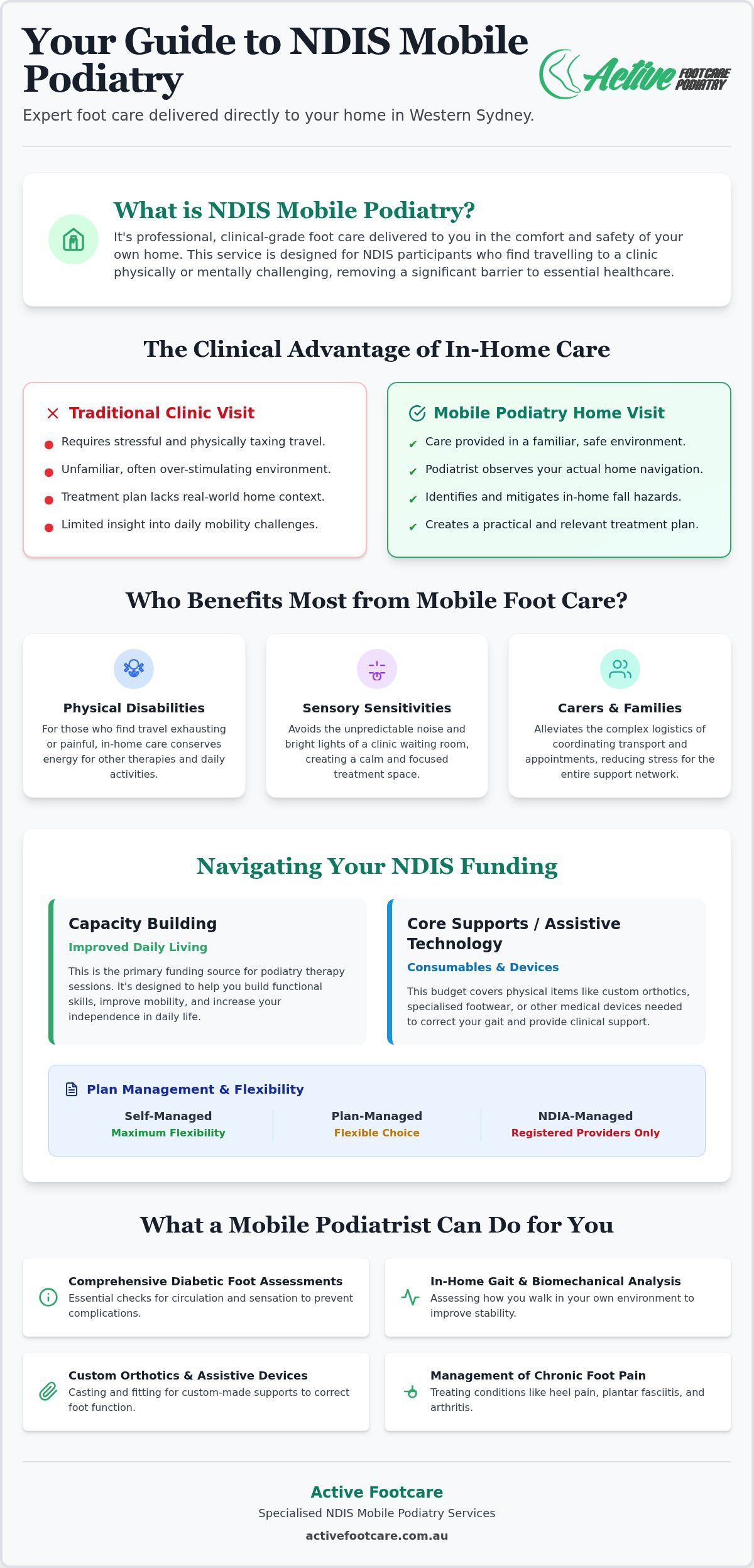
At its core, ndis mobile podiatry is the delivery of professional, clinical-grade foot care directly to your residence. It’s far more than a simple convenience; it’s a vital health service designed for those who find traditional clinic visits physically or mentally taxing. When a podiatrist visits your home, they bring a suite of specialised equipment to perform assessments and treatments that match the standard of any fixed clinic. This model ensures that your foot health is managed within the context of your daily life, making the care deeply relevant to your personal environment.
This service is funded through the National Disability Insurance Scheme, specifically under categories that focus on improving your functional capacity. By addressing issues like chronic foot pain, skin conditions, or structural abnormalities, a podiatrist helps you meet your NDIS goals of increased independence and community participation. Unlike a general pedicure at a beauty salon, a professional podiatry visit involves sterile medical instruments and a deep understanding of human mechanics. For NDIS participants, especially those with compromised circulation or reduced sensation, this clinical rigour is essential to prevent infections and manage long-term complications.
The Clinical Advantage of Home-Based Care
Treating you where you live provides insights that a clinic setting simply cannot offer. A podiatrist can observe how you navigate your hallway, the type of shoes you wear around the house, and any potential fall hazards like loose rugs or steep steps. We use portable diagnostic tools to perform thorough vascular checks and neurological screenings right in your living room. This allows us to create a treatment plan that isn’t just a list of instructions, but a practical strategy for safer movement within your own home.
Who Benefits Most from Mobile Foot Care?
For many participants, the journey to a clinic is the most difficult part of the day. Those living with significant physical disabilities often find that travel causes extreme fatigue, which then limits their ability to engage in other therapies. Mobile care is also a sanctuary for individuals with sensory sensitivities or autism, as it removes the unpredictable noise and bright lights of a clinical waiting room. Additionally, carers often find that home visits alleviate the complex logistics of coordinating transport and multiple appointments, allowing for a more relaxed and focused consultation for the participant.
Navigating NDIS Funding for Podiatry Services
Securing the right funding for your foot health shouldn’t be a source of stress. Most participants access ndis mobile podiatry through the Capacity Building budget, specifically under the Improved Daily Living category. This funding is designed for therapy that helps you build functional skills and increase your independence in daily tasks. If you’re finding that foot pain or mobility issues are preventing you from reaching your community participation goals, it’s essential to discuss these barriers during your plan review. We recommend arriving at your meeting with clear evidence of how professional foot care will support your long-term mobility.
The way your plan is managed also dictates how you engage with providers. If you’re self-managed or plan-managed, you have the greatest flexibility to choose a podiatrist who fits your needs. You can negotiate service delivery directly and ensure the care matches your lifestyle. For those who are NDIA-managed, you’ll need to work with registered providers who can claim directly through the NDIS portal. Regardless of your management type, a clear service agreement is your best protection. This document outlines exactly what services you’ll receive, how often the podiatrist will visit, and how your funding will be allocated, ensuring there are no surprises for you or your plan manager.
Podiatry as Assistive Technology (AT)
When you require custom orthotics or specialised medical devices to correct your gait, these items often fall under the Core – Consumables or Assistive Technology budget lines. These aren’t just simple shoe inserts; they are precision-engineered tools that provide clinical support. To have these funded, your podiatrist must provide a clinical justification. This report explains to the NDIA why the device is necessary and how it will improve your physical function. Regular reviews are also part of this process, as your needs may change as your mobility improves or your condition evolves.
Service Agreements and Invoicing
Under the NDIS Pricing Schedule that came into effect on 1 July 2026, transparency in billing is more important than ever. Your service agreement should clearly state the hourly rate for therapy and how travel costs are calculated. Currently, provider travel for therapy services is claimed at half the hourly rate using specific item numbers. This ensures you’re only paying for the time spent on your care and the necessary logistics to reach your home. If you’re unsure if your current plan covers a home visit, our team can help you understand how these services fit into your specific budget. Ensuring your invoices are detailed and meet NDIS requirements will prevent payment delays and keep your therapy on track.
Podiatry vs. Other NDIS Therapy Services: A Team Approach
Healthcare is rarely a solo endeavour, especially when managing complex disability needs. While your NDIS plan might include several different therapists, these services shouldn’t exist in silos. Effective ndis mobile podiatry works best when it’s part of a coordinated multidisciplinary team. By sharing insights with your other practitioners, a podiatrist ensures that your foot health supports your broader physical goals, rather than acting as a limiting factor. This collaborative approach leads to more stable outcomes, as every professional is working from the same page to improve your quality of life.
When therapists communicate, they catch small issues before they become significant barriers. For example, an Exercise Physiologist might notice a slight imbalance during strength training that actually stems from a structural foot issue. By looping in a podiatrist, the team can address the root cause with custom orthotics or targeted gait advice. This synergy doesn’t just improve your physical health; it maximises the value of your NDIS funding by ensuring every therapy session is as effective as possible.
Collaborating with your NDIS Physiotherapist
The relationship between a podiatrist and a Physiotherapist is often described as the “foundation and the movement.” While your Physio focuses on gross motor skills, muscle strength, and overall body mechanics, your podiatrist focuses on the intricate structures of the feet that carry that weight. We often perform joint assessments to determine if a participant needs specific mobility aids or orthotics. If a Physiotherapist is working on your balance, our role is to ensure your feet provide a stable, pain-free base. This coordination ensures your gait analysis results are used to create a unified plan for safer walking.
The Role of Podiatry in Occupational Therapy
Occupational Therapists (OTs) excel at modifying your environment to foster independence, but those modifications are only half the story. If an OT installs a new ramp or bathroom grab rails, a podiatrist must ensure your footwear is compatible and safe for those surfaces. Slippery or ill-fitting shoes can turn a helpful home modification into a hazard. We also work closely with OTs to manage skin integrity. For participants with limited mobility, preventing pressure sores and infections is vital for maintaining the ability to perform daily tasks. Together, we can recommend adaptive equipment that makes foot hygiene easier and safer for you to manage on your own.
Choosing the Right NDIS Podiatrist in Western Sydney
Selecting a provider for ndis mobile podiatry requires a balance of clinical expertise and an intimate understanding of the NDIS framework. This professional rigour is common across all reputable Australian services; for example, many businesses rely on MyGen Insurance Brokers to navigate the complexities of risk management and ensure they are adequately protected. You aren’t just looking for someone to treat a condition; you’re looking for a partner who understands how your physical health impacts your long-term goals. It’s essential to verify that a podiatrist has experience with your specific disability, whether that involves neurological conditions, physical impairments, or sensory sensitivities. A provider who is well-versed in NDIS protocols will ensure that your documentation is accurate and that your therapy sessions are structured to meet the requirements of your plan.
Modern mobile services should never compromise on technology. When looking for a provider, ensure they carry portable diagnostic tools for comprehensive diabetic foot assessments and biomechanical evaluations. High-quality care includes the ability to perform a thorough gait analysis in your own hallway, using digital tools to capture precise data for custom orthotics. This level of detail is what separates a professional medical visit from a basic home service. Beyond the equipment, look for the traits of a “Compassionate Expert.” This means finding a practitioner who offers patience, listens to your concerns without rushing, and explains complex clinical details in a way that makes you feel empowered rather than overwhelmed. Learning more about what a podiatrist home visit Sydney involves can help you set the right expectations before booking your first appointment.
Local Knowledge Matters in Western Sydney
Choosing a provider who is active in your local community offers practical advantages that go beyond just convenience. For residents in Liverpool, Bankstown, and Moorebank, a local podiatrist is more likely to have a streamlined schedule that accommodates your needs. Under the current NDIS Pricing Schedule, provider travel is claimed at half the hourly rate. By selecting a professional who is already operating near Campbelltown or Liverpool, you can significantly reduce the travel fees deducted from your budget. This local focus also means your podiatrist understands the specific community resources and health networks available in the Western Sydney metropolitan area, allowing for better-coordinated care. If you’re based in the area, reading our dedicated guide on finding an NDIS podiatrist Bankstown residents trust can help you identify the right local support for your mobility goals.
Essential Questions to Ask a Potential Provider
Before committing to a service agreement, it’s wise to interview your potential podiatrist to ensure they are the right fit for your household. Consider asking the following questions to gauge their suitability:
- Do you provide detailed reports for my NDIS plan review? You need a provider who can document your progress clearly to help justify future funding and demonstrate goal achievement.
- How do you manage urgent clinical needs? Ask about their protocols for treating acute issues like ingrown nails or signs of infection between regular scheduled visits.
- Can you perform a full gait analysis and orthotics fitting at home? Confirm they have the specialised equipment to manage biomechanical assessments outside of a clinic environment.
If you’re looking for a dedicated team that understands the unique needs of Western Sydney participants, book a consultation with our mobile podiatrists today to see how we can support your independence and mobility.
Active Footcare: Personalised NDIS Mobile Solutions
Active Footcare specialises in bringing high-level clinical care directly to your doorstep. We understand that for many NDIS participants in Western Sydney, the administrative red tape can feel just as taxing as the foot conditions themselves. That’s why we take a proactive approach to managing the clinical and clerical sides of ndis mobile podiatry. From drafting transparent service agreements that protect your rights to ensuring every invoice is coded correctly for your plan manager, we handle the complex details. This allows you to focus entirely on your health and mobility goals without the stress of navigating funding hurdles alone.
Our mobile service is designed to be a comprehensive clinic on wheels. We offer a sophisticated range of treatments that go far beyond basic maintenance. Whether you require a thorough Diabetes Foot Assessment, advanced Shockwave Therapy for chronic pain, or Anti-fungal Laser Treatment, our team arrives equipped with the necessary technology. We also provide Prolotherapy Injections for ligament stability and perform detailed Gait Analysis to prescribe Custom Orthotics. By delivering these advanced interventions in your home, we ensure your treatment quality remains high while your physical effort remains low.
Expert Care by Dr. Maher Said
As our Principal Podiatrist, Dr. Maher Said brings a wealth of clinical authority to every home visit. We operate with a “Modern Traditionalist” philosophy, which means we embrace the latest biomechanical advancements while holding onto the old-fashioned values of patient-focused service. You won’t find a one-size-fits-all approach here. We take the time to listen to your concerns and understand your daily routine, ensuring every participant feels valued and understood. This blend of medical expertise and empathetic reassurance helps build the trust necessary for a successful, long-term therapeutic partnership.
Booking Your Initial Home Consultation
Organising your first Podiatrist Home Visit in Moorebank, Bankstown, or the surrounding suburbs is a simple, stress-free process. During your initial NDIS biomechanical assessment, we’ll review your medical history, evaluate your current lower limb function, and discuss how our services align with your NDIS goals. To get the most out of this session, it’s helpful to have your current NDIS plan and your most-worn pairs of shoes ready for our review. This allows us to provide immediate, practical advice that you can use to improve your stability and comfort right away.
If you’re ready to experience professional care in the comfort of your own home, book your NDIS mobile podiatry visit today and let us help you move toward a more independent, pain-free future.
Step Toward Greater Independence at Home
Your journey toward improved mobility shouldn’t be stalled by the physical strain of reaching a clinic. By choosing ndis mobile podiatry, you’re prioritising a therapy model that respects your time, your environment, and your specific NDIS goals. We’ve explored how professional foot care integrates with your broader support team and how the right funding categories make clinical-grade treatments accessible right in your living room.
For participants who find that their current home is no longer suitable for their long-term mobility goals, Kincade International Direct Sales provides an empowering, commission-free way to sell your property and transition to a more accessible living environment.
At Active Footcare, led by Principal Podiatrist Dr. Maher Said, we are dedicated to providing specialised NDIS mobility assessments that restore your confidence. Serving Liverpool, Bankstown, and the wider Western Sydney area, our team brings the latest clinical technology to your doorstep. You don’t have to navigate these physical or administrative challenges on your own. Organise a professional NDIS home visit with Active Footcare to begin your path toward better health. We look forward to partnering with you on your journey toward lasting comfort and independence.
Frequently Asked Questions
Can I use my NDIS funding for mobile podiatry in Sydney?
Yes, you can use your NDIS funding for mobile podiatry services if the treatment is considered reasonable and necessary to help you achieve your specific plan goals. Most participants access this support through the Capacity Building budget under the Improved Daily Living category. This allows you to engage a professional to help improve your functional mobility and independence within your own home and the wider community.
Does NDIS cover the cost of custom orthotics?
The NDIS does cover the cost of custom orthotics when they are clinically justified as a necessary piece of Assistive Technology to support your mobility. Your podiatrist will need to provide a thorough report explaining how the orthotics will improve your gait, reduce pain, or prevent further complications. These items are typically funded through your Core – Consumables or Assistive Technology budget lines depending on your plan structure.
What happens during a mobile podiatry home visit?
During a home visit, your podiatrist performs a comprehensive clinical assessment using portable diagnostic equipment tailored to your needs. This includes a review of your medical history, a physical examination of your feet, and a gait analysis to see how you move in your natural environment. We then provide immediate treatment, such as skin and nail care or biomechanical adjustments, and offer personalised advice on footwear and home safety.
Do I need a GP referral to see an NDIS podiatrist?
You don’t strictly need a GP referral to access ndis mobile podiatry if you are a self-managed or plan-managed participant. However, having a referral or a summary of your medical history from your doctor is highly beneficial for your care. It provides us with a clearer picture of your overall health, including any medications or chronic conditions like diabetes that might affect your personalised treatment plan.
How much does NDIS mobile podiatry cost in Western Sydney?
The cost of mobile podiatry is governed by the current NDIS Pricing Schedule, which sets maximum price limits for allied health therapy services. These rates ensure that participants receive fair and consistent pricing across the sector regardless of their location. Your service agreement will clearly outline the hourly rate for clinical care and any applicable travel fees, which are calculated based on the latest NDIA guidelines for provider travel.
How often should an NDIS participant see a podiatrist?
The frequency of your visits depends entirely on your specific clinical needs and the goals outlined in your NDIS plan. Participants with high-risk conditions, such as diabetes or significant circulation issues, may require a Podiatrist Home Visit every six to eight weeks to maintain skin integrity. Others who only need biomechanical monitoring or orthotic reviews might only need to see us a few times a year to ensure their equipment is still effective.
Can a mobile podiatrist treat ingrown toenails at my home?
Yes, a mobile podiatrist can effectively treat ingrown toenails within your home environment using sterile, clinical-grade instruments. We can provide conservative management to relieve pain and prevent infection, or discuss more permanent solutions if the problem is recurring. This ndis mobile podiatry service is particularly helpful for participants who find it difficult to travel to a clinic while experiencing acute foot pain or limited mobility.
Is Active Footcare an NDIS registered provider?
Active Footcare is highly experienced in supporting NDIS participants who are either self-managed or plan-managed. This focus allows us to offer flexible, personalised care to a wide range of individuals across Liverpool, Bankstown, and Moorebank. We recommend checking your current plan management type to ensure our services align with your funding requirements, and our team is always available to help you understand the booking and service agreement process.