

Imagine finishing a long day walking between meetings in the Sydney CBD, only to find your arches throbbing with a dull, persistent ache that simply won’t shift. It’s incredibly common to feel frustrated when “fallen arches” make every step feel like a chore, especially if you’re worried that your only options are clunky shoes or invasive surgery. You’ve likely wondered if those generic gel inserts from the local chemist are enough, or if you actually need professional orthotics for flat feet to properly support your gait and restore your comfort.
We understand that you want to move with ease without the confusion of retail products. This guide will help you identify the signs that your feet require clinical intervention and provide the exact steps to transition into proper support for lasting, pain-free mobility. We will explore the vital differences between basic shop-bought cushions and medical-grade devices, giving you a clear, professional plan to improve your daily comfort and get back on your feet with total confidence.
Key Takeaways
- Learn to distinguish between flexible and rigid arch collapse to understand when your feet require clinical support for better mobility.
- Discover why custom-made orthotics for flat feet are a more effective long-term investment for your health than generic, off-the-shelf insoles.
- Understand the biomechanical process of realignment and how supporting your arches can alleviate persistent strain on your ankles and lower limbs.
- Follow a structured transition plan to help your muscles adapt comfortably to new support during the initial fortnight of use.
- Find out how to access professional gait analysis and custom fittings through NDIS-registered providers and convenient home visits in Western Sydney.
What Are Flat Feet and When Do You Need Orthotic Support?
Flat feet, clinically known as pes planus, occur when the medial longitudinal arch, the structural curve along the inside of your foot, collapses or fails to develop. While some people are born with this foot shape, many adults experience a gradual lowering of the arch over time. It’s a common misconception that all flat feet are the same; in reality, they fall into two distinct categories that dictate how we approach treatment. Flexible flat feet show a visible arch when you’re sitting or standing on your tiptoes, but the arch disappears the moment you put weight on the foot. Rigid flat feet remain flat regardless of whether you’re weight-bearing or not, which often indicates a more complex structural issue within the bones or joints.
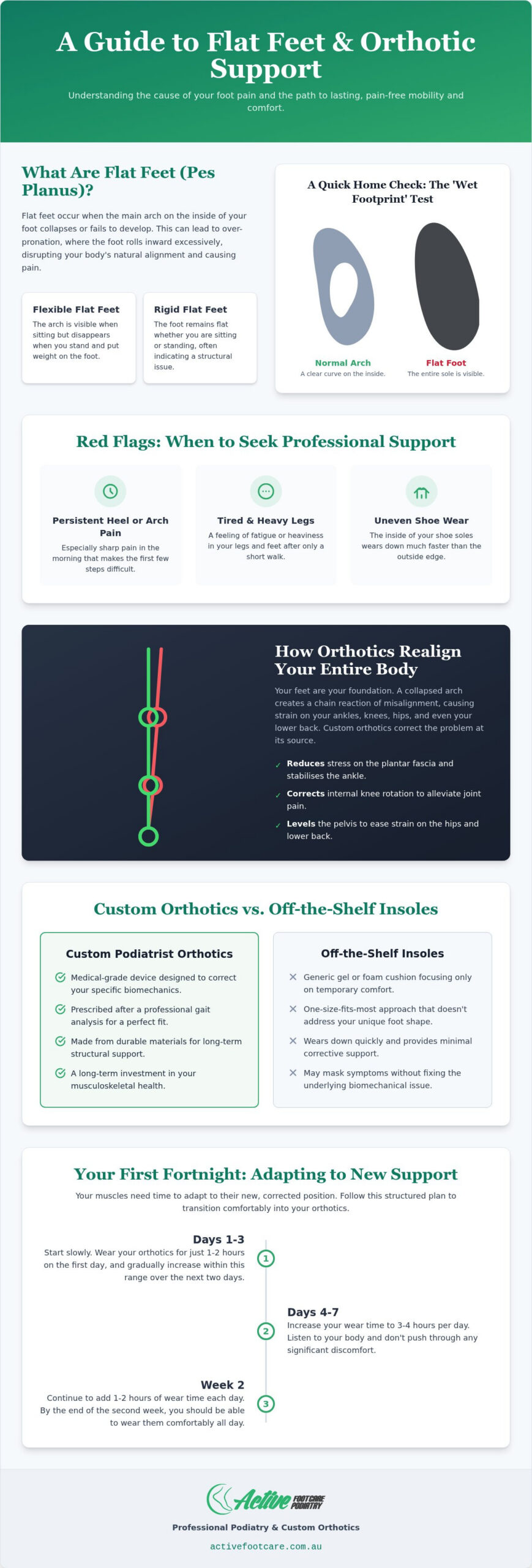
Over-pronation occurs when the foot rolls inward excessively during the gait cycle, often as a direct result of the medial longitudinal arch collapsing. This misalignment can trigger several red flags that suggest you might need professional orthotics for flat feet to prevent further discomfort. You might notice persistent heel pain, particularly first thing in the morning, or find that your legs feel unusually heavy and “tired” after a short walk. Another tell-tale sign is uneven shoe wear, where the inner side of your soles wears down much faster than the outer edge. If these symptoms are impacting your daily life, it’s a clear signal that your biomechanics require a closer look.
Common Causes of Fallen Arches in Adults
Many patients are surprised to learn that flat feet can develop later in life. This is often due to posterior tibial tendon dysfunction, where the primary tendon supporting the arch becomes weakened through repetitive wear and tear. Significant life changes, such as pregnancy or weight gain, also place increased demand on the foot’s structural integrity, leading to a gradual collapse. Additionally, previous injuries like severe ankle sprains or fractures can alter your foot’s mechanics, eventually resulting in an acquired flat foot condition that requires stabilising support.
The ‘Wet Footprint’ Test: A Quick Home Check
If you’re unsure about your arch height, you can perform a simple assessment at home. Dampen the sole of your foot and step firmly onto a piece of dark cardboard or a dry concrete surface. A “normal” arch will leave a print showing the heel and forefoot connected by a narrow strip along the outside of the foot. If your print looks like a solid, full foot shape with no inward curve, it indicates a flat foot. While this test is a helpful starting point, it only shows a static image; it doesn’t account for how your foot moves under pressure, which is why a professional gait analysis in Sydney remains the gold standard for creating effective orthotics for flat feet.
How Orthotics for Flat Feet Work to Realign Your Body
Think of a custom orthotic not as a simple cushion, but as a functional ‘shim’ for your foot’s internal architecture. When the arch collapses, as discussed in the previous section, the bones in your midfoot lose their structural stability; this causes the rest of your body to compensate in ways that often lead to chronic pain. By placing a precisely engineered device under the foot, we can restore the natural alignment of these bones. Orthotics work by controlling the rate of pronation, ensuring your foot rolls inward at a healthy, manageable speed rather than collapsing abruptly with every step you take.
This structural support is essential for reducing the constant tension placed on the plantar fascia, which is the thick band of tissue running along the bottom of your foot. When the arch is properly supported, this tissue doesn’t have to stretch excessively, which significantly lowers your risk of developing inflammation or painful heel spurs. This realignment also stabilises the ankle joint, preventing the “wobble” that often leads to tendon strain and muscle fatigue during long periods of standing or walking.
The benefits of using orthotics for flat feet extend far beyond the ankles because your feet are the foundation of your entire kinetic chain. If they are misaligned, your knees must rotate internally to compensate, which often results in nagging patellofemoral pain. This misalignment then travels up to the hips and lower back, causing the pelvis to tilt and muscles to tighten in an effort to find balance. Addressing the root cause at the ground level can often provide unexpected relief for recurring backaches. If you’re experiencing this type of radiating discomfort, a professional gait analysis can help determine exactly how your foot posture is impacting the rest of your body.
Support vs. Cushioning: Why Soft Isn’t Always Better
There is a common misconception that flat feet simply need “soft” padding to feel better. While a squishy foam insert might feel pleasant for the first few minutes, it lacks the structural integrity required to hold your arch in place during movement. True support requires a degree of rigidity to be effective. We often use materials like polypropylene for its durable flexibility or carbon fibre for high-strength, low-profile support. These materials ensure the device maintains its shape under the full weight of your body, providing the resistance necessary to prevent arch collapse.
Managing Over-Pronation Through Biomechanical Control
Over-pronation is the excessive inward rolling of the foot that occurs as you move through your gait cycle. To manage this effectively, a well-designed orthotic features a deep heel cup that stabilises the calcaneus (heel bone), preventing it from tilting too far inward. We also incorporate a “medial wedge,” which is a calculated thickness on the inner side of the device. This wedge redistributes pressure across the foot, guiding you into a more neutral position and protecting your joints from the repetitive stress of poor alignment.
Custom Podiatrist Orthotics vs. Off-the-Shelf Insoles
Walking into a local chemist and seeing a wall of gel inserts can be overwhelming. These mass-produced products are designed for a “standard” foot that rarely exists in reality. Most people have subtle differences between their left and right feet; one arch might be slightly lower, or one foot might rotate further inward. Generic inserts ignore these nuances, offering a symmetrical solution to an asymmetrical problem. When you choose custom orthotics for flat feet, you’re opting for a device engineered specifically for your unique anatomy rather than a generic template.
The creation process for medical-grade support is significantly more sophisticated than simply picking a size off a shelf. We use high-resolution 3D scanning or traditional casting to capture the exact contours of your feet while they are held in a neutral, corrected position. This ensures the resulting device provides support exactly where you need it, rather than where a manufacturer guesses your arch should be. This precision is backed by a professional gait analysis, where we observe your movement patterns to ensure the orthotics address your specific biomechanical requirements.
Durability is another area where professional solutions outshine retail alternatives. A typical foam or gel insole from a pharmacy usually loses its structural integrity within six months of daily use. In contrast, custom-made orthotics are crafted from high-quality, resilient materials designed to last between three and five years. While the initial cost is higher, the long-term value is clear. You aren’t just buying a piece of plastic; you’re investing in a durable medical tool that maintains its corrective properties for years.
When Are Pharmacy Insoles Sufficient?
Retail inserts can be a helpful temporary measure for minor, non-painful flat feet or for providing a bit of extra comfort in a new pair of shoes. While premium breathable leather insoles offer better durability than standard foam, generic inserts still carry risks for those with rigid structural issues. If you have a rigid flat foot, a generic arch support may press painfully against the bones of your midfoot, causing bruising or secondary strain. While they seem cheaper upfront, the potential for increased pain or the need for frequent replacements often makes them a less economical choice for long-term healthcare.
The Value of Professional Prescription
A podiatrist-led approach allows for adjustments that retail products simply cannot offer. We can incorporate specific modifications for limb length discrepancies, which are surprisingly common and often contribute to hip or back pain. We also consider your lifestyle and footwear choices, ensuring your orthotics for flat feet work harmoniously with the shoes you wear most often. At Active Footcare, we focus on these tailor-made solutions because we believe that your path to pain-free mobility should be as individual as your footprint.
How to Successfully Transition to Your New Orthotics
Receiving your custom orthotics for flat feet is a significant step toward long-term comfort, but your body requires a dedicated period to recalibrate. For years, your muscles and tendons have likely overcompensated for a collapsed arch, and they won’t change these deep-seated habits overnight. Think of this transition as a gentle re-education of your feet. During the first fortnight, you might feel a dull ache in your arches or calves, which is usually “good” discomfort. This sensation is similar to the muscle soreness felt after a new gym session; it indicates that previously underused muscles are finally engaging. However, sharp, stabbing pain or skin irritation should be addressed immediately.
To ensure a safe and comfortable transition, you should increase your wear-time by exactly one hour per day, starting from a baseline of just sixty minutes on day one. This methodical approach prevents the soft tissues from becoming overwhelmed by the new alignment. We always recommend a follow-up appointment after the first few weeks of use. This allows us to fine-tune the devices based on your real-world feedback, ensuring the fit is perfect for your unique gait. If you’re feeling unsure about your progress, our team can provide a comprehensive Sydney gait analysis checklist during a home visit to ensure your orthotics are performing exactly as intended.
Your 14-Day Orthotic Transition Schedule
Days one to three should be limited to one or two hours of light activity around the house. This allows you to get used to the sensation of the support without the pressure of a full day on your feet. From days four to seven, you can expand to half-day wear, paying close attention to any “hot spots” or areas of rubbing. By the second week, you should be moving toward full-day use and can begin introducing brisk walking or your usual daily exercise routine to test the support under higher impact.
Choosing the Right Shoes for Your Orthotics
The effectiveness of your orthotics for flat feet depends heavily on the shoes you put them in. Always use the “Rule of Thumb”: check if the factory insole is removable. If you place an orthotic on top of an existing arch support, it can cause the foot to sit too high, leading to heel slippage or excessive pressure. Neutral shoes are often a better choice than “stability” shoes because the orthotic is already providing the necessary correction; doubling up can actually over-correct your gait. When fitting into work boots or dress shoes, ensure there is enough depth in the heel counter to keep your foot secure throughout the day.
Professional Assessment for Flat Feet in Sydney and Western Suburbs
Active Footcare provides a specialised approach to managing flat feet across Liverpool, Bankstown, and the surrounding Western Sydney suburbs. Led by Principal Podiatrist Dr. Maher Said, our practice focuses on identifying the root cause of your discomfort rather than just treating the symptoms. We utilise advanced gait analysis technology to map your movement in real-time, which allows us to design orthotics for flat feet that are truly bespoke to your biomechanical needs. Taking a proactive stance now is essential for preventing secondary complications, such as the development of painful bunions or premature knee arthritis, which often stem from years of untreated arch collapse.
Our clinical philosophy is built on the idea that every patient deserves a clear, structured path to recovery. We don’t just hand you a pair of inserts; we partner with you to ensure those devices are working harmoniously with your lifestyle. By combining modern diagnostic tools with traditional, attentive service, we help you understand the mechanics of your own feet. This education empowers you to make informed decisions about your mobility and long-term physical health, ensuring you feel supported at every stage of your treatment journey.
This commitment to patient-centred podiatry is a global priority; for example, Local Foot Doc provides similar specialised foot and ankle care for patients in Brooklyn and Queens, ensuring high standards of mobility support across the globe.
Home Visit Podiatry: Care That Comes to You
For many residents in Moorebank, Campbelltown, and the wider Sydney region, travelling to a clinic can be a significant barrier to receiving quality care. We solve this by offering comprehensive podiatrist home visits, bringing our clinical expertise and diagnostic tools directly to your doorstep. We conduct full orthotic fittings and gait analysis in your own home, ensuring you receive professional care without the stress of a commute. This mobile service is an ideal solution for seniors or individuals with limited mobility who require the stability of custom support to maintain their independence.
NDIS and Healthcare Rebates for Orthotics
As a registered NDIS provider, Active Footcare helps participants navigate the process of accessing funding for custom orthotics and other essential mobility aids. We understand how vital proper foot alignment is for achieving your physical goals, and we’re committed to making that support accessible. For those with private health insurance, we also facilitate HICAPS claims to streamline the rebate process for your consultations. If you’d like to better understand the podiatrist cost in Sydney and how Medicare or NDIS funding can reduce your out-of-pocket expenses, our team can walk you through your options during your assessment. If you’re ready to address your foot pain with professional guidance, book your flat foot assessment with Active Footcare today and take the first step toward a more comfortable, active future.
Step Toward Lasting Mobility and Comfort
Living with the persistent ache of fallen arches doesn’t have to be your daily reality. By understanding the specific biomechanical needs of your feet and choosing medical-grade orthotics for flat feet, you’re making a vital investment in the health of your entire kinetic chain. We’ve explored how professional realignment reduces strain on your joints and why a structured transition period is the key to achieving pain-free movement in your everyday life.
Under the expert guidance of Principal Podiatrist Dr. Maher Said, Active Footcare provides the clinical authority you need with the convenience you deserve. As a registered NDIS provider, we’re proud to offer mobile home visits across Western Sydney, ensuring that professional care is accessible to everyone in our community. If you’re ready to stop guessing with retail inserts and start a personalised plan for your foot health, Book a Gait Analysis and Orthotic Consultation with our dedicated team today. We look forward to partnering with you on your journey toward improved physical ease and total confidence in every step you take.
Frequently Asked Questions
Can orthotics actually fix flat feet permanently?
Orthotics don’t permanently change the bone structure of your feet, but they do provide the necessary support to manage the condition effectively. Think of them like spectacles for your feet; they correct your alignment while you wear them to prevent pain and further collapse. For most adults with flat feet, the goal is long-term management and physical ease rather than a permanent structural cure.
How much do custom orthotics for flat feet cost in Australia?
The cost of orthotics for flat feet in Australia varies depending on the materials used and the level of customisation required for your specific gait. A professional prescription usually includes the initial gait analysis, 3D scanning or casting, and follow-up appointments to ensure a perfect fit. While the upfront investment is higher than retail options, the durability and clinical precision often make them more economical over several years. For a full breakdown of what to expect, our comprehensive guide to podiatrist cost in Sydney covers fees, rebates, and how to maximise your health fund benefits.
How often should I replace my orthotics for flat feet?
Custom-made orthotics typically last between three and five years before the structural integrity of the shell begins to decline. You might need to replace the top covers sooner if they show signs of wear, but the core support is very resilient. In contrast, retail foam inserts often lose their support within six months, which can lead to a return of your original foot pain and discomfort.
Will I have to wear ‘grandma’ shoes if I get orthotics?
You definitely don’t have to wear clunky or unattractive shoes to accommodate your support. Modern medical-grade orthotics are designed to be slim and lightweight, allowing them to fit into a wide variety of contemporary footwear, including work boots, sneakers, and even some dress shoes. We can often customise the shape of the device to suit the specific types of shoes you wear most frequently.
Can children with flat feet wear orthotics, or will they grow out of it?
Many children have flat feet as part of normal development, but a professional assessment is vital if they experience pain or have difficulty keeping up with their peers. While some kids “grow out of it” as their arches naturally strengthen, others benefit significantly from early support to prevent structural issues in adulthood. We look at each child’s unique gait to decide if intervention is necessary for their long-term health.
Should I wear my orthotics all the time, even inside the house?
It’s best to use your orthotics whenever you are weight-bearing for extended periods, as hard indoor floors can be particularly taxing on flat feet. You don’t necessarily need them for a quick trip to the kitchen, but many patients find relief by keeping a pair of supportive house shoes or slippers specifically for indoor use. This consistent support helps maintain your alignment and prevents muscle fatigue throughout the day.
What happens if I have flat feet but don’t use orthotics?
Leaving flat feet untreated can lead to a “domino effect” of pain throughout your body, often impacting your knees, hips, and lower back. Over time, the lack of arch support can also increase your risk of developing secondary issues like bunions, hammertoes, or early-onset arthritis in the foot joints. Proactive management with orthotics for flat feet helps stabilise your gait and protects your long-term mobility.
Are orthotics covered by Medicare in Australia?
Medicare generally does not cover the cost of the orthotic devices themselves, although you may be eligible for a rebate on the consultation fee if your GP provides a Chronic Disease Management plan. Most Australians use private health insurance extras or NDIS funding to cover the cost of their devices. It’s a good idea to check with your specific provider to understand your level of cover for podiatry services.