


What if the right podiatry support could make getting around home and the community feel more manageable? Finding ndis podiatry providers who understand your plan and offer home visits in Liverpool or Bankstown can feel like another challenge when mobility is already limited.
It’s understandable to be unsure where podiatry fits into your NDIS funding, especially when Core Supports, Capacity Building and assistive technology can seem difficult to separate. You may also wonder whether foot care or custom orthotics meet the “reasonable and necessary” criteria. This guide explains how to connect podiatry supports with your goals, prepare for a plan discussion and understand what to include in a Service Agreement.
Podiatry can support mobility and everyday activities through foot assessments, gait analysis and tailored care. Active Foot Care provides NDIS podiatry home visits in Liverpool, Bankstown, Moorebank and Campbelltown, with care led by Principal Podiatrist Dr Maher Said. The guidance below can help you prepare for care and make your priorities clear.
Key Takeaways
- See how podiatry may support NDIS goals around daily living, mobility and participation when it relates to your disability.
- Learn how to consider plan categories and document podiatry or equipment needs.
- Understand how your plan management type can affect your choice of ndis podiatry providers.
- Explore how a home visit in Liverpool, Bankstown, Moorebank or Campbelltown can make assessment and care more accessible.
- Find out what to clarify in a Service Agreement so your podiatry support is easier to understand and manage.
Understanding NDIS Podiatry Support and Your Eligibility
NDIS podiatry supports foot health and mobility for people with disability. A podiatrist assesses how your feet and lower limbs function, identifies concerns that may affect walking or balance, and discusses care suited to your needs. Support may include a clinical assessment, a care plan, gait analysis or advice about custom orthotics.
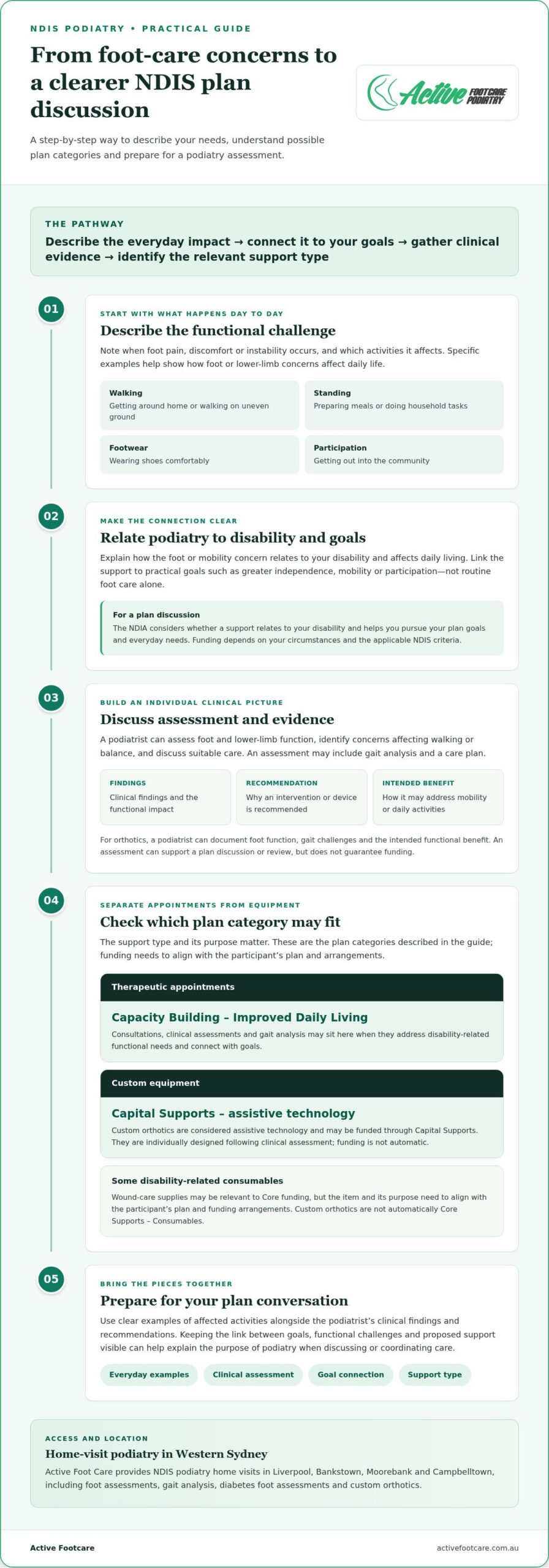
Under the National Disability Insurance Scheme (NDIS), podiatry may be funded when it relates to your disability and supports daily living. Explain the practical connection between the support and your needs. For example, foot pain or instability may make it harder to walk around your home, prepare meals while standing or get out into the community. Connecting the support to your individual goals helps show why it matters, rather than describing it as routine foot care alone.
A clinical assessment can be useful when you’re seeking funding for assistive technology such as orthotics. A podiatrist can examine your foot function and gait, document the challenges you experience, and explain how a recommended device may address them. This report can support a plan discussion or review by setting out the intended benefit for your mobility and daily activities. An assessment supports a request, but funding decisions depend on your circumstances and the applicable NDIS criteria.
Is Podiatry Considered ‘Reasonable and Necessary’?
The NDIA considers whether a support relates to your disability and helps you pursue your plan goals and everyday needs. A podiatrist’s report can describe clinical findings, their functional impact and the reason for a recommended intervention. Healthy feet also matter to mobility. Identifying pressure areas, skin changes or pain can help inform timely clinical care and address concerns that may interfere with daily activities.
Common Conditions Supported by NDIS Podiatrists
Disability can affect foot function in different ways. Cerebral palsy or multiple sclerosis may be associated with changes in gait, balance or lower-limb movement. Diabetes can make careful foot assessment important for participants with complex needs. Biomechanical concerns may also prompt an assessment for custom orthotics. The right approach depends on an individual examination, not diagnosis alone.
When comparing ndis podiatry providers, look for care that connects clinical findings with everyday function. Active Footcare provides NDIS podiatry, diabetes foot assessments, gait analysis and custom orthotics, with home visits in Liverpool, Bankstown, Moorebank and Campbelltown. Discussing how these services relate to your mobility and goals can help make your support needs clearer.
How Podiatry Fits into Your NDIS Plan Categories
Understanding which part of your plan may fund podiatry can make it easier to organise care. Therapeutic appointments such as consultations, assessments and gait analysis commonly sit under Capacity Building – Improved Daily Living. This support is intended to build or maintain skills and function, with podiatry recommendations connected to disability-related needs and goals.
Equipment is considered separately. Custom orthotics are assistive technology and may be funded through Capital Supports, rather than automatically coming from Core Supports – Consumables. Some disability-related consumables, such as wound-care supplies, may be relevant to Core funding, but the item and its purpose need to align with the participant’s plan and funding arrangements. The Australian Podiatry Association NDIS Update provides podiatry-specific context on changes affecting the sector.
Capacity Building: Therapeutic Supports
Plan funding may support consultations, clinical assessments and gait analysis when these address disability-related functional needs. A podiatrist can assess how foot pain, limited joint movement or an altered walking pattern affects tasks such as moving around the home or accessing community activities. Recommendations may focus on movement, balance and confidence, with progress reviewed against practical goals. Outcomes vary for each person.
Assistive Technology and Orthotics
Custom orthotics are designed following an individual assessment of foot function and clinical needs. They differ from general off-the-shelf inserts, which aren’t made following a participant-specific clinical assessment. A podiatrist can explain why a custom device is recommended, its intended functional benefit and any review needs. Funding isn’t automatic: the request needs to meet the relevant NDIS requirements and fit the participant’s plan.
Consider review needs as part of planning rather than treating orthotics as a one-off request. The participant’s podiatrist can document changes in comfort, fit or function and advise whether reassessment is clinically appropriate. Support coordinators can help organise reports and keep recommendations connected to the person’s goals and plan review timing.
A Service Agreement sets out the agreed podiatry supports, how appointments will be arranged, and how the participant or their nominee and provider will communicate. Before services begin, coordinators can map each agreed activity to its intended funding category, confirm the participant’s plan management arrangements and keep relevant clinical documentation together. Clear records make it easier to track delivered support and discuss changing needs.
For Western Sydney participants, Active Footcare provides NDIS podiatry, gait analysis and custom orthotics, including home visits in Liverpool, Bankstown, Moorebank and Campbelltown. Explore Active Footcare’s NDIS podiatry support as part of your care planning.
Choosing the Right NDIS Podiatry Provider in Western Sydney
The right provider needs to suit both your clinical needs and the way your NDIS plan is managed. Registration affects which providers can deliver NDIS-funded supports under different management types, but it doesn’t tell you everything about the care itself. Consider how the podiatrist explains recommendations, understands disability-related needs and connects treatment to activities you want to manage more comfortably.
Plan Managed vs. Self Managed Considerations
Plan-managed participants can generally choose registered or unregistered providers for eligible supports, with invoices sent to their plan manager for payment. Self-managed participants can also use registered or unregistered providers and manage payments and records themselves. If the NDIA manages your funding, you generally need to use an NDIS-registered provider for NDIS-funded supports. Include your management type in your planning before arranging care.
Local knowledge can make ongoing care more practical. A podiatrist who provides mobile services in Liverpool and Bankstown can assess mobility in the participant’s home environment, where everyday barriers may be easier to describe and observe. Local appointments can also help maintain continuity between assessments and follow-up, particularly when travel is difficult.
Evaluating Clinical Expertise and Equipment
Look beyond the service name. Ask how the podiatrist assesses walking and balance, what the assessment will inform, and how findings are recorded in relation to the participant’s goals. For orthotics, ask how the clinical assessment guides the design and how reviews are considered if comfort, fit or function changes. Gait analysis can inform clinical recommendations, but equipment should be based on individual findings rather than assumed to suit everyone.
Specialist experience matters too. A podiatrist familiar with disability-related mobility needs can take account of how a condition affects movement, communication, comfort and daily routines. For NDIS-funded care, clear clinical records can help explain the functional purpose of an assessment or recommendation. Discuss how the provider documents findings and communicates with the participant, nominee or support coordinator, then make sure the Service Agreement sets out the agreed supports and arrangements.
Active Footcare’s NDIS podiatry services are led by Principal Podiatrist Dr Maher Said. The clinical team provides mobile care in Liverpool, Bankstown, Moorebank and Campbelltown, with gait analysis and custom orthotics among its podiatry services. Shockwave therapy is also offered. These options are considered in the context of a person’s needs, rather than treated as a standard package.
Before signing a Service Agreement, make sure you understand:
- Which podiatry supports and appointments are included in the agreement.
- How appointments, changes and communication will be handled.
- How clinical findings and recommendations will be shared with the participant or their support team.
- How the agreed services fit the participant’s plan management and goals.
When comparing ndis podiatry providers, look for a podiatrist who makes room for questions and explains clinical recommendations in plain language. Clinical skill, disability-aware care and local mobile support can help participants and their teams make informed choices.
The Benefits of Mobile NDIS Podiatry Home Visits
For a participant with limited mobility, getting to an appointment can involve organising transport, managing a transfer and coping with an unfamiliar setting. Mobile podiatry brings assessment and care to the participant, reducing those practical hurdles. A home visit in Sydney lets participants receive clinical care in familiar surroundings, without travelling to a clinic.
This can be particularly helpful for residents in Moorebank and Campbelltown who find travelling to a clinic difficult. At home, it may be easier to discuss foot pain or walking concerns in the setting where they affect everyday routines. Familiar surroundings can also help the participant feel more at ease and retain control over the appointment.
Personalised Care in Your Own Environment
A home visit gives a podiatrist a chance to understand mobility in context. With the participant’s agreement, the assessment may consider the footwear they use day to day and the surfaces or spaces they move through at home. This can help the clinician understand practical challenges, such as negotiating a hallway or getting to the front door, and tailor clinical recommendations to the person’s routine.
Family members or carers may also find it easier to take part in a home consultation, share observations and hear guidance directly. This can support consistent communication about the participant’s care plan. Active Footcare provides podiatrist home visit Sydney services for participants who benefit from care at home.
Servicing Western Sydney: From Bankstown to Liverpool
For participants in Bankstown, Liverpool, Moorebank and Campbelltown, local mobile care can reduce the need to travel across Sydney. Less travel may make it easier for people with transport barriers to attend an assessment and maintain continuity of care. Active Footcare provides mobile podiatry for NDIS and aged care clients in these Western Sydney locations.
Older people who are also NDIS participants may have podiatry needs connected to disability-related goals and supports in their plan. Mobile care can make it more practical to access an assessment in familiar surroundings. Information about aged care podiatry can also help families understand foot care for older adults, while NDIS supports remain guided by the individual’s plan.
At home, a podiatrist can carry out a clinical assessment and, where appropriate, gait analysis in the participant’s usual environment. Active Footcare provides on-site gait analysis and custom orthotics, with care led by Principal Podiatrist Dr Maher Said. The focus is individual care, not a one-size-fits-all routine. For participants seeking ndis podiatry providers with mobile support in Western Sydney, a home visit may make care more accessible and comfortable.
Learn about Active Footcare’s home visit services in Western Sydney.
Partnering with Active Footcare for Your NDIS Journey
NDIS podiatry support should be clinically thorough and easy to understand. Active Footcare, led by Principal Podiatrist Dr Maher Said, provides care for NDIS participants in Sydney, including Liverpool, Bankstown, Moorebank and Campbelltown. The focus is on understanding how foot health affects your mobility and daily routines, then discussing care that relates to your needs and goals.
Clear communication matters throughout the process. A Service Agreement can set out the agreed supports, appointment arrangements and communication expectations, giving participants, nominees and support coordinators a shared reference. Active Footcare works with participants and Plan Managers to support clear communication about podiatry services and plan arrangements. Clinical findings and recommendations can also help the participant and their team understand the purpose of care when discussing support needs.
Our Specialised NDIS Process
An initial assessment is an opportunity to discuss what you’d like to manage more comfortably, such as walking around home or taking part in community activities. Your podiatrist can assess foot health and movement, including gait where appropriate, and use the findings to guide recommendations. The appointment centres on you: your daily experience, concerns and priorities shape the discussion.
As needs change, further assessment may help review comfort, mobility or how a recommended intervention is working in everyday life. Clinical notes and relevant recommendations can provide useful information for a plan review by explaining the connection between podiatry and your functional goals. Where custom devices may be appropriate, an individual assessment can inform the next steps. Learn more about custom orthotics and their role in foot care.
Booking Your First Appointment
Participants, carers and Support Coordinators can get in touch to discuss the podiatry need, the participant’s goals and preferred appointment setting. The NDIS guidance outlined earlier in this guide indicates that a GP referral isn’t required to see an NDIS podiatrist. Sharing relevant plan information and explaining whether funding is self-managed, plan-managed or NDIA-managed can help clarify arrangements from the outset.
Active Footcare provides mobile NDIS podiatry home visits in Liverpool, Bankstown, Moorebank and Campbelltown. This option can help participants with limited mobility access care in familiar surroundings. The clinical team also provides gait analysis, diabetes foot assessments and custom orthotics for NDIS participants. Appointment arrangements and the supports to be delivered can be discussed and recorded in the Service Agreement, so everyone involved understands the plan.
Before the first appointment, note the main mobility concern, the activities it affects and any questions you’d like addressed. Support Coordinators can share relevant context with the participant’s consent, helping the podiatrist understand what matters in day-to-day life. This gives care a practical starting point and supports communication between the participant, provider and Plan Manager.
To discuss your NDIS podiatry needs and take the next step, contact Active Footcare today.
Take the Next Step Towards More Confident Mobility
Your next step can be a conversation about what you’d like to do more comfortably, whether that’s moving around home, managing foot pain or getting out into the community. Clear goals give your podiatrist a practical starting point and help keep care focused on what matters in your everyday life.
Choosing between ndis podiatry providers is about more than arranging an appointment. It’s about finding clinical guidance that respects your priorities and helps you understand your options. At Active Footcare, Principal Podiatrist Dr Maher Said leads a patient-focused team supporting NDIS participants in Western Sydney, including Liverpool and Bankstown.
Discuss your podiatry needs and preferred appointment setting with the team. Book your NDIS podiatry assessment with Active Footcare and begin planning care that supports your goals.
Frequently Asked Questions
Does the NDIS cover the full cost of podiatry appointments?
Not necessarily. NDIS funding depends on your plan, the support’s eligibility and the available budget. The NDIS pricing limit is a maximum, not a promise that every appointment will be fully funded. Before starting, compare the proposed supports with your plan and management arrangements, and keep track of invoices and remaining funds. If a support isn’t covered by your plan, you may need to discuss other payment arrangements with the provider.
Can I use my NDIS funding for custom orthotics at Active Footcare?
Active Footcare provides custom orthotics, and NDIS funding may be used when the device relates to your disability and meets the relevant funding criteria. Funding isn’t automatic. A podiatrist’s assessment can explain why orthotics are recommended, the functional need they address and how they relate to your goals. Keep the assessment and supporting documentation with your plan records, then discuss the request with your plan manager or support coordinator.
What is the difference between a registered and unregistered NDIS podiatry provider?
A registered provider has completed the NDIS registration process and can deliver funded supports to NDIA-managed participants. Plan-managed and self-managed participants generally have more choice and may use registered or unregistered providers. Registration is separate from clinical suitability, so consider whether the podiatrist’s assessment and communication approach fit your needs. When comparing ndis podiatry providers, make sure the provider arrangement matches your plan-management type.
How do I add podiatry to my NDIS plan if it isn’t already included?
Raise the need with your support coordinator, Local Area Coordinator or the NDIA, and explain how your disability affects foot health, mobility or daily activities. A podiatrist’s assessment may help document the functional impact and recommended support. Use specific examples, such as difficulty walking safely to the shops or standing to prepare meals. The NDIA decides whether funding is included, so a request or report doesn’t guarantee approval.
Do you provide mobile podiatry home visits for NDIS participants in Bankstown?
Yes. Active Footcare provides mobile NDIS podiatry home visits in Bankstown. A home appointment can be helpful if transport, transfers or unfamiliar environments make clinic visits difficult. To plan the visit, participants, carers or Support Coordinators can share the main foot or mobility concern, relevant NDIS plan-management details and any access considerations for the home. This helps the clinical team prepare for an appointment suited to the participant’s needs.
What information do I need to provide for an NDIS Service Agreement?
To help prepare the agreement, provide the participant’s details, preferred contact person, plan-management type and the podiatry supports being arranged. It’s also useful to explain the participant’s goals, appointment preferences and any communication or access needs. If a Plan Manager is involved, share their relevant invoicing details. Read the agreement before services begin so the supports, responsibilities and arrangements are clear to the participant or their nominee.
How often can an NDIS participant see a podiatrist?
There’s no single appointment frequency that suits every participant. The appropriate schedule depends on clinical needs, the goals being addressed and the funding available in the plan. A podiatrist can recommend a review approach based on assessment findings and changes in comfort, mobility or foot health. If needs change between planned appointments, record what’s different and discuss it with the treating podiatrist and support team.
Can NDIS podiatry help with diabetic foot complications?
Yes. Podiatry can support NDIS participants with diabetes through clinical foot assessments and care tailored to their needs. An assessment may identify concerns such as changes to skin, nails, sensation or foot comfort and help guide appropriate next steps. Active Footcare provides diabetes foot assessments for NDIS participants. If a foot concern is new or worsening, arrange prompt clinical advice rather than waiting for a routine review.