


Foot pain, reduced balance or limited mobility can affect ordinary activities, from walking around the home to getting dressed or joining community activities. Those practical effects can be difficult to explain. An NDIS podiatry functional assessment report Campbelltown can help describe how foot and lower-limb function relates to everyday activities and your NDIS goals.
You may be wondering what a podiatrist will assess and how the findings could be used in NDIS planning. A report can record relevant clinical findings and describe functional challenges discussed during an assessment. It may provide useful information for planning discussions, but it cannot guarantee that a particular support will be funded.
This article explains what a podiatrist may assess, what information can help you prepare, and how to connect foot-related challenges with daily goals. Active Foot Care provides NDIS podiatry services in Campbelltown, with care tailored to foot health and mobility. Home visits are available for people who find travel difficult. Active Foot Care also serves Liverpool, Bankstown, Moorebank and Sydney.
Key Takeaways
- An NDIS podiatry functional assessment report Campbelltown can explain how foot health affects daily function, rather than simply record a diagnosis.
- The assessment can focus on your concerns and goals, including how foot symptoms relate to comfort, balance, mobility and participation.
- Everyday examples can connect clinical observations with functional impacts and possible recommendations, without promising a funding decision.
- Prepare by noting your NDIS goals and the daily activities you find challenging, so you can focus the discussion on what matters most.
- Active Footcare provides tailored NDIS podiatry care in Campbelltown, with home visits available for people who need care at home.
What is an NDIS podiatry functional assessment report in Campbelltown?
An NDIS podiatry functional assessment report describes relevant foot health findings and how they relate to a person’s function and podiatry support needs. For someone seeking an NDIS podiatry functional assessment report Campbelltown, it can put practical effects, such as difficulty walking or standing, into clear language for planning discussions.
Unlike routine foot care, which may focus on an immediate concern, a functional assessment considers how foot health affects activities. It also goes beyond a diagnosis alone by explaining the day-to-day effects discussed during the assessment. A clear report distinguishes clinical findings, what the podiatrist observes or assesses, from recommendations, which describe possible next steps for discussion. It can inform planning, but it cannot guarantee funding or a particular NDIS decision.
This video introduces functional capacity assessment reporting more broadly. Its focus is occupational therapy, but it may offer useful context about how functional information is presented.
Who may seek an NDIS podiatry functional assessment?
A participant may find this assessment useful when a foot or lower-limb concern affects activities such as walking around the home, standing to prepare a meal, transferring between surfaces or getting out into the community. For example, someone might describe discomfort that makes a shopping trip difficult. The podiatrist can consider how that concern relates to foot function and mobility.
Family members, nominees and support coordinators may help gather information or describe support needs, while keeping the participant’s preferences central. A diagnosis can provide relevant clinical context, but it does not by itself establish NDIS eligibility or guarantee funding for a particular support. The NDIS is the National Disability Insurance Scheme (NDIS), and a podiatry report is one piece of information that may contribute to wider planning conversations.
What questions can the assessment help clarify?
The discussion can explore when foot symptoms arise, which tasks become difficult, and whether balance, comfort or walking tolerance affects participation. Specific examples are more useful than a general statement such as “walking is hard”. For instance, a participant might need to pause on the way to a local appointment or feel less steady when moving between rooms.
Assessment findings can help identify areas for further podiatry discussion, such as whether clinical advice or another approach to foot health and mobility may be relevant. The scope depends on the participant’s concerns, goals and clinical presentation, so reports will not all cover the same things. If getting to a clinic is difficult, Active Footcare’s NDIS mobile podiatry guide explains home-visit care. The assessment helps turn lived experience into a clearer clinical discussion, rather than promising a particular outcome.
What does a Campbelltown NDIS podiatry assessment examine?
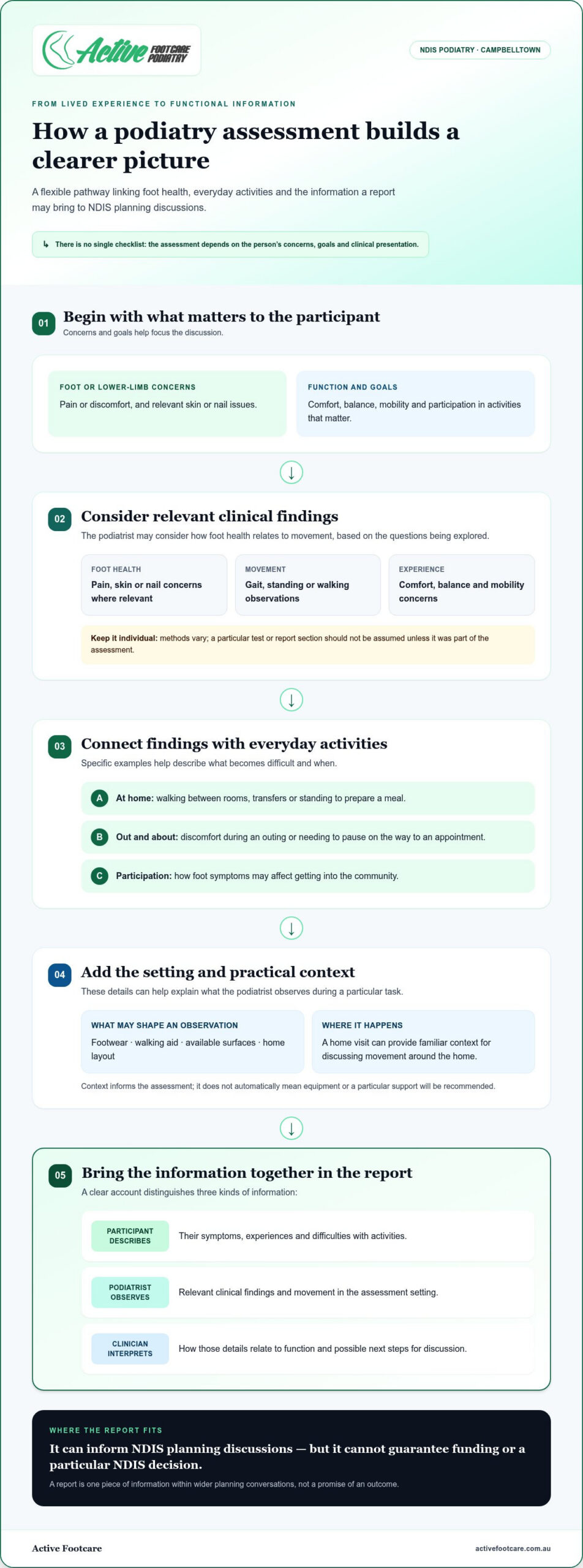
There is no single checklist for every participant. The assessment depends on the person’s concerns, goals and clinical presentation. A podiatrist may consider how foot health relates to comfort, balance, walking or standing, then focus on observations relevant to the activities the participant wants or needs to manage.
A useful report distinguishes three kinds of information: what the podiatrist observed, what the participant described, and the clinician’s interpretation of how those details relate to function. This keeps the account grounded in the individual’s experience instead of assuming every participant has the same difficulties or needs.
Foot health, gait and mobility observations
Where relevant, a podiatrist may consider concerns such as pain, skin or nail issues, and how these relate to movement. Observing gait or standing can help describe how a person moves in the assessment setting. The methods depend on the person and the questions being explored, so a particular test or report section should not be assumed unless it was part of the assessment.
For example, a participant may report discomfort after standing to prepare food. The report can distinguish that account from observed movement and the podiatrist’s clinical interpretation. This makes it clearer what the participant experienced, what the podiatrist saw and what may need further discussion. One observation is not a complete picture of how someone functions in every setting.
Everyday activities and environmental context
Foot function can affect transfers, movement around the home and getting out into the community. The assessment may explore the participant’s own examples, such as difficulty moving between rooms or discomfort during an outing. These details put clinical observations in context without suggesting that one report captures every part of daily life.
The setting and equipment can also shape what the podiatrist observes. Footwear, a walking aid, the available surfaces and the layout of a home may help explain a particular task. During a home visit, the familiar environment can provide context for discussing movement around the home. These factors inform the assessment, but do not automatically mean that equipment or a particular support will be recommended.
For an NDIS podiatry functional assessment report Campbelltown, the value is in bringing together the person’s specific concerns, relevant clinical observations and careful interpretation. Active Footcare’s podiatry team provides tailored care focused on foot health and mobility. You can explore Active Footcare’s podiatry support as you consider what to discuss.
How can a podiatry report support NDIS planning without promising funding?
A podiatry report can clarify how foot-related concerns affect everyday activities. Its role is to present relevant clinical information and recommendations, not to decide what the NDIS will fund. The NDIA makes funding decisions under current rules, so no report can guarantee approval or a particular outcome.
When reviewing the information, follow the connection from observation to decision:
- Clinical observation: What the podiatrist assessed or observed, such as difficulty with a movement during an activity.
- Functional impact: How that finding relates to a task the participant describes, such as walking to a community activity.
- Recommendation: The podiatrist’s clinical view about a support or next step that may relate to the assessed need.
- Decision-maker consideration: The NDIA considers the information under NDIS rules when making a funding decision.
Clinical evidence can explain a participant’s needs, but the NDIA decides whether a support is funded. Keeping these roles separate helps set realistic expectations while recognising that a report may still be useful in planning discussions.
Turning foot-related difficulties into clear functional evidence
Concrete examples help describe what a person experiences without overstating it. Explain when a difficulty occurs, where it happens and how it affects the activity. Instead of saying “I can’t walk far”, a participant could describe needing to stop during a particular outing because foot discomfort makes it difficult to continue. The podiatrist can record the participant’s account separately from clinical observations and interpretation.
Include details about how often a difficulty occurs, what assistance is needed or what makes an activity harder only when they reflect the assessment information. A useful report describes the person’s actual experience, including what they can do and the circumstances that create barriers. Assumptions should not be presented as observed findings.
Recommendations, supports and NDIS decision-making
A podiatry recommendation should relate to the concerns assessed and the participant’s goals. It may explain why an approach is suggested, but it remains clinical advice, not funding approval. The NDIA considers requests under current rules, and a report alone does not settle whether a support meets those requirements.
NDIS guidance can change, so participants and their representatives should refer to the NDIA’s current information about reasonable and necessary supports when reviewing funding rules. An NDIS podiatry functional assessment report Campbelltown can contribute individualised clinical information to that wider discussion while keeping the recommendation and funding decision distinct.
How to prepare for an NDIS podiatry functional assessment in Campbelltown
A little preparation can make it easier to explain what is happening and what you want the assessment to clarify. You do not need a large file of paperwork. Focus on information that helps the podiatrist understand the participant’s priorities, foot concerns and everyday routines.
Use this simple sequence to get ready:
- 1. Note the main concerns. Write down current foot or lower-limb symptoms, relevant history and what the participant most wants to discuss.
- 2. Record everyday examples. Note affected activities, such as moving around the home, standing to prepare a meal or getting out into the community. Include what makes the task harder and any help the participant uses.
- 3. Identify relevant goals. Bring the NDIS plan or note goals related to mobility, independence or participation. If a support coordinator is involved, relevant information from them may help frame the discussion.
- 4. Gather useful clinical and practical items. Bring relevant medical information, current footwear, orthotics or walking aids if they relate to the concern. Unrelated personal documents are not needed.
Information to gather before the appointment
Keep notes brief and specific. For example, note that foot discomfort tends to arise during a particular household task, rather than relying on a broad description such as “walking is difficult”. Mention if the impact varies. This gives the podiatrist a clear starting point while leaving room to ask questions and hear the participant’s experience in their own words.
Share information that is relevant to the assessment. A plan detail, previous clinical note or support-coordinator observation may add useful context, but there is no need to provide a full history of unrelated matters. The aim is a focused conversation, not a paperwork exercise.
Choosing an assessment setting that supports participation
An in-clinic appointment may suit someone who can travel comfortably and wants to discuss concerns in that setting. For a participant whose mobility or access needs make travel difficult, a home visit may be a practical alternative. Familiar surroundings can help frame discussion of movement around the home and the tasks the participant wants to manage. The assessment remains individual, and the setting does not determine any recommendation.
Active Footcare provides podiatry home visits, and its guide to podiatrist home visits in Sydney explains this care setting. A few clear notes can also help you make the most of an NDIS podiatry functional assessment report Campbelltown discussion, whether it takes place at home or in a clinic.
For tailored NDIS podiatry support focused on foot health and mobility, get in touch with Active Footcare to discuss the participant’s needs.
Arrange NDIS podiatry support and assessment in Campbelltown
A functional concern is a useful starting point for a podiatry discussion. Note what is difficult, such as standing during a daily task, moving around the home or getting out into the community, and how it relates to the participant’s goals. Active Footcare provides NDIS podiatry services in Campbelltown, with care focused on individual foot health and mobility needs.
In a discussion with the podiatry team, the participant can describe their experience, with a family member, nominee or support coordinator involved where helpful. The conversation can clarify which foot-related issues may benefit from podiatry input and what assessment approach is clinically relevant. It does not predetermine what a report will contain or what the NDIS may fund.
What participants and support coordinators can expect
The discussion centres on the participant’s concerns and priorities. A podiatrist can ask which activities feel difficult, listen to the participant’s account and consider relevant clinical findings. The assessment depends on the person’s presentation and needs, so any written reporting should reflect the information gathered rather than follow an assumed standard format.
Findings and possible next steps can be explained in clear language, helping participants and support coordinators understand the clinical information. You can ask how an observation relates to a particular activity or goal, and which details come from the participant’s account versus the podiatrist’s assessment. Clear distinctions help everyone use the information accurately in later planning conversations.
An NDIS podiatry functional assessment report Campbelltown may be useful when foot health affects everyday function and the participant needs clinical information to describe that impact. The report can inform a discussion, but cannot guarantee that a support will be approved. The NDIA makes funding decisions, while the podiatrist assesses and communicates clinical needs.
Take the next step with a local podiatry team
Before starting a conversation, identify one or two priorities, such as walking more comfortably at home, managing standing tasks or taking part in a community activity. A support coordinator can help organise relevant plan information, while the participant’s own account keeps the discussion connected to daily life.
Active Footcare offers tailored NDIS podiatry care in Campbelltown and surrounding local areas, including Liverpool, Bankstown, Moorebank and Sydney. Home visits are available for people who find travel or access difficult. The assessment setting and reporting can be considered in light of the participant’s clinical needs. You do not need to have every detail worked out before raising a concern.
If foot pain or mobility is affecting everyday activities, contact Active Footcare to discuss NDIS podiatry care and the participant’s goals with the local team.
Take a clear next step towards footcare support
You do not need every answer before starting a podiatry conversation. Begin with the change you would most like to work towards, whether that is feeling steadier at home, managing a regular task more comfortably or taking part in an activity that matters to you. That priority can help shape a practical discussion about what to assess and what information may be useful.
If you are considering an NDIS podiatry functional assessment report Campbelltown, start by describing the foot-related difficulty in your own words and explaining what you hope support might help you do. A podiatrist can discuss your concerns and relevant clinical needs with you. A report does not promise a funding outcome.
Active Footcare provides NDIS podiatry services in Campbelltown and surrounding areas, including Liverpool, Bankstown, Moorebank and Sydney. Discuss NDIS podiatry care with Active Footcare and take the next step towards support tailored to your foot health and mobility needs.
Frequently Asked Questions
What is an NDIS podiatry functional assessment report?
It is a podiatrist’s written account of relevant foot health findings and how they relate to a participant’s function. Unlike notes focused only on one treatment, it can explain why a foot concern matters in the context of the person’s support needs. The report reflects the assessment and clinical information available. It is not a general certificate of NDIS eligibility or a guarantee that a requested support will be funded.
Can a podiatrist write a functional assessment report for the NDIS?
Yes. A podiatrist can document foot-related clinical findings and explain their relevance to function as part of their professional work. The report should stay within the podiatrist’s clinical knowledge and describe information gathered about the participant, rather than make claims outside that assessment. Whether the NDIA finds the report useful for a particular request is a separate matter, considered alongside the participant’s circumstances and current NDIS rules.
What does a podiatrist assess in an NDIS functional assessment?
A podiatrist considers issues relevant to the participant’s presentation, which may include foot health, discomfort and movement. The discussion can also cover how these concerns relate to particular tasks, such as standing at a bench or walking across different surfaces. The assessment is not necessarily the same for everyone. Mentioning a specific concern, such as discomfort in particular footwear, can help guide what to explore.
Does an NDIS podiatry report guarantee funding for treatment or equipment?
No. A podiatrist’s report may explain clinical reasoning and why a support is being considered, but it cannot guarantee funding for treatment, orthotics or other equipment. The NDIA makes funding decisions under current rules. If you are preparing a request, use the report as clinical information and review current NDIA guidance for the relevant support. Keep a copy of the decision and any questions you want clarified for planning discussions.
What should I bring to an NDIS podiatry assessment?
Bring items that help explain the concern, rather than paperwork for its own sake. These might include footwear or orthotics you use, a relevant medical note and a short record of activities that bring on symptoms. If a support person helps with daily routines, they may be able to add practical context. You can also bring a written question to help raise your main concern during the appointment.
Can an NDIS podiatrist assess me at home in Campbelltown?
Yes, Active Footcare provides podiatrist home visits, including for NDIS clients, in Campbelltown. A home setting may be useful if travel is difficult or if discussing movement in familiar surroundings helps explain an access concern. The podiatrist can consider the participant’s needs and the assessment context. Active Footcare also serves people in Liverpool, Bankstown, Moorebank and Sydney.
How does a podiatry report relate to my NDIS goals?
A report can describe how a foot-related concern connects with a goal that matters to you, such as taking part in an activity or managing a routine more independently. If a goal involves getting out to a regular community activity, for example, you could explain how foot discomfort affects that outing. The podiatrist can consider the clinical relevance of that information, while the NDIA decides funding requests under its current rules.