


Could a change in your child’s walking pattern be part of growing up, or a reason to seek advice? Searching “children’s foot specialist Liverpool” can bring up different types of care, and it’s not always clear where to start. A podiatrist assesses foot concerns and walking mechanics, while an orthopaedic specialist focuses on broader musculoskeletal conditions and may be involved when more complex care is needed.
It’s understandable to want reassurance before booking an appointment, especially if your child feels unsure about being examined. Persistent pain, recurring discomfort or a walking pattern that affects everyday activities may be worth discussing with a podiatrist. An assessment can help you understand what’s being observed and whether any next steps are appropriate. Not every difference needs treatment.
This guide explains what to look for, when podiatry may help and what to expect from an individual assessment. At Active Foot Care, Principal Podiatrist Dr Maher Said leads care, with gait analysis used when clinically appropriate. Clinic appointments and podiatrist home visits give families in Liverpool, Bankstown, Moorebank, Sydney and Campbelltown options for discussing their child’s feet and movement.
Key Takeaways
- Children develop at different rates, but persistent discomfort, activity avoidance or recurring limping can be reasons to consider an assessment.
- A podiatry appointment can help clarify your child’s concern by considering symptoms, relevant history and walking patterns.
- A podiatrist focuses on foot function, while an orthopaedic surgeon has a broader musculoskeletal role.
- When choosing a children’s foot specialist Liverpool families can look for individual recommendations, clear explanations and room to ask questions.
- Active Footcare tailors care to the child’s concern, with gait analysis or custom orthotics considered when appropriate.
When should a child in Liverpool see a foot specialist?
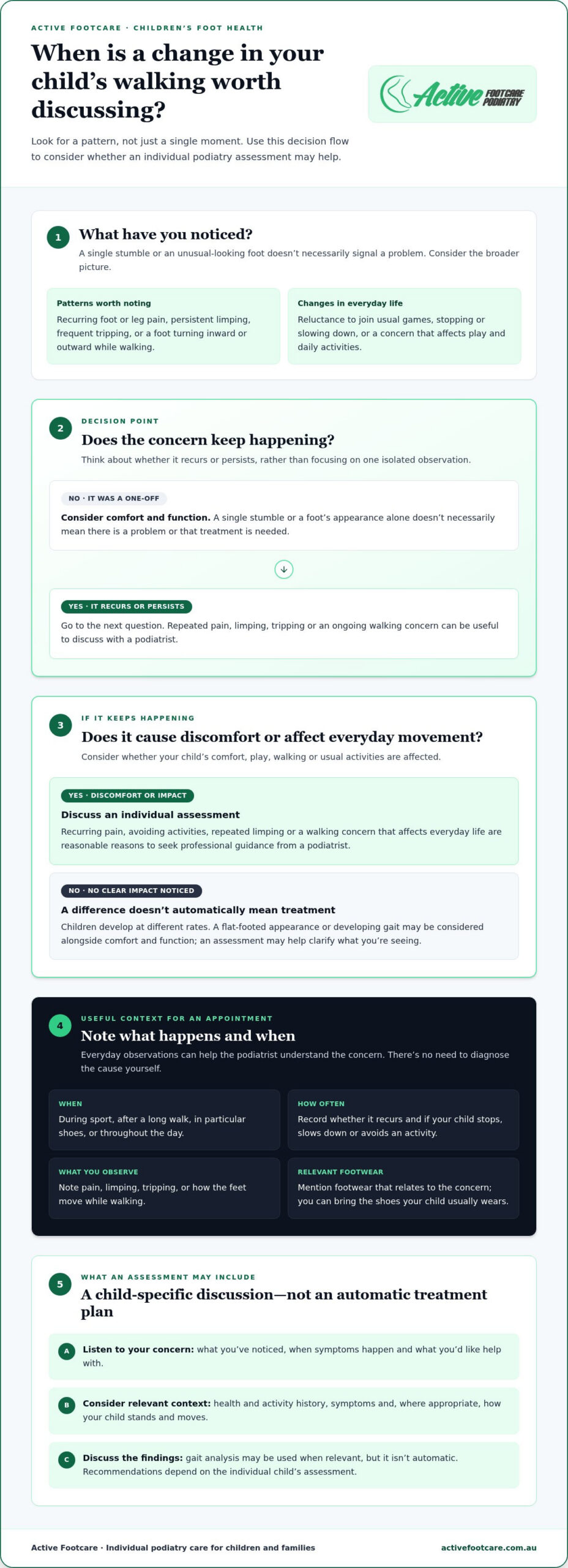
Children develop at different rates, and a single observation, such as a stumble or an unusual-looking foot, doesn’t necessarily signal a problem. Consider the broader picture: does the concern keep happening, cause discomfort or change how your child plays and manages everyday activities? Noticing a pattern can help you decide whether to seek individual advice.
If you’re considering a children’s foot specialist Liverpool parents can start by noting what they’ve seen and how it affects their child, rather than trying to diagnose the cause themselves. Recurring pain, avoiding activities, repeated limping or a persistent walking concern are reasonable reasons to discuss an assessment.
Toe walking is one walking pattern parents may notice. This video offers general information to help you understand the topic:
What changes in a child’s feet or walking are worth noticing?
Look for patterns rather than isolated moments. Recurring foot or leg pain, persistent limping, frequent tripping or reluctance to join usual games may be reasons to seek professional guidance. You might also notice that a foot turns inward or outward while your child walks. That observation alone doesn’t identify a cause, but sharing it can help the podiatrist understand your concern.
Note when it happens: during sport, after a long walk, in particular shoes or throughout the day. Record how often it occurs and whether your child stops, slows down or avoids an activity. These everyday details give an assessment useful context beyond how the feet look at rest.
Are flat feet or unusual walking patterns always a problem?
No. Children’s feet and walking patterns can look different, and appearance needs to be considered alongside comfort and function. A flat-footed appearance or a developing gait doesn’t automatically mean treatment is needed. General information about Pediatric podiatry describes children’s foot development and common variations, but an individual assessment can help interpret what you’re seeing in your child.
A podiatrist can consider the concern in context, including whether it’s painful, recurring or limiting movement. Sometimes the discussion may simply provide reassurance; if further care is appropriate, the next steps can be explained clearly. At Active Footcare, gait analysis may help assess a child’s walking pattern when clinically appropriate, supporting an individual discussion rather than a decision based on appearance alone.
In short: consider professional guidance when a foot or walking concern keeps recurring, causes discomfort or interferes with play and daily activities. Note what happens and when, then share those observations so your child’s needs can be considered individually.
What happens during a children’s podiatry assessment?
A children’s podiatry assessment should help you understand your child’s concern. The appointment usually begins with the podiatrist listening to what you’ve noticed and what you’d like help with. Explain when symptoms occur, how long they’ve been happening and whether they affect sport, walking to school or play.
The podiatrist then considers relevant health and activity history, symptoms and, where appropriate, how your child stands and moves. The assessment is guided by the concern, so gait analysis isn’t automatically necessary. If observing walking is useful, it forms one part of the picture, rather than being a diagnosis or treatment in itself.
The podiatrist discusses the findings with you in clear, practical language. You can ask what the observations may mean, whether further assessment is useful and what options could suit your child. If your concern involves flexible flat feet, the American Academy of Orthopaedic Surgeons’ guide to Flexible Flatfoot in Children offers background on assessment and when care may be considered.
Recommendations depend on the individual child’s assessment. There isn’t one plan that suits every child with a similar-looking foot or walking pattern.
How does gait analysis help assess a child’s walking?
Gait analysis involves observing how a child moves while standing and walking, when this is relevant to the concern. The podiatrist may look at the overall pattern, including how the feet move through each step. These observations are considered alongside symptoms and everyday function, such as whether discomfort affects walking or activity. Gait analysis can inform the discussion, but it can’t promise to identify or resolve every cause of concern.
How can parents help a child feel comfortable at an appointment?
Before the visit, explain simply that the podiatrist will listen, look at how their feet move and talk with you both. Let your child know they can say if something feels uncomfortable. A calm, respectful consultation gives your family space to ask questions and understand what’s happening.
A few notes can help you explain the concern clearly. Jot down when symptoms appear, how often they happen and which activities seem affected. You can also mention relevant footwear or bring the shoes your child usually wears if they relate to the concern. There’s no need to prepare a diagnosis; your observations are enough to start the conversation.
At Active Footcare, Principal Podiatrist Dr Maher Said leads individualised podiatry care in Liverpool. If you’re looking for a children’s foot specialist Liverpool families can speak with, an assessment provides a clear discussion of the concern and possible next steps. Depending on what’s appropriate, care may include gait analysis. Active Footcare also provides home visits for suitable circumstances. Find out more about Active Footcare’s podiatry care.
Podiatrist or orthopaedic surgeon: which Liverpool care pathway fits?
These professionals have different, sometimes complementary, roles. A podiatrist focuses on foot health and function, including how the feet move and relate to a child’s activities. An orthopaedic surgeon is a medical specialist who assesses musculoskeletal conditions, including concerns that may involve complex injury or surgery. The right starting point depends on the nature and severity of the concern, not simply on the label “foot problem”.
For ongoing foot discomfort, activity-related symptoms or questions about walking mechanics, a podiatrist can assess foot function and discuss suitable podiatry care. A suspected injury, significant symptoms or complex medical concern may call for broader clinical input. These pathways aren’t interchangeable, and one doesn’t automatically rule out the other.
What does a podiatrist assess for a child?
A podiatrist considers foot comfort, function and movement in the context of the child’s concern. Depending on what’s relevant, this may include looking at walking patterns and how symptoms relate to activities such as sport or everyday walking. Active Footcare offers gait analysis and custom orthotics, but neither is assumed in advance. Recommendations follow an individual assessment and discussion of what may be appropriate.
When might an orthopaedic opinion be part of the care pathway?
Orthopaedic clinicians assess a broad range of musculoskeletal concerns, including some conditions where surgical expertise may be relevant. This can be a different pathway from podiatry’s focus on foot health and function, though care may involve more than one type of clinician. If symptoms are severe, changing or linked to a suspected injury, follow appropriate medical guidance rather than relying on a general comparison to decide what’s happening.
As a practical guide, consider the concern and what kind of assessment may help:
- Foot comfort or function: A podiatrist may assess recurring discomfort, foot movement or walking-related concerns and explain suitable podiatry options.
- Possible complex injury or broader musculoskeletal issue: Medical assessment may help determine whether orthopaedic input is appropriate.
- Sudden or serious symptoms: Seek urgent medical care, particularly if your child’s condition is rapidly worsening or you’re concerned about their immediate wellbeing.
These are broad signposts, not a way to diagnose a child at home. A podiatrist can assess a foot-related concern and explain whether podiatry care is suitable or whether symptoms call for broader medical input.
For parents searching for a children’s foot specialist Liverpool, the key is matching the assessment to the concern. At Active Footcare, Principal Podiatrist Dr Maher Said leads podiatry care, with recommendations shaped around the child’s needs. That may include gait analysis or custom orthotics when appropriate, while complex or urgent concerns should follow the relevant medical pathway.
How to choose children’s foot care in Liverpool
Choosing care is less about finding the most impressive label and more about finding an assessment that fits your child’s concern. Start by considering what you’ve noticed, how it affects your child and whether the clinician explains their approach in a way your family can understand. These points make it easier to compare options without relying on one sign or promotional claim.
Use this parent-friendly checklist to guide your decision:
- Is the assessment relevant? Look for an approach that considers your child’s symptoms, movement and day-to-day activities, rather than judging foot appearance alone.
- Are findings explained clearly? You should be able to understand what the clinician observed, what it may mean and what the possible next steps are.
- Are recommendations individual? Care should follow assessment. Gait analysis or orthotics may be considered when appropriate, but shouldn’t be assumed before your child is assessed.
- Can you ask questions? Choose care that gives you and your child room to raise concerns and understand the discussion.
- Which setting suits your family? Consider whether clinic care or a home visit is more practical for your circumstances.
What should parents prioritise when comparing care options?
Prioritise a relevant assessment, clear communication and recommendations that make sense for your child’s needs. Be cautious about making a decision based only on a clinic label, a strong promotional promise or one visual feature, such as flat feet. Active Footcare’s podiatry assessment considers each concern individually, with gait analysis and tailored care options discussed when suitable.
For further context, the guide to children’s podiatry in Sydney and Liverpool explains the kinds of questions parents may consider when exploring children’s foot care.
When might home-visit podiatry suit a family?
A home visit may be practical for suitable patients and circumstances, such as when attending a clinic is difficult for the family. It isn’t necessary for every child, and the best setting depends on the concern and what’s appropriate for the assessment. Active Footcare provides podiatry home visits alongside clinic care for families in Liverpool, Bankstown, Moorebank, Sydney and Campbelltown.
Active Footcare is led by Principal Podiatrist Dr Maher Said, with care shaped around the individual assessment rather than a standard package. This overview of podiatrist home visits explains the service in more detail.
For parents seeking a children’s foot specialist Liverpool families can approach for thoughtful podiatry care, the aim is to feel informed about the assessment and comfortable discussing options. Learn about Active Footcare’s podiatry care.
How Active Footcare supports children and families in Liverpool
It can be hard to know what to do next when you’re concerned about a child’s feet or walking. Active Footcare offers podiatry care for families in Liverpool, Bankstown, Moorebank, Sydney and Campbelltown. Care starts with listening to the concern and understanding how it affects the child’s comfort and everyday mobility.
Led by Principal Podiatrist Dr Maher Said, Active Footcare considers each child’s needs before discussing suitable care. Where relevant, gait analysis can help assess walking patterns. Custom orthotics may also be considered following assessment, rather than being assumed as the answer to every concern. Recommendations are explained so parents can understand the reasoning and ask questions.
What can families expect from Active Footcare’s approach?
The focus is on a considered conversation about what you’ve noticed, what activities matter to your child and what support may be appropriate. If orthotics are relevant, the decision should follow an assessment of the child’s individual needs. Parents wanting to understand this option can explore the custom orthotics assessment process.
Active Footcare provides care in clinic and through podiatrist home visits, which may suit some families and circumstances. NDIS podiatry services are also available where relevant to a family’s circumstances. These options give families different ways to access podiatry support, while the appropriate setting and recommendations depend on the child and the concern being discussed.
How can parents take the next step in Liverpool?
When arranging care, describe the main concern in everyday terms. Mention when it occurs, how often it affects your child and whether it changes their usual activities. If you’ve noticed a particular walking pattern, explaining when it happens can also help shape the discussion. You don’t need to work out the cause beforehand.
The assessment and recommendations are guided by your child’s individual needs. A home visit may suit some circumstances, and clinic care is also available. The guide to podiatrist home visits explains what a home appointment can involve.
If you’re looking for a children’s foot specialist Liverpool families can speak with about a foot or walking concern, Active Footcare can help you explore an appropriate podiatry assessment. Share what you’ve observed and discuss a suitable next step for your family. Get in touch with Active Footcare to start the conversation.
Take the next step with confidence
You don’t need to have all the answers before seeking guidance. A simple note about what you’ve noticed, when it happens and how it affects your child can give the first conversation a helpful starting point. Your child’s needs can then guide what happens next, without assuming every difference in foot shape or movement requires treatment.
If you’re looking for a children’s foot specialist Liverpool families can talk with about their concerns, choose a conversation that leaves you better informed and comfortable asking questions. It’s reasonable to take things one step at a time and make decisions once you understand the assessment and the options discussed.
Active Footcare welcomes families seeking clear, individualised podiatry guidance. Get in touch with Active Footcare to discuss your child’s foot-care needs and explore a suitable next step.
Frequently Asked Questions
Is a podiatrist the right specialist for my child’s foot pain?
A podiatrist can assess foot pain and consider whether podiatry care may suit your child’s needs. Parents searching “children’s foot specialist Liverpool” can seek individual advice if pain keeps returning, causes a limp or makes everyday activities difficult. Before an appointment, note where your child feels discomfort and what they were doing when it began. This general information isn’t a diagnosis; the suitable care pathway depends on your child’s circumstances.
Can children have flat feet without needing treatment?
Yes. A flat-footed appearance by itself doesn’t show whether a child needs treatment. Notice whether your child also reports discomfort, changes how they move or avoids activities they usually enjoy. For example, note whether symptoms appear only after sport or also during ordinary walking. Sharing those details can help a podiatrist consider foot shape alongside comfort and function, and explain whether any action is appropriate.
At what age should a child see a podiatrist?
There isn’t one set age for every foot concern. Consider seeking advice if a problem persists, causes discomfort or affects your child’s usual play or daily activities, whatever their age. Write down when you first noticed it, whether it’s changing and what seems to bring it on. That timeline helps put the concern in context and supports a discussion about whether assessment or follow-up would be useful.
Do children need custom orthotics for walking problems?
No, custom orthotics aren’t automatically needed for a particular foot shape or walking pattern. A podiatrist considers the child’s symptoms, everyday function and assessment findings before discussing whether orthotics could be suitable. If a device is proposed, ask what role it’s intended to play and how its use will be reviewed. Active Footcare provides custom orthotics, with recommendations based on individual needs rather than a standard response to every walking concern.
Can a podiatrist assess a child at home in Liverpool?
Active Footcare provides podiatry home visits, which may suit some patients and circumstances. Families can describe the child’s main concern and any practical needs when arranging care, so the appropriate next step can be discussed. Active Footcare serves Liverpool and surrounding areas, including Bankstown, Moorebank, Sydney and Campbelltown. A home visit isn’t necessary for every child; the setting depends on the family’s circumstances and the care required.
Do I need a GP referral to see a podiatrist in Australia?
Referral and rebate requirements depend on the way care is funded and your individual eligibility. A referral connected with a Medicare-supported care plan doesn’t automatically mean every podiatry appointment or device is covered. Services Australia guidance outlines referral pathways and funding conditions, which can vary with your circumstances.
When should I seek urgent medical help for my child’s foot problem?
Seek urgent medical advice if symptoms are sudden or severe, follow a significant injury, or your child can’t comfortably put weight on the foot. Prompt attention is also important if swelling is rapidly worsening, there’s a concerning wound or your child seems seriously unwell. For immediate danger, call 000. Ongoing concerns that aren’t urgent can be discussed through an appropriate clinical assessment.