


Did you know that approximately 1.5 million Australians will experience the debilitating grip of Achilles tendinopathy in their lifetime? If you’re waking up to a sharp, stabbing sensation in your heel or finding that your first steps of the day feel like walking on glass, you’re certainly not alone. It’s incredibly frustrating when morning stiffness prevents you from enjoying a simple walk or when the fear of a sudden rupture keeps you on the sidelines. You might feel like you’ve tried everything, yet the pain always seems to return. Finding effective achilles tendonitis treatment sydney wide shouldn’t feel like a guessing game when your mobility and quality of life are at stake.
At Active Footcare, we believe you deserve more than just a temporary fix for your discomfort. We’re here to help you move beyond short-term relief and toward a permanent recovery guided by clinical expertise and genuine care. This article outlines how our modern approach, led by Dr. Maher Said, combines advanced diagnostics like gait analysis with non-invasive therapies to restore your tendon’s strength. You’ll discover a clear, stage-based rehabilitation plan designed to reduce stiffness immediately while providing long-term prevention through custom orthotics and specialised shockwave therapy. Let’s explore how we can get you back on your feet with confidence.
Key Takeaways
- Learn how to distinguish between insertional and mid-portion heel pain to ensure your recovery plan targets the exact source of your discomfort.
- Discover why relying solely on rest and ice can lead to tendon stiffness and why active, stage-based loading is essential for lasting repair.
- Explore advanced, non-invasive achilles tendonitis treatment sydney residents can use to accelerate healing, such as Shockwave Therapy and regenerative Prolotherapy.
- Understand how detailed gait analysis and custom orthotics work together to correct the underlying biomechanical issues that put undue stress on your heel.
- Gain practical insights into choosing the right footwear and lifestyle adjustments to maintain your mobility and prevent future Achilles injuries.
What is Achilles Tendonitis? Understanding Your Heel Pain
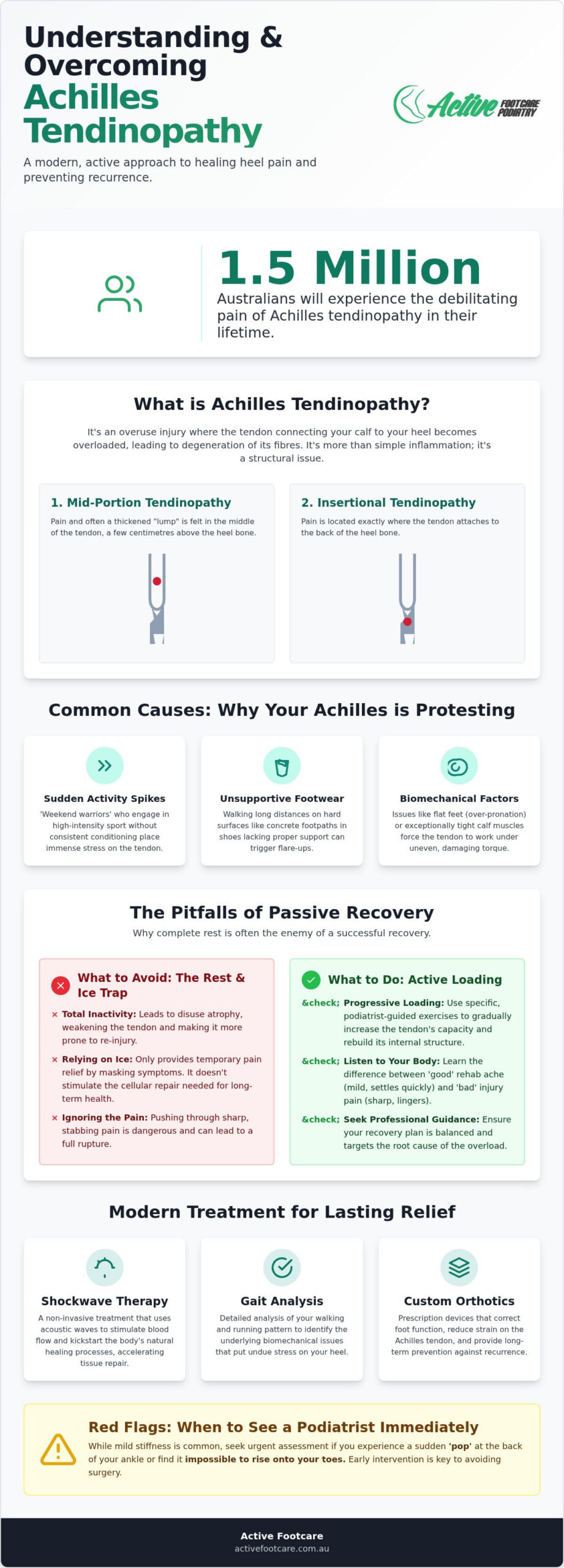
Waking up in Sydney should be about starting your day fresh, not dreading that first step out of bed. Achilles tendonitis is an overuse injury that occurs when the large tendon connecting your calf muscles to your heel bone becomes overloaded. While many refer to this pain as Achilles tendinitis, it often progresses from simple inflammation into tendinosis. This is a more complex stage where the tendon fibres begin to degenerate because the body’s natural repair cycle cannot keep up with the constant stress. This transition from a temporary ache to a chronic structural issue is why professional achilles tendonitis treatment sydney wide is so important for long term health.
We typically categorise this condition into two main types based on where the pain sits. Mid-portion issues occur in the middle of the tendon, often feeling like a thickened “lump” a few centimetres above the heel. Insertional problems happen right where the tendon attaches to the heel bone. Distinguishing between these is essential, as each requires a slightly different rehabilitation approach. If you’ve noticed the classic ‘morning hobble’—that stiff, painful shuffle during your first few steps of the day—it is a clear sign your tendon is struggling to manage its daily load.
Common Causes: Why Your Achilles is Grumbling
Many patients we see in Liverpool and Bankstown are ‘weekend warriors’ who lead busy work lives but engage in high-intensity sport or running on the weekends. This sudden spike in activity without adequate conditioning puts immense pressure on the Achilles. Additionally, walking long distances on the hard concrete footpaths of Western Sydney in unsupportive footwear can trigger flare-ups. Biomechanical factors also play a huge role. If you have flat feet that over-pronate or exceptionally tight calf muscles, your tendon is forced to work under uneven torque, making it more susceptible to micro-tears over time.
When to See a Sydney Podiatrist
While mild stiffness might seem manageable at first, certain red flags demand immediate attention to prevent a full tendon rupture. If you hear a sudden ‘pop’ at the back of your ankle or find it impossible to rise onto your toes, you need an urgent assessment. Early intervention is the most effective way to avoid the need for invasive surgery or months of total inactivity. Professional assessment is required the moment your pain persists for more than a few days or begins to limit your ability to complete daily activities without discomfort.
The Pitfalls of Passive Recovery: Why Rest Isn’t Enough
When you feel that sharp twinge in your heel, your first instinct is likely to put your feet up and stay off them entirely. While this feels logical, complete rest is often the enemy of a successful recovery. Tendons are unique structures that require a specific amount of tension to maintain their integrity. Without it, the tissue begins to weaken, a process known as disuse atrophy. This makes the tendon even more susceptible to injury when you finally try to return to your normal routine. Total inactivity leads to stiffness that can be harder to resolve than the initial injury.
Many people also fall into the ‘ice trap’. While cooling the area provides temporary relief, it often just masks the symptoms without addressing the underlying mechanical load issues. High-quality research on Achilles Tendinopathy treatment confirms that while passive treatments have a place in managing acute flare-ups, they don’t stimulate the cellular repair needed for long-term health. Simply numbing the pain doesn’t fix the structural degeneration of the tendon fibres.
The Loading Paradox: Why Tendons Need Stress
Tendons thrive on stress, but it must be the right kind. This concept is known as progressive loading. Instead of staying sedentary, we use specific exercises to gradually increase the weight and tension the tendon can handle. This methodical process rebuilds the internal architecture of the fibres. It’s a delicate balance. Pushing through sharp, stabbing pain is dangerous, but avoiding all movement is equally counterproductive. We teach you to listen to your body and identify the difference between ‘good’ rehab pain, which is a mild ache that settles quickly, and ‘bad’ injury pain that lingers into the next morning.
A podiatrist-guided programme is essential because generic online advice can be misleading. For example, if you have insertional tendonitis, traditional calf stretches can compress the tendon against the heel bone, aggravating the condition further. Our role is to ensure your exercises are tailored to your specific type of injury.
Safe First Aid for Immediate Relief
If you’re currently in an acute phase, there are ways to find comfort without stopping your life. Temporary heel lifts can be placed in your joggers to de-load the tendon and reduce the constant pull on the heel bone. This isn’t a permanent fix, but it provides the breathing room needed to begin active rehab. For those whose pain is so severe that a trip to a clinic feels impossible, we offer a Podiatrist Home Visit Sydney service to bring expert care to your door. If you’re struggling to take those first steps, booking a consultation with us can provide the clarity you need to start moving again with confidence.
Advanced Achilles Tendonitis Treatment Options in Sydney
Modern achilles tendonitis treatment sydney residents can access often requires more than just loading exercises. At Active Footcare, we combine clinical precision with a gentle, patient-first approach to help you overcome chronic discomfort. Our team provides these specialised services across Liverpool, Bankstown, and Campbelltown, ensuring that advanced care is accessible regardless of your location. We understand that every tendon is different, which is why we offer a range of regenerative therapies designed to stimulate the body’s natural healing response. We focus on getting you back to your daily routine without the constant worry of a flare-up.
For chronic, non-healing tendons that haven’t responded to traditional methods, we also offer Prolotherapy injections. This regenerative option involves injecting a mild irritant solution into the affected area to encourage the growth of healthy new tissue. It’s a targeted way to address the underlying structural weakness of the tendon. By pairing these treatments with our clinical expertise, we ensure your recovery is both thorough and sustainable.
Shockwave Therapy: A Game-Changer for Chronic Pain
Shockwave therapy uses high-energy acoustic waves to target damaged tendon tissue. For stubborn, long-term injuries where the healing process has stalled, these waves create micro-trauma that triggers a fresh repair cycle. It’s essentially a way to re-start your body’s recovery. The process increases blood flow and breaks down calcification that may have formed within the tendon fibres over time.
What should you expect during a session? The treatment is entirely non-invasive and performed right in our clinic. There’s no downtime required, meaning you can walk out and continue your day immediately. Many patients find shockwave therapy more effective than cortisone injections for long-term health. While cortisone can sometimes weaken the tendon structure, shockwave therapy focuses on strengthening the tissue and improving its overall resilience.
Mobile Podiatry: Bringing Specialist Care to Your Door
We recognise that for some, travelling to a clinic is a significant barrier to recovery. This is why we’ve expanded our reach to offer NDIS mobile podiatry for Achilles rehab. Whether you’re in Moorebank or Bankstown, our mobile specialists bring professional assessment tools directly to your home. This ensures that your rehabilitation programme stays on track without the stress of commuting while in pain.
This service is particularly valuable for maintaining high clinical standards in podiatry services for aged care. We ensure that seniors and those with mobility challenges receive the same level of expert care they would find in a traditional clinical setting. Our Principal Podiatrist, Dr. Maher Said, ensures every mobile consultation remains thorough, supportive, and focused on your specific recovery goals.
Permanent Relief: Gait Analysis and Custom Orthotics
Achieving a permanent recovery requires us to look beyond the tendon itself and examine how your entire foot interacts with the ground. Many cases requiring achilles tendonitis treatment sydney are driven by underlying biomechanical imbalances like over-pronation or supination. When your foot rolls too far inwards or outwards, it creates an uneven twisting force, or torque, on the Achilles tendon. This constant “bowstring” effect prevents the tissue from healing and leads to recurring flare-ups. By identifying these mechanical faults, we can stop the cycle of injury before it leads to more serious degeneration.
We address these root causes by prescribing custom orthotics that are specifically engineered for your unique foot shape. These devices aren’t just cushions; they’re medical tools designed to redistribute pressure away from the vulnerable heel area and realign your lower limbs. You don’t have to worry about changing your entire wardrobe either. Modern orthotics are slim and versatile, designed to fit seamlessly into your existing joggers or work shoes so you can maintain your lifestyle while you heal. Our goal is to provide stability that feels natural and supportive from your very first step.
The Step-by-Step Gait Analysis Process
Our diagnostic journey begins with a thorough investigation of your movement patterns to ensure we aren’t just treating symptoms. We follow a methodical process to get you back to peak performance:
- Step 1: Visual assessment: We observe your walking and running patterns to see exactly how your feet strike the ground and where the most stress is concentrated.
- Step 2: Biomechanical mapping: We identify specific imbalances, such as high arches or flat feet, that contribute to uneven loading on your Achilles fibres.
- Step 3: Tailored prescription: Using the data gathered, we create a precise blueprint for a device that corrects your specific alignment issues and off-loads the tendon.
Why Custom Beats ‘Off-the-Shelf’ Every Time
It’s tempting to grab a generic insole from the local chemist, but this can often do more harm than good. Generic insoles are built for an “average” foot that rarely exists, and they might actually increase the angle of strain on your tendon if they don’t match your arch height perfectly. Professional, podiatrist-designed devices provide the targeted support needed for complex issues like heel inside pain, where precision is paramount. Custom orthotics are a long-term investment in your mobility that helps prevent future injuries. If you’re ready to fix the root cause of your discomfort, book your gait analysis today to start your journey toward lasting relief.
Your Path to Recovery: A Holistic Approach at Active Footcare
At Active Footcare, we believe that effective achilles tendonitis treatment sydney residents can trust must be as compassionate as it is clinical. Recovery isn’t just about the physical tendon. It’s about making you feel understood and supported throughout the entire journey. We work closely with your GP or NDIS plan manager to ensure your care is seamless and integrated into your broader health goals. This collaborative approach means you don’t have to navigate the complexities of rehabilitation alone. We’re here to act as your partner in restoration, providing the professional guidance needed to move with ease again.
Chronic Achilles pain can feel like an endless cycle, but it doesn’t have to be your permanent reality. With the right blend of advanced technology and personalised care, most patients see significant improvements in their mobility and comfort. We are dedicated to helping you reclaim your active lifestyle, whether that means returning to competitive sport or simply walking to the shops without discomfort. You’ve taken the time to understand your condition; now it’s time to take action with a team that truly cares about your progress.
Footwear Advice for Western Sydney Residents
Choosing the right footwear is a critical component of preventing future Achilles issues. When selecting joggers, follow the ‘rule of thumb’: ensure there’s a thumb’s width of space between your longest toe and the end of the shoe to allow for natural foot expansion. A moderate heel-to-toe drop is also beneficial, as it slightly de-loads the tendon compared to flat, zero-drop shoes. Once you’re ready to transition back to exercise, start with gentle walks on level surfaces. Local spots like the walking tracks around Chipping Norton Lake in Liverpool or the paths at Bankstown City Gardens are excellent for a controlled return to activity. We’ll guide you on how to increase your intensity slowly to avoid re-injury.
Booking Your Consultation: In-Clinic or At-Home
Taking the first step toward recovery is simple and stress-free. Whether you prefer to visit our clinics in Liverpool and Bankstown or require the convenience of a home visit, we’ve streamlined our booking process to suit your needs. To prepare for your first biomechanical assessment, we recommend bringing along your most-worn pairs of shoes and any previous imaging results you might have. This allows us to get a complete picture of your foot health from day one. You don’t have to endure chronic pain or the fear of limited mobility any longer. Book your Achilles assessment with Dr. Maher Said today and let’s start building your personalised path to lasting relief.
Take the First Step Toward Pain-Free Movement
Achieving lasting relief from heel pain requires a shift from temporary fixes to a structured, evidence-based plan. You’ve seen that while rest might offer a moment of comfort, true recovery comes from progressive loading and addressing the biomechanical imbalances identified through professional gait analysis. By choosing specialised achilles tendonitis treatment sydney patients can move beyond the “morning hobble” and regain their full mobility with confidence.
Active Footcare, led by Principal Podiatrist Dr. Maher Said, combines this clinical expertise with a warm, patient-focused approach. Whether you require advanced Shockwave Therapy, regenerative Prolotherapy, or the convenience of mobile home visits across Liverpool and Bankstown, we’re here to support your journey. You don’t have to navigate this recovery alone or live with the fear of further injury. Our team is dedicated to helping you rediscover the joy of movement without the constant shadow of discomfort.
Book your Achilles tendonitis consultation with Active Footcare today and start your personalised path to a permanent recovery. We look forward to being your partner in health and helping you walk, run, and live with ease again.
Frequently Asked Questions
How long does it take for Achilles tendonitis to heal with professional treatment?
Recovery typically follows a timeline based on the injury’s stage and chronicity. While mild inflammation might settle within six to twelve weeks, chronic degeneration often requires six months or longer for the tendon to regain full structural integrity. Success depends on your adherence to a structured loading programme and the use of regenerative therapies. We monitor your progress closely to ensure you’re meeting specific strength milestones before significantly increasing your activity levels.
Can I still exercise while being treated for Achilles tendonitis?
You can certainly remain active, but we must modify your routine to avoid aggravating the injury. Complete rest is often counterproductive, so we encourage low-impact movements like swimming or stationary cycling that don’t place excessive torque on the heel. We provide a specific “traffic light” system to help you gauge which activities are safe. The goal is to maintain your cardiovascular fitness while giving the tendon fibres the environment they need to repair.
Does the NDIS cover Achilles tendonitis treatment and orthotics?
Yes, the NDIS often covers podiatry services and custom medical devices if they are deemed reasonable and necessary for your disability. As registered NDIS providers, we work alongside plan managers to ensure you receive the specialised care you need to maintain your mobility. This can include gait analysis, custom orthotics, and ongoing rehabilitation. We handle the necessary documentation to ensure your treatment plan aligns with your specific funding goals and requirements in Sydney.
Is shockwave therapy painful for Achilles injuries?
Most patients describe shockwave therapy as a series of rapid, rhythmic pulses that can feel slightly uncomfortable but not unbearable. It feels like a small hammer tapping against the skin. We always start at a lower intensity and gradually increase it as your comfort levels allow. The treatment only lasts about five to ten minutes per session, and any mild soreness usually settles within twenty four hours, leaving you free to continue your daily routine.
Will I need surgery for my Achilles tendonitis?
Surgery is rarely the first option and is typically only considered after six months of dedicated non-surgical intervention has failed. Research indicates that a vast majority of patients respond successfully to conservative achilles tendonitis treatment sydney wide. By combining progressive loading exercises with advanced therapies like shockwave or prolotherapy, we can usually stimulate enough healing to avoid invasive procedures. We focus on exhausting every modern clinical pathway before discussing surgical referrals.
Can a podiatrist come to my home in Liverpool for Achilles treatment?
Absolutely, we provide professional mobile consultations for residents throughout Liverpool, Bankstown, and Moorebank. If your heel pain is too severe to drive or if you have mobility challenges, our team brings the necessary diagnostic tools directly to your doorstep. We perform full biomechanical assessments and can even initiate rehabilitation plans in the comfort of your own home. This ensures that your recovery starts immediately without the added stress of travelling to a clinic while in pain.
What are the best shoes for Achilles tendonitis?
The ideal footwear features a stable heel counter and a moderate heel-to-toe drop, usually between ten and twelve millimetres. This slight elevation helps de-load the Achilles tendon by reducing the amount it needs to stretch during each step. You should avoid completely flat shoes, such as thongs or thin plimsolls, as these can increase the strain on the heel. We often recommend specific joggers that provide the necessary rearfoot support to complement your custom orthotics.
How do I know if my Achilles tendon has ruptured?
A rupture often feels like a sudden, sharp blow to the back of the leg, sometimes accompanied by an audible “pop” sound. You’ll likely experience immediate weakness and find it impossible to rise onto your toes or push off while walking. If you notice a visible gap or significant swelling above the heel bone, seek professional assessment immediately. We use clinical tests, such as the Thompson squeeze test, to confirm a rupture and coordinate your urgent care pathways.