


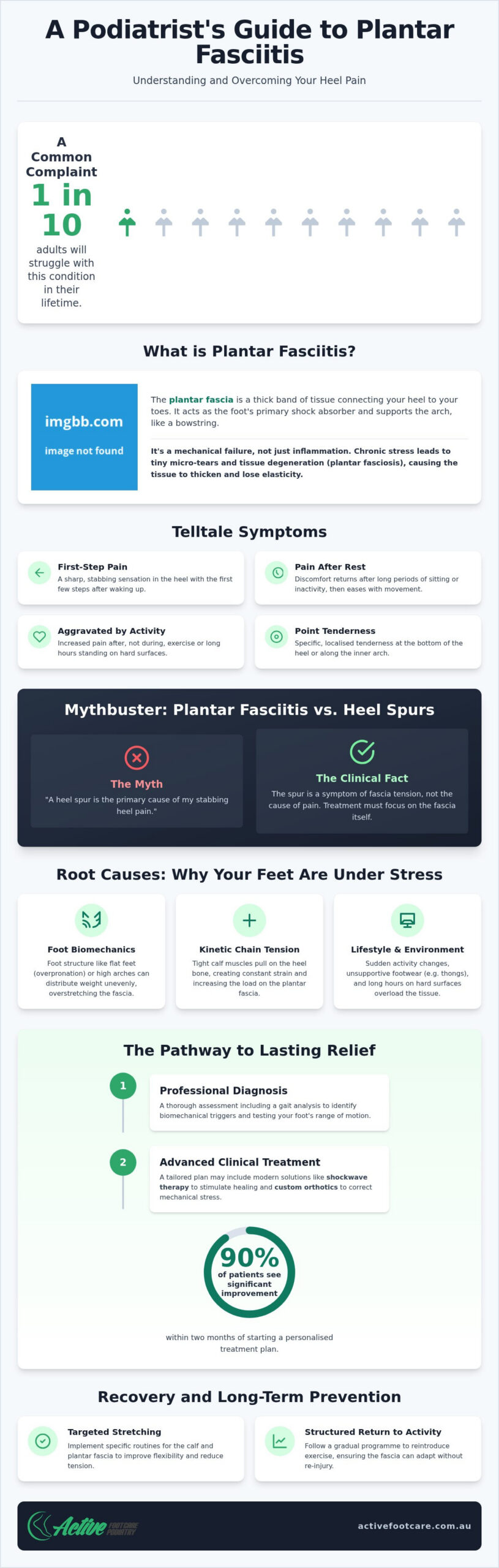
You swing your legs out of bed, expecting a normal start to the day, but the moment your heel touches the floor, a sharp, stabbing sensation shoots through your foot. If those first few steps feel like walking on broken glass, you aren’t alone. Approximately 1 in 10 adults will struggle with Plantar Fasciitis at some point, a condition that often turns a simple walk to the kitchen into a painful ordeal. Whether you’re a busy professional in Bankstown or an active parent in Liverpool, this persistent heel pain can make exercise or standing at work feel nearly impossible.
We understand how confusing it’s to navigate choices between new shoes, off-the-shelf orthotics, or the fear of needing surgery. Our team is here to provide clinical clarity and empathetic guidance. In this article, you’ll discover the underlying causes of your discomfort and the most effective clinical treatments to finally resolve your chronic pain. We’ll preview how modern solutions like shockwave therapy and personalised gait analysis can help you achieve a pain-free morning routine. With 90% of patients seeing significant improvement within two months of starting a tailored plan, a return to your active lifestyle is closer than you think.
Key Takeaways
- Understand the mechanical role of your heel’s connective tissue and how it functions as a critical shock absorber for every step you take.
- Identify the biomechanical triggers, such as overpronation or improper footwear, that often cause stress when walking on hard Sydney surfaces.
- Learn about the professional assessment methods used to confirm a diagnosis of Plantar Fasciitis and why testing your range of motion is essential for recovery.
- Explore a tiered approach to healing that includes immediate relief techniques alongside advanced clinical options like custom orthotics and shockwave therapy.
- Discover how to maintain your mobility through targeted stretching routines and a structured return-to-activity programme designed to prevent re-injury.
What is Plantar Fasciitis? Understanding Your Heel Pain
To understand why your heel feels so tender, we first need to look at the anatomy of your foot. The plantar fascia is a robust, thick band of connective tissue that stretches from your heel bone to the base of your toes. In clinical terms, What is Plantar Fasciitis describes the stress and structural changes that occur within this vital tissue. It’s designed to act as a structural “bowstring,” supporting the natural arch of your foot and absorbing the impact every time your foot strikes the ground.
While the suffix “itis” traditionally suggests inflammation, modern podiatry recognises that chronic heel pain is often more about tissue degeneration. When the fascia is consistently overloaded, it develops tiny micro-tears that the body struggles to repair. Over time, this leads to a condition called plantar fasciosis, where the tissue loses its elasticity and becomes thickened and painful. This isn’t just a minor ache; it’s a mechanical failure of your foot’s primary shock absorber.
Common Symptoms: Is it Plantar Fasciitis or Something Else?
The most distinctive sign of this condition is a sharp, stabbing sensation during your first steps of the day. This happens because the fascia tightens overnight, and those first movements cause it to stretch abruptly. You might also notice:
- Pain that gradually eases as you move around but returns after you’ve been sitting for a while.
- Increasing discomfort after a long shift standing on hard surfaces, which is a frequent complaint from our patients in Bankstown and Liverpool.
- Point-specific tenderness right at the bottom of the heel or along the inner arch.
Plantar Fasciitis vs. Heel Spurs: Clearing the Confusion
It’s a common misconception that a bony growth is the primary cause of heel pain. A heel spur is a calcium deposit that forms where the fascia pulls on the bone, often developing as a response to chronic tension over many months. While these spurs show up on X-rays, they are frequently asymptomatic. Many people carry these deposits without ever feeling a twinge of pain. At our clinics, we focus on the health of the plantar fascia itself, because the spur is merely a symptom of the underlying mechanical stress rather than the source of the stabbing sensation.
Root Causes: Why Your Feet Are Under Stress
Heel pain doesn’t just appear without reason; it’s usually the result of cumulative mechanical stress. While many factors contribute to the symptoms and causes of plantar fasciitis, the root of the problem often lies in how your foot interacts with the ground. In areas like Liverpool and Bankstown, where many of our patients work in retail, healthcare, or warehousing, spending eight hours a day on unforgiving concrete floors creates a perfect storm for tissue overload.
One of the most overlooked contributors is the tension in your kinetic chain. Tight calf muscles act like a tether, pulling on the heel bone and increasing the constant strain on the plantar fascia. This tension makes it harder for your foot to flex naturally, forcing the fascia to take on more load than it was ever designed to handle, which is a leading driver of Plantar Fasciitis. Many patients find that clinical soft tissue work helps manage this tension; for instance, you can learn more about San Diego Medical Massage and their specialised approach to pain relief. When this mechanical strain is combined with the hard pavements of Sydney, the tissue eventually reaches a breaking point.
The Role of Biomechanics and Foot Structure
Your foot’s unique shape dictates how weight is distributed with every step. If you have “flat feet”, your arch collapses inward during each stride, which overstretches the fascia and causes micro-tears. Conversely, high arches often lack the necessary shock absorption, sending the full force of every impact directly into your heel. This is why a professional gait analysis is so critical. We use this assessment to map exactly how your feet move, allowing us to identify the subtle misalignments that are driving your discomfort.
Lifestyle and Activity Triggers
Sudden changes in your routine can also trigger a painful flare-up. We often see “weekend warriors” who have increased their running kilometres too quickly or started a new exercise programme without supportive footwear. In the Sydney heat, it’s tempting to live in thongs or worn-out runners, but these offer zero arch support on hard surfaces. As we age, the natural fat pad on our heel thins and our tissues lose elasticity, making proper support even more vital. If you’re struggling to stay on your feet, our team at Active Footcare can help you identify these triggers before they lead to chronic injury.
Professional Diagnosis: Getting to the Bottom of the Pain
Walking into a clinic with chronic heel pain can feel overwhelming, especially when you’ve already tried various “quick fixes” without success. At Active Footcare, we believe an accurate diagnosis is the first step toward lasting relief. We don’t just focus on the symptoms; we take the time to listen to your specific pain history. Understanding whether your pain is sharper in the morning or worsens after a long shift at a Liverpool warehouse helps us build a complete picture of your condition. This “Compassionate Expert” approach ensures you feel heard and understood throughout the clinical process.
Our assessment begins with a thorough physical examination. We carefully palpate the heel and arch to locate the exact source of tenderness and assess your foot’s range of motion. We pay close attention to the flexibility of your ankle and the strength of your intrinsic foot muscles. While most cases are diagnosed through this clinical exam, we occasionally recommend an ultrasound or X-ray if we suspect underlying issues like a stress fracture or significant tissue tearing. These tools are valuable, but they’re secondary to the insights gained from watching how your feet function in real time.
The Importance of Biomechanical Assessment
Your gait is the blueprint of your foot health. During your consultation, we evaluate how your foot moves through the different phases of walking to see if your arch is collapsing or if your weight is shifting unevenly. We also look for muscle imbalances or joint restrictions in your legs that might be forcing your fascia to work harder than it should. These findings are essential for creating a tailored heel inside pain treatment plan that addresses your unique anatomy rather than offering a one-size-fits-all solution.
Ruling Out Other Causes of Heel Pain
It’s vital to remember that not all heel pain is Plantar Fasciitis. Our diagnostic process is designed to rule out “imposter” conditions that require very different management strategies. These may include:
- Fat Pad Atrophy: The thinning of the natural cushioning under your heel bone.
- Tarsal Tunnel Syndrome: A nerve entrapment that can cause burning or tingling sensations.
- Achilles Tendonitis: Inflammation of the tendon that connects your calf muscles to your heel.
By differentiating these conditions early, we prevent you from wasting time and resources on incorrect treatments. Accessing evidence-based Plantar fasciitis treatments requires this level of precision. Whether you’re visiting us in Bankstown or Liverpool, our goal is to provide a clear diagnosis that explains the root cause of your discomfort, giving you the confidence to move forward with a proven recovery programme.
Treatment Pathways: From Home Care to Advanced Therapy
Treating Plantar Fasciitis effectively requires a multi-layered strategy that addresses both the immediate pain and the underlying mechanical cause. We generally categorise care into three distinct phases: immediate relief for acute flare-ups, long-term mechanical correction, and advanced regenerative healing. While rest and ice are helpful starting points, relying on them alone often leads to a cycle of recurring pain. Our goal is to move you through these phases quickly so you can regain your mobility without the need for invasive surgery.
For those experiencing a sudden increase in discomfort, the “RICE” method (Rest, Ice, Compression, Elevation) remains a standard first-line approach. Applying ice for 15 minutes several times a day can help settle the area, but it’s vital to remember this only masks the symptoms. Clinical studies indicate that 90% of patients see significant improvement within two months when they move beyond home care into a professional, personalised treatment plan. This high success rate highlights why early clinical intervention is so valuable for long-term health.
Advanced Clinical Solutions: Shockwave and Prolotherapy
When chronic pain persists for more than six months, we often recommend advanced interventions that stimulate the body’s natural healing response. Shockwave Therapy is a highly effective, non-invasive option that uses acoustic waves to increase blood flow and tissue repair within the fascia. Clinical research shows a success rate of 60-80% for chronic cases, making it a gold-standard alternative to more invasive measures. For patients seeking regenerative options, prolotherapy for foot pain involves targeted injections that encourage the repair of weakened connective tissues. These modern therapies allow us to resolve the underlying damage without the risks associated with corticosteroid injections, which can sometimes weaken the tissue over time.
Custom Orthotics: Support Where You Need It
While off-the-shelf inserts might provide temporary cushioning, they rarely account for the unique architecture of your foot. If your arch collapses or your heel strikes at an odd angle, a generic insert won’t fix the mechanical imbalance. This is where custom orthotics become essential. We design these specialised devices based on your gait analysis to realign the foot and permanently offload the pressure on the plantar fascia. By correcting the way your foot interacts with the ground, we can stop the repetitive micro-tearing that causes your pain. If you’re ready to stop managing symptoms and start fixing the root cause, you can book a consultation with our Liverpool or Bankstown team to discuss a tailored recovery plan.
Recovery and Prevention: Staying Pain-Free in Sydney
Resolving the acute phase of Plantar Fasciitis is a significant victory, but the real success lies in preventing a relapse. Many patients in Sydney make the mistake of jumping back into high-impact exercise the moment the stabbing pain subsides. We advocate for a “progressive loading” approach. This means slowly increasing your walking distance or intensity over several weeks, allowing the repaired tissue to strengthen without being overwhelmed again. Consistency during this transition is what separates a temporary fix from a permanent recovery.
Daily maintenance is your best defence against recurring discomfort. Incorporating specific stretches into your morning routine can make a world of difference to your foot’s resilience. We recommend focusing on three key areas:
- Calf stretches: Lean against a wall with one leg back to release the tension that pulls on your heel bone.
- Arch rolls: Use a firm ball or a frozen water bottle under your foot to gently massage the fascia and reduce tightness.
- Toe flexions: Sit and use your toes to scrunch a towel toward you, which helps strengthen the intrinsic muscles that support your arch.
Your choice of shoes acts as the first line of support for your clinical treatment. For our patients working long shifts in Liverpool or Bankstown, we recommend footwear with a firm heel counter and adequate arch support. It’s best to avoid wearing completely flat thongs or worn-out runners that have lost their structural integrity. Regular podiatry check-ups every six to twelve months allow us to monitor your gait and ensure your custom orthotics are still providing the correct level of correction as your activity levels change.
Mobile Podiatry: Care for Those with Limited Mobility
We recognise that for some, the severity of heel pain or other health conditions makes travelling to a clinic difficult. To ensure everyone has access to professional care, we offer a podiatrist home visit Sydney service. This is particularly beneficial for NDIS participants and aged care residents in the Moorebank, Liverpool, and Bankstown regions. Receiving a professional assessment and treatment in the comfort of your own home removes the stress of travel while maintaining the same high standard of clinical expertise you would receive in our rooms.
Next Steps: Taking Action Against Heel Pain
If you’ve been experiencing heel pain for more than two weeks, it’s time to seek professional advice. Early intervention is the most effective way to reduce your overall recovery time and prevent Plantar Fasciitis from becoming a chronic, debilitating issue. You don’t have to navigate this journey alone. At Active Footcare, we’re dedicated to being your partner in mobility, helping you move from a state of uncertainty toward a future of pain-free walking and a more active lifestyle.
Step Into a Future Without Heel Pain
Living with the constant shadow of foot discomfort is exhausting, but it doesn’t have to be your permanent reality. By understanding that Plantar Fasciitis is a mechanical challenge requiring a clinical solution, you’ve already taken the most important step toward recovery. Our approach at Active Footcare focuses on identifying your unique gait patterns and applying modern, evidence-based treatments to restore your foot health and long-term stability.
Led by Principal Podiatrist Dr. Maher Said, our team specialises in advanced interventions like Shockwave Therapy and the design of precision custom orthotics. We’re also proud to be an NDIS registered provider, offering the convenience of home visits across the Liverpool and Bankstown regions for those who find it difficult to reach our clinic. Whether you’re dealing with a new flare-up or chronic pain that’s persisted for years, we’re here to provide the expert care and empathetic support you deserve.
Book a consultation with Active Footcare today for expert heel pain relief and let us help you rediscover the joy of pain-free movement. Your journey back to mobility starts with a single, supported step.
Frequently Asked Questions
How long does it take for plantar fasciitis to heal with treatment?
Most patients experience significant relief within two months of starting a professional treatment plan. While the healing timeline varies based on the severity of the tissue damage, consistent adherence to stretching and orthotic use speeds up the process. We monitor your progress closely to ensure your Plantar Fasciitis is resolving as expected. Early intervention is key, as chronic cases that have persisted for over six months may require more advanced regenerative therapies.
Can I still exercise if I have plantar fasciitis?
You can stay active, but we recommend switching to low-impact exercises like swimming or cycling during the initial healing phase. High-impact activities such as running or jumping can aggravate the micro-tears in your fascia and delay recovery. Once your pain levels decrease, we’ll guide you through a gradual return-to-sport programme. This ensures your foot is strong enough to handle increased loads without risking a painful relapse or further injury.
Does Medicare or private health cover podiatry for heel pain?
Yes, many patients can access rebates for their consultations. In 2026, the Medicare rebate for eligible podiatry services under a Chronic Disease Management plan is $63.40. Most private health insurance providers also offer coverage for podiatry under their “extras” policies, which can significantly reduce out-of-pocket costs for assessments and custom orthotics. We suggest checking with your specific fund to confirm your level of cover for clinical treatments and medical devices.
Are custom orthotics worth the investment for plantar fasciitis?
Custom orthotics are a valuable investment because they provide precise mechanical correction tailored to your unique foot structure. Unlike generic store-bought inserts, our orthotics are designed using professional gait analysis to realign your foot and permanently offload the pressure on your fascia. This targeted support addresses the root cause of your pain rather than just providing temporary cushioning, making them a critical component for long-term recovery and prevention.
What happens if I leave my plantar fasciitis untreated?
Ignoring the symptoms often leads to chronic heel pain that becomes much harder to treat over time. When you change the way you walk to avoid pain, you risk developing secondary injuries in your knees, hips, or lower back. Untreated Plantar Fasciitis can also progress into plantar fasciosis, a degenerative state where the tissue loses its structural integrity. Seeking professional help early prevents these complications and keeps you mobile.
Is shockwave therapy painful for treating heel issues?
Shockwave therapy is a non-invasive procedure that some patients find mildly uncomfortable, but it’s generally well-tolerated. The treatment uses acoustic waves to stimulate blood flow and trigger the body’s natural healing response in the heel. Each session is relatively short, and we can adjust the intensity to suit your comfort level. With a clinical success rate of 60-80% for chronic cases, it’s a preferred option for those seeking effective, surgery-free relief.
Can plantar fasciitis be cured permanently?
While “cure” is a strong word, the condition can certainly be resolved permanently by addressing the underlying mechanical failures. By combining gait correction, appropriate footwear, and tissue-strengthening exercises, we can stop the repetitive stress that causes the injury. Our goal at Active Footcare is to provide you with the tools and clinical treatments necessary to maintain healthy, resilient feet, ensuring you can walk and exercise without the fear of pain returning.
How do I know if I need a podiatrist home visit?
A home visit is ideal if your heel pain is so severe that travelling to our Liverpool or Bankstown clinics is difficult. This service is also a vital resource for NDIS participants, aged care residents, or those with limited transport options in Moorebank and surrounding suburbs. We bring our clinical expertise and diagnostic tools directly to your doorstep, ensuring you receive high-quality care in a comfortable and convenient environment.