


If you’re exploring NDIS funding for high-risk foot care Moorebank, it can be difficult to connect a clinical concern with disability support needs, especially when you’re worried about a problem getting worse. NDIS funding isn’t automatic, but clear evidence linking the support to the participant’s disability and goals can help explain why it may be relevant.
A podiatrist’s assessment can describe foot health, functional limitations and the care recommended. This information may help the participant and their support team consider whether the request relates to their disability, supports their goals and represents value for money.
This guide explains what to document, how to describe foot-care needs in relation to daily activities, and what to consider when discussing support with a plan manager or NDIS contact. Active Foot Care provides NDIS podiatry services and podiatrist home visits in Moorebank, including support for self-managed and plan-managed participants. The local service area also includes Liverpool, Bankstown, Sydney and Campbelltown.
Key Takeaways
- High-risk foot care is a clinical concern that needs individual assessment; it doesn’t guarantee NDIS funding.
- Understand how foot-care needs may relate to disability support, plan goals and everyday function.
- Learn what a podiatrist can document to explain foot-care needs and recommended support.
- Compare clinical concerns, daily impacts and relevant plan details before discussing next steps.
- Active Footcare’s NDIS podiatry and home visits in Moorebank can provide access to an assessment.
High-risk foot care in Moorebank: what it means for NDIS participants
High-risk foot care is a clinical concern assessed individually by a podiatrist. It is not a funding category or a guarantee of NDIS funding. The term describes foot-health needs that may require closer professional assessment, based on a person’s circumstances and clinical findings. A concern may be relevant to an NDIS discussion if it relates to disability support needs and affects everyday function. Funding decisions depend on the applicable NDIS criteria.
A podiatry assessment is different from general foot-care advice. A podiatrist can examine foot health, assess changes and explain whether further care is appropriate. General information can help with awareness, but it can’t determine an individual’s clinical needs or establish whether NDIS funding applies. The National Disability Insurance Scheme (NDIS) provides broader background on the scheme; a participant’s foot-care request still needs to be considered in the context of their plan and circumstances.
For an overview of the person-centred support context, watch this video:
What can make foot care higher risk?
Risk can’t be confirmed with a checklist at home. During an assessment, a podiatrist may consider a person’s health history and changes in sensation, skin, nails or comfort. Reduced sensation, for example, can make it harder to notice pressure or an injury. A skin or nail change may also need closer attention. These details help the clinician assess the whole picture rather than relying on one symptom alone.
Note changes, when they began and whether they’re getting worse. New or worsening symptoms need appropriate clinical attention, but urgency depends on what’s happening and the person’s health. A health professional can advise how promptly an assessment is needed. If a concern feels sudden or severe, seek timely professional advice rather than waiting for an NDIS funding discussion to be resolved.
Why connect foot health with everyday function?
Foot discomfort can affect more than walking. It may make standing to prepare a meal uncomfortable, reduce confidence on stairs, or make transfers between a bed, chair and mobility aid more difficult. A participant might also need more time or assistance to get ready, move around at home or take part in a usual activity. Describe the specific task and what changes when the foot concern is present.
These examples make clinical information more useful in an NDIS conversation. Instead of saying only “my feet hurt”, explain how the concern affects mobility, routines or participation, and connect this to the participant’s goals. The relevance of support varies between people. A podiatrist can assess the foot concern and document findings and recommended care without promising a particular result. This evidence can help clarify whether NDIS funding for high-risk foot care Moorebank may be relevant to the participant’s needs and plan.
How clinical evidence can support an NDIS foot-care request
A clear clinical record can explain why foot care is being requested and how the concern affects the participant’s life. A podiatrist can assess the feet, document relevant findings, discuss functional effects and recommend care suited to the person’s circumstances. This gives the participant and their support team specific information to consider alongside the plan, rather than relying on a diagnosis or general statement alone.
A clinical report can inform an NDIS funding decision, but it cannot guarantee that a support will be funded. The funding decision is separate from the podiatrist’s clinical role. Evidence describes the need; the request must still be considered against the participant’s plan, goals and applicable NDIS criteria.
What information may be useful to document?
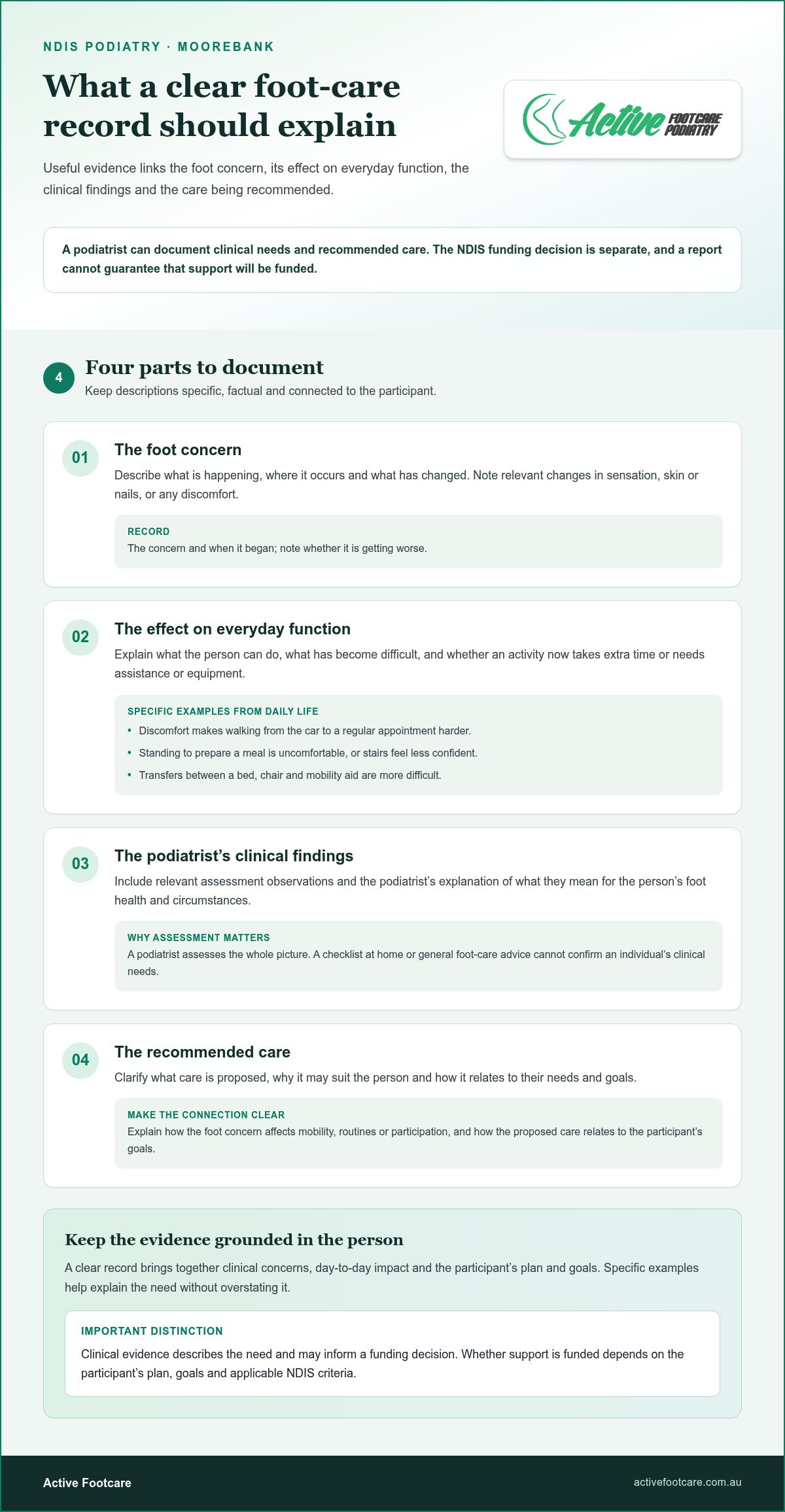
There’s no single report format that guarantees a particular outcome. Useful information is specific, clear and connected to the participant. A podiatrist may record assessment findings and explain the clinical reasoning behind a recommendation. The participant can also note changes over time and describe what has become harder to do.
- The concern: describe the foot issue, where it occurs and any changes noticed, such as altered sensation, skin or nail changes, or discomfort.
- The functional effect: explain what the person can do, what is difficult, and whether they need extra time, assistance or equipment for an activity.
- The clinical findings: include relevant assessment observations and the podiatrist’s explanation of their significance.
- The recommendation: clarify what care is proposed, why it may be suitable and how it relates to the participant’s needs and goals.
Keep descriptions factual. Instead of writing only “walking is difficult”, note that foot discomfort makes it harder to walk from the car to a regular appointment, or that the person needs support to complete a usual household task. Specific examples make the impact easier to understand without overstating it.
How can podiatry findings relate to participant goals?
Goals are personal, so connect clinical information to what matters to the participant. If a goal involves attending a local group, explain whether foot concerns affect getting ready, moving around the venue or staying for the activity. If the goal is to manage more of a daily routine independently, describe which foot-related tasks are difficult and what support is currently needed.
A podiatrist can explain recommendations in plain language for the participant and their support team, including assessment findings and how proposed care relates to daily function. The aim is clarity, not a promise that care will prevent complications or achieve a particular outcome. For a discussion about NDIS funding for high-risk foot care Moorebank, this evidence can help frame the request around the person’s circumstances.
Active Footcare’s NDIS podiatry service provides individual assessments for participants in Moorebank. A podiatry assessment and care discussion can help clarify clinical concerns and the information that may be useful to share with the participant’s support team.
Compare your NDIS plan and foot-care needs before arranging support
Before booking care, compare the podiatry recommendation with the participant’s current plan and circumstances. This helps identify what needs clarification before support is arranged. A clinical recommendation explains the foot-care need; it doesn’t establish that the NDIS will fund it. Funding arrangements depend on individual plan details and current NDIS guidance, so don’t assume that the same support category applies to every podiatry service.
Use this table to organise the conversation. It’s a prompt for reviewing the situation, not a funding decision or a substitute for checking the participant’s plan.
| Area to compare | What to consider | Next discussion |
|---|---|---|
| Clinical need | What foot concern has the podiatrist assessed, and what care is recommended? | Clarify the clinical reasoning and what the proposed support involves. |
| Functional impact | How does the concern affect mobility, daily routines or participation? | Describe the specific activities affected and their connection to the participant’s goals. |
| Plan information | What goals and support details are set out in the current plan? | Review the plan and check how its funding is managed. |
| Next conversation | What remains unclear about the fit between the recommendation and the plan? | Discuss those points with the relevant plan manager or support coordinator, if applicable. |
Read plan information alongside the recommendation
Look at the plan as a whole rather than matching podiatry to a budget label based on its name alone. Consider the participant’s stated goals, support details and plan management arrangements, then compare these with the recommendation. If a plan manager or support coordinator is involved, they may help clarify the plan information and next steps. Review current NDIS guidance for applicable terminology and rules.
Keep clinical advice and funding decisions distinct
A podiatrist assesses foot concerns and explains recommended care. The NDIS funding decision is separate and depends on the participant’s circumstances and current requirements. A recommendation can support a discussion, but it doesn’t mean funding is approved or that a particular budget will cover the service. Avoid relying on assumed categories, past decisions or another participant’s plan as a guide to your own.
For a discussion about NDIS funding for high-risk foot care Moorebank, gather the relevant plan details and clinical information before arranging support. Active Footcare provides NDIS podiatry in Moorebank, including home visits, so a podiatrist can assess foot concerns and discuss care in the context of individual needs.
Reviewing the plan first can make the next conversation clearer. If you’re preparing for a clinical discussion, an NDIS podiatry assessment can help document the foot-care need and relevant functional concerns.
Prepare for high-risk foot care in Moorebank: a practical checklist
Preparation can make a podiatry appointment more focused and help you explain what support is being considered. Before discussing NDIS funding for high-risk foot care Moorebank, bring together relevant plan details, notes about the foot concern and any clinical information already available. You don’t need every answer ready; clear examples of what’s changed and what’s difficult are a useful starting point.
Work through these steps before the appointment:
- Review the plan. Note the participant’s goals and any support or funding details that may be relevant. If a plan manager or support coordinator is involved, record questions for them.
- Describe the concern. Write down what has changed in the feet, when it started and whether it varies. Include changes in comfort, sensation, skin or nails without trying to diagnose the cause.
- Track everyday effects. Note specific activities affected, such as walking around the home, standing to prepare food, transfers or getting out to a regular activity. Include what assistance is needed, if any.
- Gather clinical information and questions. Bring existing recommendations or relevant health information, and list what you’d like to understand about assessment, suitable care and follow-up.
These notes help the podiatrist understand the concern in context and give the participant a practical way to describe their needs. For broader information about home-based therapy, the NDIS mobile podiatry guide outlines the role of mobile podiatry and home therapy services.
What to expect from a Moorebank home visit
A home visit brings podiatry assessment to the participant’s home. This may make access more practical for someone who finds travel difficult or whose circumstances make an appointment away from home challenging. The podiatrist can assess foot concerns, discuss clinical findings and talk through care suited to the participant’s needs. The assessment informs the clinical conversation; it doesn’t determine whether NDIS funding will apply.
Before the visit, consider what would help the participant feel comfortable discussing their feet and everyday routines. They may want a support person present or notes within reach. Share the participant’s goals and any changes in mobility or daily activities that matter to them. For more detail about what a home appointment can involve, see the Sydney podiatrist home-visit guide.
Active Footcare provides NDIS podiatry and podiatrist home visits in Moorebank. If a home-based assessment would make access more manageable, arrange a podiatry discussion with Active Footcare to talk through the foot concern and relevant care needs.
Access Active Footcare NDIS podiatry in Moorebank
Once you’ve gathered information about the foot concern and the participant’s plan, a local podiatry discussion can help clarify the clinical next step. Active Footcare provides NDIS podiatry services and podiatrist home visits in Moorebank. The podiatrist can assess foot concerns, consider how they relate to everyday needs and discuss suitable care based on individual circumstances.
High-risk foot care is not a funding guarantee. Whether NDIS funding may apply depends on the participant’s plan and current NDIS guidance. A clinical assessment can explain the foot-care need, but it doesn’t decide eligibility or guarantee that a particular support will be funded. Keep the clinical conversation and funding discussion connected, while treating them as separate steps.
How Active Footcare supports NDIS participants
Foot concerns can be easier to discuss when an assessment considers the person, not just their symptoms. The podiatrist can listen to what has changed, assess the feet and talk through care relevant to the participant’s needs. If mobility or daily activities are affected, explaining those practical details helps shape a more useful clinical discussion.
A home visit may make access to podiatry more practical for a participant who finds travelling to an appointment difficult or whose circumstances make care at home preferable. For NDIS participants in Moorebank, Active Footcare’s home-visit service brings podiatry assessment into the home. The clinician can discuss findings and recommendations with the participant and, where appropriate, their family or support team. Care is individual, with no assumed outcome or funding decision.
Use the information already gathered to guide the conversation: the participant’s current plan details, relevant goals, foot-care concerns and any existing clinical recommendations. If funding is being considered, review the plan and current NDIS guidance as well. This gives everyone involved a shared starting point for discussing the participant’s needs.
Take the next step towards local podiatry care
Participants, families and support coordinators can discuss the foot-care concern with Active Footcare and explain what the participant hopes to address. Having relevant plan information and examples of how foot health affects everyday function nearby can make the conversation more focused. You don’t need to resolve every funding question before raising a clinical concern; the podiatrist can assess the feet and discuss care, while funding remains subject to the participant’s plan and current NDIS requirements.
If you’re ready to talk through local podiatry care, contact Active Footcare to discuss podiatry care in Moorebank. A clear conversation can help identify an appropriate clinical next step for the participant.
Take a considered next step for foot health
A foot concern doesn’t need to be fully explained before you start a conversation. Note what you’d most like help with, whether that’s understanding a change, discussing comfort or making everyday movement easier. This gives the appointment a practical focus and keeps the participant’s priorities at the centre of care.
If you’re weighing up NDIS funding for high-risk foot care Moorebank, keep the clinical discussion grounded in the participant’s needs and consider funding separately against their plan and current NDIS guidance. Bring questions about what an assessment involves and what information may help with planning.
Active Footcare provides NDIS podiatry services and podiatrist home visits in Moorebank, with local relevance for participants in Liverpool, Bankstown, Sydney and Campbelltown. Participants, families and support coordinators can start with a discussion about the foot-care concern and the assessment that may be helpful. Discuss NDIS podiatry care in Moorebank with Active Footcare.
Frequently Asked Questions
Is high-risk foot care covered by NDIS funding?
It may be, depending on the participant’s circumstances, plan and current NDIS requirements. A podiatrist can assess the concern and explain its effects, while the funding decision is considered separately. For example, note whether a foot issue affects a goal such as moving around the home more independently, then compare that need with the plan. Review current official NDIS guidance before making arrangements, as high-risk status alone doesn’t mean funding is approved.
Can I use NDIS funding for a podiatrist home visit in Moorebank?
A home visit may make podiatry more accessible for someone who needs care at home, but whether NDIS funding applies depends on their plan and current requirements. Active Footcare provides podiatrist home visits in Moorebank. Before arranging one, describe why a home appointment suits the participant’s circumstances, such as difficulty travelling, and discuss the proposed care and relevant plan details with their care team.
What foot problems are considered high risk?
There isn’t one description that determines every person’s level of foot risk. A podiatrist considers the person’s health, symptoms, examination findings and functional needs together. Changes in sensation, skin, nails or comfort may warrant professional assessment, but they don’t allow a reader to diagnose themselves. If symptoms are sudden or severe, seek timely medical care appropriate to the situation rather than relying on an online guide to judge urgency.
How much NDIS funding can be used for podiatry?
There’s no single amount that applies to every participant. What may be available depends on the individual plan, its support arrangements and current NDIS requirements. Don’t estimate a budget from another person’s experience or assume a particular amount is available. Review the plan’s relevant details and discuss the proposed clinical support with a plan manager or support coordinator, where relevant, before making arrangements. This can help clarify which funding questions need an answer.
What information should I provide when requesting NDIS-funded foot care?
Share a clear account of the foot concern, its effect on function, relevant clinical findings and any recommended support. A short record can help: note when a change occurs, what activity is affected and what assistance is needed. A podiatrist can explain assessment findings in relation to daily function and personal goals. The information needed varies by participant, and no single report or document guarantees a funding decision.
What happens if my NDIS plan does not clearly mention podiatry?
A plan that doesn’t name podiatry doesn’t, by itself, establish whether support can or can’t be funded. Review the plan’s goals and support details, then consider how the clinical recommendation relates to the participant’s circumstances. A podiatrist can explain the foot-care need; a plan manager or support coordinator may help interpret plan information. Check current official NDIS guidance before deciding how to proceed, as requirements can change. To discuss a podiatry assessment in Moorebank, contact Active Footcare.