


What if the primary barrier to your social life in Western Sydney isn’t a lack of transport, but the sharp, persistent foot pain that makes every step a challenge? We understand that for many NDIS participants in areas like Liverpool and Bankstown, the journey to a clinic can feel as taxing as the condition itself. You deserve to move through your community with confidence; however, confusion over ndis funding for custom orthotics often leaves essential support out of reach.
It’s common to feel overwhelmed by the technicalities of Capital versus Capacity Building budgets, especially when your priority is simply pain-free movement. In this 2026 guide, we’ll show you how to maximise your funding to access expert podiatry care that improves your stability and prevents falls. You’ll discover how a registered provider handles the complex documentation and Service Agreements for you, while offering the convenience of mobile home visits across Campbelltown and Moorebank to ensure your path to better mobility is as smooth as possible.
Key Takeaways
- Learn how NDIS podiatry focuses on capacity building to help you move more freely and participate in your local community.
- Understand how to navigate budget categories to correctly access ndis funding for custom orthotics and clinical consultations.
- Discover the benefits of professional home visits for participants who find travelling to a clinic in Western Sydney difficult.
- Find out how to align your foot health needs with your NDIS mobility goals to ensure your plan provides the right support.
- See why a registered provider is essential for managing the clinical documentation and Service Agreements required for your peace of mind.
Understanding NDIS Foot Care Services: More Than Just General Podiatry
NDIS podiatry is a specialised clinical discipline. It’s about more than just basic comfort; it’s about your ability to move through your world safely and with dignity. While many people think of podiatrists primarily for basic nail care, the National Disability Insurance Scheme (NDIS) views these services as vital interventions for lower limb health and functional mobility. We focus on how your feet and legs function as a foundation for your entire body.
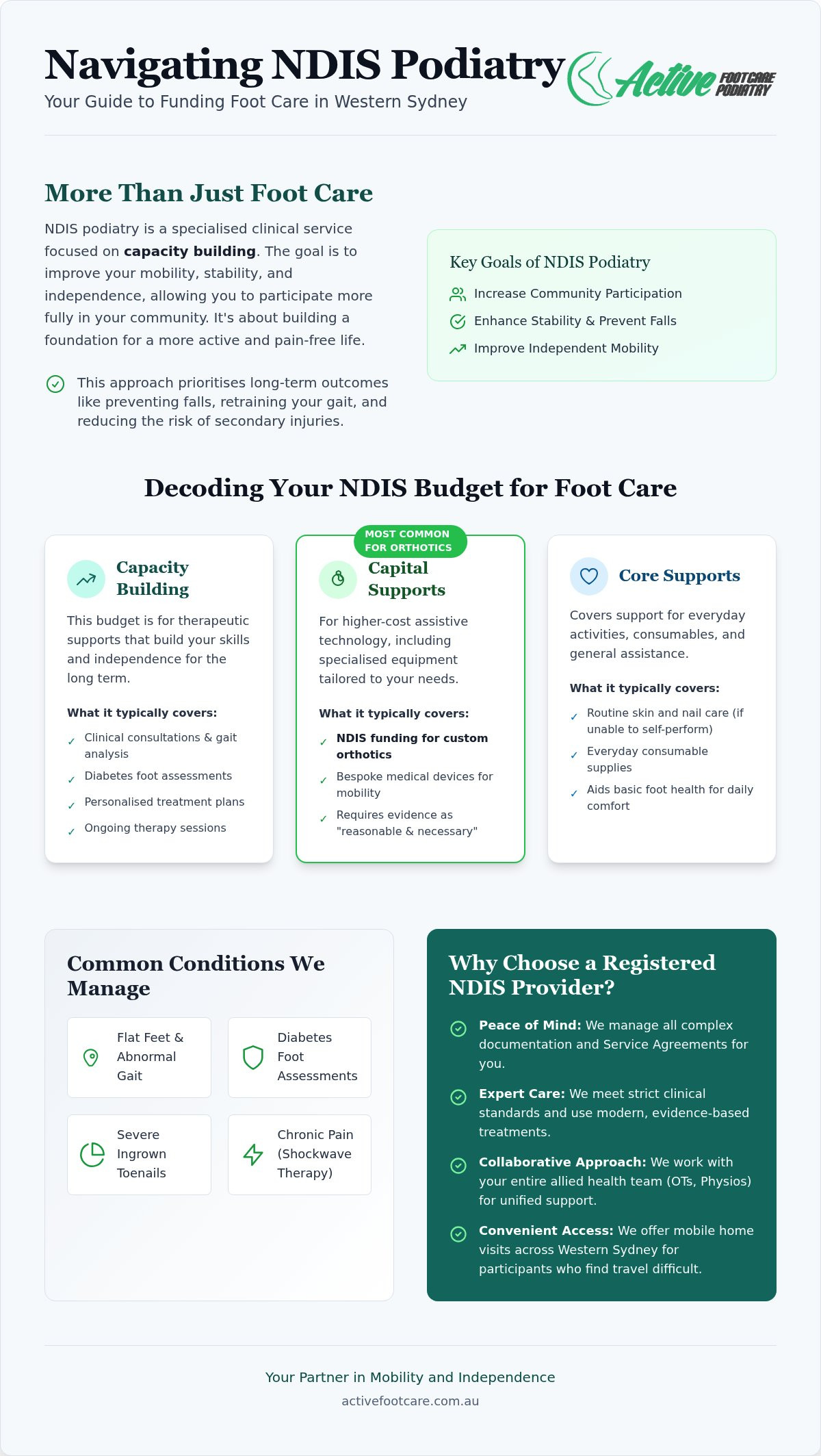
The framework has shifted away from simple maintenance care. Instead, it focuses on capacity building. This means our goal is to help you gain the skills and physical stability needed to live independently. For many participants, securing ndis funding for custom orthotics is a key part of this journey, as these devices provide the structural support required for gait retraining and falls prevention. We prioritise outcomes that allow you to walk further, stand longer, and engage in the activities you love without the constant distraction of physical discomfort.
Key Conditions Managed Under NDIS Podiatry
We manage a wide range of biomechanical issues that can limit your social participation. If you struggle with flat feet or abnormal gait patterns, our team uses targeted interventions to correct your alignment. We also provide critical diabetes foot assessments to prevent secondary complications that might otherwise lead to hospitalisation. Even chronic conditions like severe ingrown toenails are treated with a focus on restoring your ability to walk without pain, ensuring your foot health supports your long-term independence. These treatments are designed to reduce the risk of secondary injuries, keeping you active and safe in your local community. To further support your daily independence, you can learn more about im ok™ to see how a simple safety check-in app can help you stay connected with your support network.
The Role of a Registered NDIS Podiatrist
Choosing a registered provider like Active Footcare means you’re partnering with a team that meets strict clinical standards and audit requirements. We don’t just provide standard care; we use modern, evidence-based treatments like shockwave therapy to address chronic pain at its source. Our podiatrists work as a cohesive unit with your broader allied health team, including Occupational Therapists and Physiotherapists. This collaborative approach ensures that your ndis funding for custom orthotics and other treatments aligns perfectly with the goals set out by your entire support network. By sharing clinical insights with your other therapists, we create a unified path toward your physical recovery.
Navigating Your NDIS Plan: Budget Categories for Foot Care
Understanding where your support comes from is the first step toward better mobility. The NDIS structure can seem complex, but it’s designed to ensure you receive the right type of care for your specific disability needs. Most foot care services fall into three primary categories: Capacity Building, Core Supports, and Capital Supports. Distinguishing between these ensures you don’t run out of funds for essential clinical treatments mid-plan.
Capacity Building vs. Core Funding
Your “Capacity Building – Improved Daily Living” budget is where regular clinical consultations live. This includes your initial gait analysis, diabetes foot assessments, and ongoing therapy sessions. According to the Australian Podiatry Association, these services are vital for participants to manage their long-term health and functional goals. We use this funding to develop your personalised treatment plan and monitor your progress over time through professional assessment.
Routine skin and nail care often fits within your “Core – Consumables” budget if your disability prevents you from performing these tasks yourself. This category covers everyday supplies and maintenance that help you remain comfortable. It’s about ensuring your basic foot health doesn’t become a barrier to your daily routine, especially for those with reduced physical capacity. Capacity Building funding empowers you to increase your daily walking distance and community participation through structured clinical support.
NDIS Funding for Custom Orthotics
When you require specialised equipment, ndis funding for custom orthotics is typically accessed through the “Capital – Assistive Technology” budget. These are considered bespoke medical devices rather than simple off-the-shelf inserts. Because custom orthotics are tailored to your specific biomechanics, the NDIA requires clear evidence that they are a “reasonable and necessary” expense for your situation. Navigating ndis funding for custom orthotics involves more than just a prescription; it requires a strategic alignment with your plan’s goals.
To secure this funding, our podiatrists provide a comprehensive clinical justification report. This document explains how the orthotics will help you achieve your specific plan goals, such as reducing chronic pain or improving your balance to prevent falls. We also include a formal quote for the manufacturing process to satisfy NDIS requirements. The NDIS evaluates these requests based on whether the device is cost-effective and directly related to your disability. If you’re ready to start this process, we can organise a consultation to assess your needs and prepare the necessary documentation for your plan manager or the NDIA.
Clinic vs. Home Visits: Accessing NDIS Podiatry in Liverpool and Bankstown
Choosing between a clinic visit and a home consultation depends largely on your physical needs and the specific goals of your treatment plan. For many participants in Western Sydney, accessibility is the deciding factor. Whether you’re located in Moorebank, Campbelltown, or Bankstown, having flexible options ensures that your foot health is never neglected due to transport challenges. Our team delivers professional care in both settings, adhering to the Official NDIS guidelines for foot care to guarantee high-quality outcomes for every patient.
We maintain the same clinical rigour during a home visit as we do in our modern clinic centres. This means you don’t have to sacrifice the quality of your medical care for the sake of convenience. During these sessions, we often discuss how to best utilise ndis funding for custom orthotics to ensure your equipment fits your home life perfectly. Our goal is to provide a seamless experience that respects your time and your physical boundaries.
The Convenience of Mobile Podiatry
A podiatrist home visit in Sydney offers a practical solution for those with severe mobility restrictions or sensory sensitivities. By bringing the clinic to your living room, we reduce the travel stress and transport costs that often burden participants and their carers. These visits allow us to conduct home environment assessments, where we can recommend safer footwear for indoor use to prevent slips and falls. For those residing in residential facilities, we provide specialised podiatry services for aged care facilities, ensuring seniors on the NDIS receive consistent, high-standard care without leaving their familiar surroundings.
When to Visit the Liverpool or Bankstown Clinic
To further enhance your comfort at home, you might consider how wellness solutions like Elite Massage Chairs can complement your mobility goals by providing targeted relaxation and support for your overall physical well-being.
While mobile care is highly effective, certain advanced treatments are best performed in a controlled clinical environment. Our clinics in Liverpool and Bankstown are equipped with specialised diagnostic tools, such as 3D gait analysis and anti-fungal laser therapy, which require stationary equipment. If your plan involves complex biomechanical assessments to justify ndis funding for custom orthotics, an initial in-clinic appointment is often beneficial. This allows us to use high-precision sensors to capture detailed data about your walking pattern. A dedicated clinical space is also preferred for complex ingrown toenail procedures, where we can ensure the highest levels of sterilisation and surgical precision. Once we establish your long-term care plan in-clinic, many follow-up treatments can then be transitioned to the comfort of your home.
How to Prepare for Your NDIS Podiatry Consultation
Preparation is the key to ensuring your consultation is both productive and stress-free. To begin, please have your NDIS plan details ready, including your unique participant number and a clear understanding of your budget management type. Whether your plan is self-managed, plan-managed, or NDIA-managed determines how we process our Service Agreement and invoices. Having this information on hand allows us to focus entirely on your clinical care from the moment we meet.
We also ask that you prepare a brief summary of your medical history. This should include a list of current medications and any history of chronic conditions like diabetes or circulatory issues, as these factors significantly influence our treatment approach. It’s equally important to have your primary footwear available for inspection. Don’t bring brand-new shoes; we need to see the wear patterns on the pairs you use most frequently. These patterns provide our podiatrists with vital clues about your gait and where you might need ndis funding for custom orthotics to improve your stability.
Setting Functional Goals for Your Service Agreement
The NDIS framework is built around personal goals. When we sit down to draft your Service Agreement, we’ll help you phrase these goals so they align with NDIS funding requirements. Instead of a general request for “better feet,” we focus on functional outcomes like “increasing my walking distance to reach the local shops independently.” By linking your foot health directly to social and community participation, we create a stronger case for the supports you need. We’ll also help you establish a schedule of supports that fits comfortably within your annual funding cycle, ensuring you have consistent care throughout the year.
What Happens During the Initial Assessment?
Your first appointment is a comprehensive review of your lower limb health. We perform neurovascular testing to check your circulation and nerve function, followed by a thorough biomechanical screening. This is where we determine if ndis funding for custom orthotics is a “reasonable and necessary” requirement for your mobility. We’ll also discuss modern treatment options, such as prolotherapy for foot pain, if we believe regenerative healing could assist your recovery. Once the assessment is complete, we draft a detailed report for your Plan Manager or the NDIA, outlining our clinical findings and recommended path forward. If you’re ready to take the first step toward pain-free movement, you can book your initial NDIS assessment here to begin your journey.
Why Choose Active Footcare as Your NDIS Provider in Western Sydney
Active Footcare, under the clinical leadership of Dr Maher Said, has established itself as a trusted partner for NDIS participants across Western Sydney. We believe that professional podiatry is a cornerstone of independence, and our team is dedicated to providing empathetic care that respects your unique journey. By combining medical expertise with a warm, patient-focused approach, we ensure you feel heard and supported at every stage of your treatment. Our practitioners specialise in securing ndis funding for custom orthotics for those with complex mobility needs, ensuring your equipment is perfectly suited to your lifestyle.
We offer a comprehensive range of advanced treatments that go beyond standard care. From shockwave therapy for chronic heel pain to high-precision gait analysis, we use modern technology to deliver measurable results. Alongside our clinical work, we prioritise seamless coordination with your Plan Managers and Support Coordinators. We handle the administrative heavy lifting, from drafting Service Agreements to managing NDIS Portal claims, so you can focus on your physical progress. Our mobile services remain a vital resource for the community, bringing high-quality care directly to doorsteps in Liverpool, Bankstown, and Moorebank.
A Tailor-Made Approach to Disability Support
We don’t believe in one-size-fits-all solutions. Every participant has distinct goals, whether it’s improving balance for safer movement at home or increasing stamina for social outings. Our team customises every treatment plan to match your specific abilities and long-term aspirations. We focus on durable outcomes rather than just temporary symptom relief, aiming to build your physical capacity over time. You’ll always receive friendly, up-to-date advice in clear language, ensuring you feel confident and informed about your foot health decisions.
Booking Your NDIS Consultation Today
Starting your journey with Active Footcare is a straightforward process designed to get you the support you need without delay. First, contact our team to discuss your NDIS plan and mobility goals. We’ll then organise an initial assessment, either at one of our Western Sydney clinics or in the comfort of your home. Once we’ve established your needs, we’ll draft a formal Service Agreement and provide the clinical justification reports required for ndis funding for custom orthotics. We take pride in being a proactive partner in your well-being, ensuring all claims and documentation meet NDIS standards for your peace of mind.
Book your NDIS podiatry assessment here to begin working with a provider who truly understands your mobility needs.
Your Journey to Pain-Free Mobility Starts Here
Achieving your mobility goals requires more than just clinical treatment; it demands a strategic partnership with a provider who understands the NDIS framework. We’ve explored how professional podiatry builds your physical capacity and how navigating the different budget categories ensures you receive the support you deserve. Securing ndis funding for custom orthotics doesn’t have to be a complicated process when you have the right clinical evidence and a dedicated team handling your documentation and Service Agreements.
As an NDIS Registered Provider led by Principal Podiatrist Dr Maher Said, Active Footcare is committed to delivering both medical excellence and empathetic reassurance. Whether you prefer to visit us in Western Sydney or require our expert home visit service across the wider Sydney region, we’re here to help you move with confidence. It’s time to reclaim your independence and participate fully in your community without the burden of chronic foot pain.
Book your NDIS Podiatry Consultation with Active Footcare to take the first step toward a more active and stable future. We look forward to supporting your path to improved health and physical ease.
Frequently Asked Questions
Is podiatry covered by the NDIS for everyone?
Podiatry is funded for participants whose foot or lower limb conditions are a direct result of their disability. The NDIS assesses whether the support is “reasonable and necessary” to help you achieve your specific plan goals. While it isn’t a universal health benefit like Medicare, it provides essential clinical care for those whose mobility or independence is limited by their condition. We help you determine if your needs align with these criteria during your initial assessment.
How do I find a registered NDIS podiatrist in Liverpool or Bankstown?
You can find a registered provider by searching the NDIS Provider Finder tool or by contacting local clinics like Active Footcare directly. Choosing a registered provider in Liverpool or Bankstown ensures the clinic meets the NDIS Quality and Safeguards Commission standards. Our team is fully registered to work with all management types, including NDIA-managed participants. This registration confirms our commitment to clinical excellence and compliant documentation for your Service Agreements and claims.
Can NDIS pay for my custom orthotics and medical footwear?
Yes, the NDIS can cover these costs when they are essential for your mobility and directly related to your disability. We facilitate ndis funding for custom orthotics by providing the required clinical justification reports and formal quotes for your Plan Manager. This equipment usually falls under your Capital – Assistive Technology budget. We ensure every device is bespoke to your needs, focusing on improving your balance and reducing pain for long-term functional success.
Do I need a GP referral to see an NDIS podiatrist?
You don’t strictly need a GP referral to access podiatry through your NDIS plan. However, having a summary of your medical history from your doctor is very helpful for our clinical assessment. While Medicare-funded plans require a GP Management Plan, NDIS participants can book directly with us using their self-managed or plan-managed funds. We simply need your plan details and a signed Service Agreement to begin providing your personalised care in Western Sydney.
What is the difference between NDIS podiatry and a standard foot appointment?
NDIS podiatry focuses specifically on capacity building and achieving your long-term functional goals rather than just providing temporary relief. A standard appointment might focus on general maintenance, but an NDIS consultation involves detailed gait analysis and reporting to the NDIA. We look at how your foot health impacts your ability to live independently and participate in the community. This goal-oriented approach ensures that every treatment session directly supports your broader NDIS plan objectives.
Can I use my NDIS funding for a podiatrist home visit?
Yes, you can use your funding for a mobile service if your disability makes it difficult to travel to a clinic. Our team provides professional home visits across Western Sydney, ensuring you receive high-quality care in a comfortable environment. This is typically funded through your Capacity Building budget. We bring all the necessary clinical equipment to your door, allowing us to perform thorough assessments and treatments without the stress of transport or clinic waiting rooms.
How much of my NDIS budget should I allocate for foot care?
Your allocation depends on your clinical risk level and whether you require specialised equipment. Participants with high-risk conditions like diabetes or severe biomechanical issues may need more frequent consultations. When planning for ndis funding for custom orthotics, you should account for both the assessment time and the cost of the device itself. We can help you estimate these costs during your first appointment so you can discuss the requirements with your Support Coordinator or Plan Manager.
What happens if my NDIS plan doesn’t specifically mention podiatry?
You can often still access podiatry even if it isn’t explicitly named, provided you have funding in flexible categories like Improved Daily Living. If your goals relate to mobility or independence, podiatry is considered a therapeutic support that fits within this category. We recommend checking your plan’s Support Categories for flexibility. If you’re unsure, our team can review your plan details and help you understand how to use your existing budget to access essential foot care.