


Imagine waking up and dreading the simple act of putting on your favourite pair of shoes because of a sharp, throbbing ache in your toe. For many residents across Liverpool and Bankstown, Ingrown Toenails are far more than a minor nuisance; they’re a persistent source of pain that makes every step feel like a gamble. You’ve likely tried soaking your foot at home or even finished a round of antibiotics from the GP, only to find the redness and swelling returning just a few weeks later.
It’s exhausting to deal with a condition that keeps coming back, and we know that the fear of a painful procedure often makes people delay seeking the help they need. This guide explains how professional podiatric care can resolve your discomfort safely and permanently, using gentle techniques that prioritise your peace of mind. We’ll walk you through everything from conservative clinical clearing to expert surgical solutions, showing you exactly how we help you return to a life of physical ease and improved mobility.
Key Takeaways
- Learn why common habits like “bathroom surgery” or tight footwear lead to Ingrown Toenails and how to identify the early signs of infection.
- Discover the benefits of conservative clinical clearing, a gentle method for removing painful nail edges and providing immediate relief without the need for invasive surgery.
- Explore the Partial Nail Avulsion (PNA) procedure, which offers a permanent solution by ensuring the offending nail edge doesn’t grow back.
- Understand the importance of a professional assessment where your podiatrist evaluates your circulation and nail pathology to create a personalised care plan.
- Find out how to access expert podiatry services across Western Sydney, including the convenience of mobile consultations for NDIS participants in Moorebank and Campbelltown.
Understanding Ingrown Toenails: Why They Happen and When to Worry
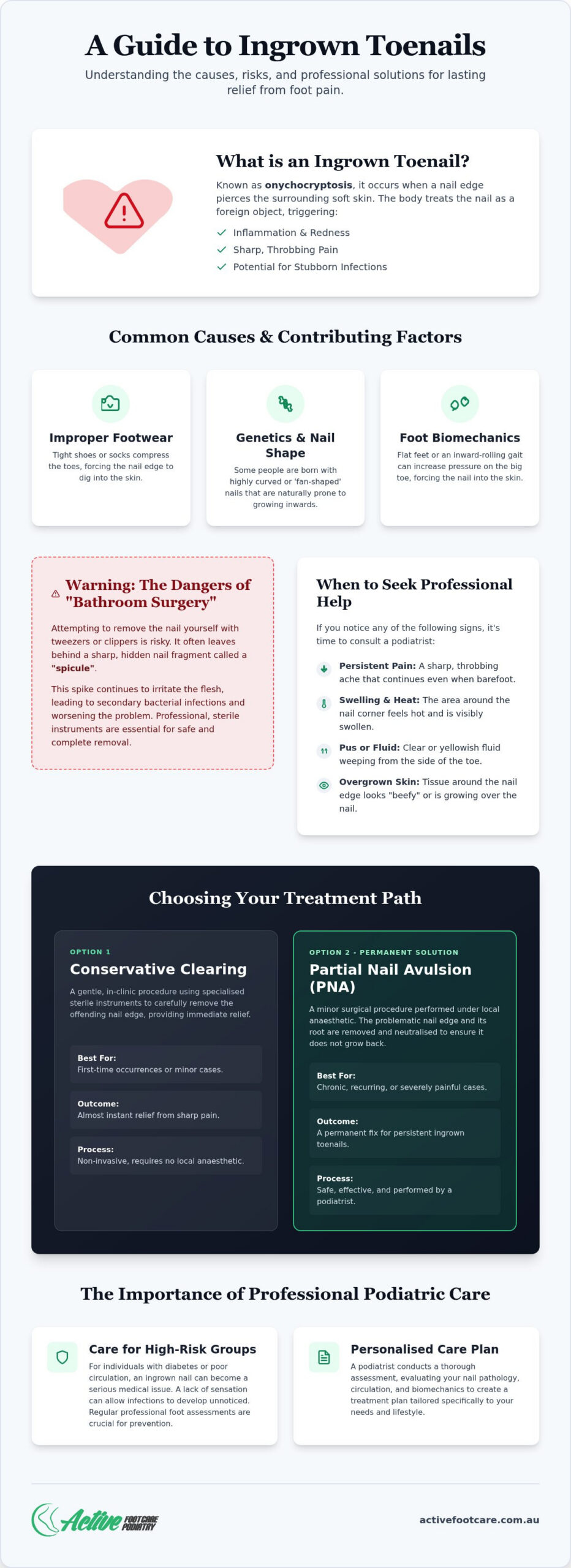
Technically known as onychocryptosis, an ingrown toenail occurs when the side of the nail plate pierces the periungual skin, which is the soft tissue surrounding your nail. This isn’t just a surface-level scrape. It’s a physical penetration of the skin that the body treats as a foreign object, leading to inflammation, swelling, and often a stubborn infection. Understanding Ingrown Toenails involves recognising that while the pain feels sudden, the underlying cause has often been developing for some time.
Several factors contribute to this condition. While many people blame poorly fitting footwear or tight socks that compress the toes, your genetics play a significant role too. Some individuals are simply born with highly curved or “fan-shaped” nails that are naturally prone to digging in. Beyond footwear and heredity, your biomechanics are a major piece of the puzzle. If you have flat feet or a gait that causes your foot to roll inward excessively, the increased pressure on the edge of the big toe can force the nail into the skin during every step you take.
Recognising the warning signs early can save you from weeks of discomfort. Mild irritation might involve slight redness or pressure when wearing shoes, but you should seek professional help if you notice:
- A sharp, throbbing pain that persists even when you’re barefoot.
- Localised heat or significant swelling around the nail corner.
- The presence of pus or clear fluid weeping from the side of the toe.
- Skin that looks overgrown or “beefy” around the nail edge.
The Hidden Dangers of “Bathroom Surgery”
It’s tempting to reach for the bathroom tweezers or nail clippers to try and hook out the offending piece of nail yourself. However, this often results in leaving behind a small, jagged fragment known as a “spicule” deep within the nail fold. This hidden spike continues to irritate the flesh, frequently leading to secondary bacterial infections or even cellulitis. Professional sterile instruments and specialised lighting are non-negotiable for safe nail clearing because they allow a podiatrist to remove the entire offending edge without further damaging the delicate tissue.
High-Risk Groups: Diabetes and NDIS Participants
For some members of our community, an ingrown nail is a medical emergency rather than a minor inconvenience. Patients living with diabetes or those with poor circulation and neuropathy may not feel the initial “warning” pain of a piercing nail. This lack of sensation means an infection can take hold unnoticed, leading to serious complications. We highly recommend regular diabetic foot assessments to catch these issues before they escalate. Similarly, NDIS participants with physical disabilities may find it difficult to maintain their own foot hygiene, making professional, local care essential for preventing chronic nail conditions and maintaining overall mobility.
Conservative vs. Surgical Treatment: Which Path is Right for You?
Choosing the right approach for Ingrown Toenails depends entirely on the severity of the condition and how often it recurs. Many of our patients in Liverpool and Bankstown come to us after trying home remedies like Epsom salt soaks, which might soothe the skin but don’t address the physical cause. If the nail has already pierced the soft tissue, it acts like a splinter. We often see people who have finished several courses of antibiotics; however, medicine alone cannot remove a physical obstruction. Our first priority is to assess the area and determine if we can resolve the pain conservatively or if a more permanent solution is required.
Professional Nail Clearing (Conservative)
For minor cases or a first-time occurrence, professional nail clearing is often the best starting point. During this routine clinical treatment, we use specialised, sterile nippers to carefully remove the offending nail edge. This process is remarkably gentle and provides almost instant relief from that sharp, throbbing sensation. Once the edge is cleared, we apply antiseptic dressings to support the healing process and prevent secondary infections. To ensure the problem doesn’t return, we look beyond the toe itself. If your walking pattern or foot shape is creating excessive pressure, we may prescribe custom orthotics to realign your foot and protect the nail fold from future trauma.
When Surgery Becomes Necessary
There are specific criteria we use to decide when a conservative approach is no longer the most effective path. If you suffer from chronic recurrence, or if your nail has an “involuted” shape where it curls deep into the flesh like a pincer, a minor surgical procedure is usually the most reliable option. We carefully weigh the benefits of Conservative vs. Surgical Treatment based on your specific nail pathology and lifestyle needs. Surgery is particularly beneficial for those who have experienced multiple infections or have a nail shape that makes simple clearing only a temporary fix. Our goal is to move you away from constant maintenance and toward a permanent state of comfort. If you’re tired of the cycle of pain, our team can provide a tailored assessment of your foot health to help you decide on the best way forward.
What to Expect During Your Ingrown Toenail Consultation in Sydney
When you arrive at our clinic with the sharp pain of Ingrown Toenails, the first thing you’ll notice is that we prioritise your comfort and understanding. A consultation isn’t just about a quick fix; it’s a comprehensive clinical review of your lower limb health. We begin with a detailed assessment of the nail’s pathology, carefully examining how the nail plate is interacting with the surrounding skin. Because your safety is paramount, we also perform a thorough check of your circulation and neurological status to ensure your body has the capacity to heal effectively after treatment.
During this time, we’ll discuss your medical history in depth. It’s vital for us to know about conditions like diabetes or any medications that might affect blood flow or skin integrity. By gathering this information, we create a personalised management plan that aligns with your lifestyle and pain level. This Comprehensive overview of ingrown toenail pathology highlights why a structured diagnostic approach is necessary for achieving long-term relief rather than a temporary patch.
A Friendly, Patient-Centred Environment
We believe that a clinical setting doesn’t have to feel cold or intimidating. Our clinics are designed to be warm, welcoming spaces where you feel like a partner in your care rather than just a patient. We take the time to explain every step of the process, which is especially helpful for children or those who may feel anxious about foot procedures. Seeing a dedicated Sydney podiatrist means you’re receiving care from someone who understands the local community and is committed to your long-term well-being.
Modern Diagnostic Tools
To stop the cycle of recurring pain, we use advanced diagnostic techniques to uncover why your nail is ingrowing in the first place. This often involves a detailed gait analysis to observe how your feet move when you walk. We also examine your footwear to identify “hot spots” where shoes might be pinching the toes or forcing the nail into the skin. Our diagnostic process ensures we treat the biological or mechanical cause of your discomfort rather than just providing a temporary fix for the symptom. By addressing these root factors, we help you step back into your daily routine with confidence and ease.
Toenail Surgery (Partial Nail Avulsion): A Permanent Fix for Chronic Pain
When conservative clearing no longer provides lasting relief, we recommend the gold-standard procedure for Ingrown Toenails: the Partial Nail Avulsion (PNA). Unlike temporary trimming, a PNA is a minor clinical procedure designed to offer a permanent solution to recurring pain. It is particularly effective for patients who have suffered through multiple infections or those with nail shapes that naturally predispose them to injury. By focusing on the specific section of the nail causing the trauma, we can restore comfort without removing the entire nail plate.
The defining feature of this procedure is the phenolisation process. After the offending nail edge is removed, we apply a specialised chemical agent to the underlying nail matrix. This step is crucial because it prevents the problematic sliver of nail from ever growing back. While a standard GP might simply clip the nail, our specialised approach achieves a success rate of over 98%, according to clinical studies. This ensures you aren’t just managing the problem, but actually resolving it for good.
Step-by-Step Surgical Journey
We understand that the idea of “surgery” can be daunting, so we have refined our process to be as relaxed as possible. The journey begins with a local anaesthetic, which is the only part of the procedure you might actually feel. Most patients describe it as a small, brief pinch. Once the toe is completely numb, we gently remove the narrow sliver of nail that has been piercing your skin. We then apply the chemical agent to the exposed root. The entire process is performed in our sterile clinic environment, ensuring you feel safe and supported throughout the 30 to 45 minute appointment.
Post-Operative Care and Healing
Recovery from a PNA is surprisingly rapid. Most of our patients return to their normal work or school activities within 24 to 48 hours. We provide you with a comprehensive home-care kit and clear instructions on how to keep the area clean and protected. We also schedule follow-up redressing appointments at our Liverpool or Bankstown clinics to monitor your progress and ensure the skin is healing beautifully. One of the most common concerns we hear is about the final look of the toe. Because we only remove a tiny portion of the nail edge, the remaining nail maintains a very natural, aesthetic appearance. If you are ready to end the cycle of chronic foot pain, you can book a surgical assessment with our experienced team today.
Expert Podiatry Care in Liverpool, Bankstown, and Beyond
Active Footcare provides a local, friendly alternative to the sterile, often overwhelming environment of a large hospital. We focus on being accessible to our community, which is why we have established clinics in the heart of Liverpool, Bankstown, and Moorebank. Whether you are dealing with a first-time flare-up or chronic Ingrown Toenails, our team is here to provide the clinical expertise you need with the personal touch you deserve. We’ve built our reputation on being a practice that values the “Modern Traditionalist” approach; we use the latest medical advancements while maintaining the old-fashioned values of attentive, patient-focused service.
Led by Principal Podiatrist Dr. Maher Said, our practice is dedicated to the well-being of every individual who walks through our doors. We don’t just treat your feet; we partner with you to ensure your long-term mobility and comfort. This commitment to thoroughness is why we take the time to understand your unique lifestyle factors, ensuring that the solutions we provide are practical and sustainable for your daily life. Our approach is grounded in medical expertise, yet it remains consistently warm and supportive, aiming to make you feel understood rather than just diagnosed.
Mobile Podiatrist Home Visits in Sydney
We understand that for many residents, especially those in Campbelltown and surrounding areas, visiting a clinic isn’t always a simple task. If you have limited mobility or are managing a busy household, we offer professional Ingrown Toenails treatment in the comfort of your own lounge room. This service is a vital resource for seniors who require podiatry services for aged care, allowing them to receive high-quality clinical attention without the stress of travel. Our mobile consultations are equipped with the same sterile instruments and professional standards you’d expect in-clinic, ensuring your safety and comfort are never compromised.
Booking Your Relief
Organising your path to pain-free walking is straightforward and stress-free. We accept various payment methods and work closely with private health insurers to help you access the rebates you’re entitled to. As a registered NDIS podiatry provider, we also facilitate specialised care for participants, ensuring that foot health remains a priority in their broader support plans. Our team is proactive and diligent, moving you from a state of physical concern toward informed confidence. If you’re ready to resolve your foot pain permanently, you can book your ingrown toenail assessment with Active Footcare today and experience the difference that compassionate, expert care makes.
Step Into a Pain-Free Future Today
Resolving the sharp, persistent ache of Ingrown Toenails doesn’t have to be a source of anxiety. Whether you require a gentle clinical clearing or a permanent surgical solution like Partial Nail Avulsion, our team provides a structured path toward recovery. We focus on treating the underlying mechanical causes of your discomfort to ensure that once the pain is gone, it stays gone for good.
Led by Principal Podiatrist Dr. Maher Said, Active Footcare combines modern diagnostic tools with a patient-centred approach. As a registered NDIS provider for Western Sydney, we are committed to making expert care accessible to everyone in our community. If you can’t make it into our Liverpool or Bankstown clinics, our mobile podiatry service brings professional treatment directly to your lounge room in Campbelltown and surrounding suburbs.
You don’t have to let foot pain dictate your daily activities or limit your mobility. You deserve to walk with confidence and ease again. Schedule Your Ingrown Toenail Consultation at Active Footcare and let us help you find the lasting relief you’ve been looking for. We look forward to supporting you on your journey back to full physical comfort.
Frequently Asked Questions
Is ingrown toenail surgery painful?
The procedure itself is not painful because we use a local anaesthetic to completely numb the toe before we begin. You might feel a small pinch during the initial injection, but once the area is numb, you won’t feel any discomfort while we work. Most patients report significant relief immediately after the pressure of the nail is removed. We prioritise your comfort throughout the entire clinical process to ensure a relaxed experience.
How long does it take to recover from a Partial Nail Avulsion (PNA)?
Most patients can return to their normal daily activities within 24 to 48 hours. While the initial healing of the soft tissue happens quickly, the full recovery of the nail bed typically takes a few weeks. We provide a comprehensive post-operative kit and clear instructions to support your recovery. Regular follow-up appointments at our Liverpool or Bankstown clinics ensure that the area is healing cleanly and without any complications.
Can I go back to work or school immediately after nail surgery?
You can generally return to work or school the following day, provided you can wear an open-toed shoe or a loose-fitting trainer. We recommend avoiding strenuous exercise, heavy lifting, or swimming for at least two weeks to allow the site to heal properly. If your job requires heavy safety boots, we might suggest a few days of light duties to prevent excessive pressure on the recovering toe during those first few days.
Will my ingrown toenail grow back after professional treatment?
When we perform a Partial Nail Avulsion with phenolisation, the success rate for preventing Ingrown Toenails from returning is over 98%. The chemical application specifically targets the nail matrix to stop the offending edge from regrowing. While conservative clearing is a helpful temporary fix, this minor surgical procedure is designed to be a permanent solution for chronic sufferers, ensuring long-term comfort and preventing the need for repeat clinical visits.
Does the NDIS cover ingrown toenail removal and podiatry?
As a registered NDIS podiatry provider, we can facilitate treatments for participants whose plans include podiatry services under their improved daily living or health and wellbeing categories. This coverage often includes assessments, conservative management, and surgical procedures if they are deemed necessary for your mobility and health goals. We recommend checking your specific plan or speaking with your coordinator to confirm how your funding can be applied to your podiatry care.
Can a podiatrist visit my home in Liverpool or Bankstown for treatment?
We certainly can. Active Footcare offers a dedicated mobile podiatry service for residents across Liverpool, Bankstown, and Campbelltown. This is an ideal solution for seniors, NDIS participants, or anyone with limited mobility who finds it difficult to travel to a clinic. Our mobile consultations bring professional, sterile equipment directly to your home, ensuring you receive the same high standard of care for your Ingrown Toenails as you would in-clinic.
What happens if I leave an ingrown toenail untreated?
Leaving the condition untreated can lead to serious complications, including chronic bacterial infections and the formation of painful tissue called a granuloma. In severe cases, the infection can spread to the surrounding skin, a condition known as cellulitis, or even reach the underlying bone. For high-risk individuals, such as those with diabetes, an untreated nail can quickly escalate into a medical emergency that threatens the overall health and safety of the foot.
Do I need a referral from my GP to see a podiatrist for an ingrown nail?
You don’t need a referral to see us as a private patient or through your NDIS plan; you can simply book an appointment directly with our team. However, if you wish to claim a Medicare rebate under a Chronic Disease Management (CDM) plan, you will need to obtain a specific referral from your GP first. We also work with all major private health funds, allowing you to claim rebates on-the-spot during your consultation.