


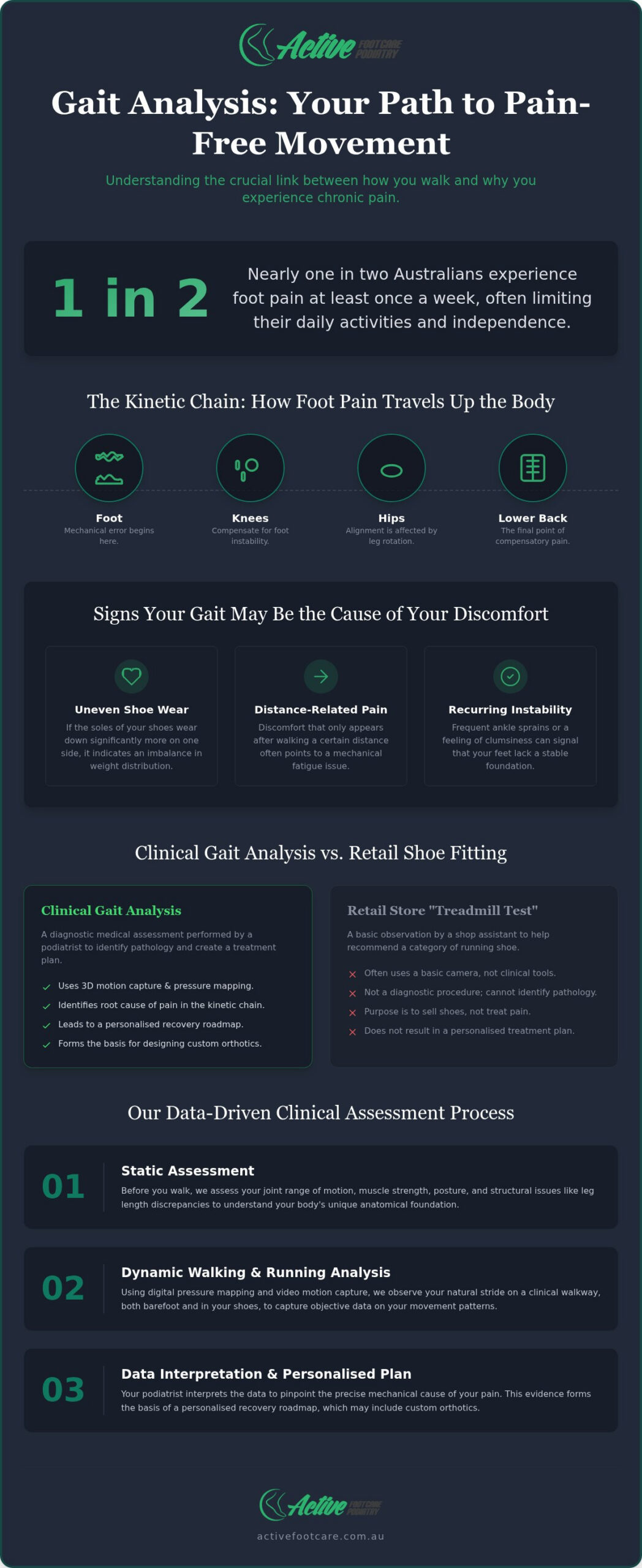
Nearly one in two Australians experience foot pain at least once a week, often turning a simple stroll through the park into a source of genuine dread. If you’re struggling with recurring heel or arch pain, you’ve likely felt the frustration of trying different shoes or generic chemist insoles with little to show for it. It’s completely natural to worry that this ongoing discomfort might eventually limit your independence or lead to permanent mobility issues. Professional gait analysis for foot pain offers the clinical clarity you’ve been searching for by identifying the precise mechanical root of your symptoms.
At Active Footcare, we believe that understanding how you move is the essential first step toward lasting comfort. By using advanced clinical tools to observe your stride, we can bridge the gap between vague symptoms and a targeted solution. This article will show you how a detailed biomechanical assessment provides a precise diagnosis and a personalised treatment plan, including custom orthotics if they’re right for your specific needs. You’ll discover how to regain the confidence to move through your day and exercise without the constant shadow of pain.
Key Takeaways
- Understand the kinetic chain and how a small mechanical error in your foot can cause pain that travels up to your knees, hips, and lower back.
- Discover how professional gait analysis for foot pain uses digital pressure mapping and 3D technology to identify exactly where your weight is distributed.
- Learn to recognise common biomechanical triggers, such as overpronation, which often act as the silent cause of chronic arch and heel discomfort.
- See how clinical data is transformed into a personalised recovery roadmap, including the design of custom orthotics tailored to your unique movement.
- Find out how to access expert podiatry assessments across Sydney or through convenient home visits for those with limited mobility.
Understanding the Link Between How You Walk and Why You Hurt
Gait analysis is a professional, clinical assessment of the way your feet, legs, and hips move in unison during locomotion. It’s a deep dive into your body’s unique movement patterns to find out why certain areas are under stress. The kinetic chain describes the way a mechanical error in the foot travels up the body to cause compensatory pain in the knees, hips, and lower back. When one link in this chain isn’t functioning correctly, the rest of your frame has to work harder to pick up the slack.
You might wonder why a podiatrist doesn’t just watch you walk across the room. While observation is part of the process, the human eye isn’t capable of catching micro-movements that occur in milliseconds. High-speed clinical technology allows us to see the subtle rotations and pressure shifts that stay hidden during a standard walk-through. It is also vital to distinguish a clinical gait analysis for foot pain from the “free” treadmill tests often found in retail running stores. While a shop assistant might use a basic camera to help you pick a shoe, a clinical analysis is a diagnostic medical tool used to identify pathology and design a comprehensive recovery plan.
The Anatomy of a Single Step
Every step you take is a complex sequence divided into three primary phases: the heel strike, mid-stance, and toe-off. Most foot pain originates when there’s a breakdown in timing or alignment during these specific moments. For example, if your heel strikes the ground at an awkward angle, it forces the rest of the foot to compensate during the mid-stance phase. Our podiatrists identify these mechanical inefficiencies to understand exactly where your structure is failing to provide the stability you need for pain-free movement.
Signs You Need a Professional Biomechanical Review
There are often physical clues that your walking mechanics are working against you. If you notice any of the following, your stride might be the hidden cause of your discomfort:
- Uneven shoe wear: Check the soles of your favourite work shoes or runners; if the rubber is worn down significantly more on one side, your weight isn’t being distributed evenly.
- Distance-related pain: Chronic discomfort that only flares up after you’ve walked a certain distance often suggests a mechanical fatigue issue rather than a simple strain.
- Recurring instability: A history of frequent ankle sprains or a general sense of “clumsiness” can indicate that your feet aren’t providing a reliable foundation for your gait.
The Science of Gait Analysis: Beyond the Naked Eye
Modern podiatry centres use synchronised technology to map your movement in 3D, providing a level of detail that was once only available to elite athletes. By using digital pressure mapping, we can identify exactly where your weight is distributed on the sole of your foot during every millisecond of contact. Video motion capture then allows for slow-motion playback, where we analyse joint angles at the ankle and knee that are otherwise invisible to the observer. The ultimate goal is to gather objective data, effectively removing the guesswork from your treatment plan and ensuring every recommendation is backed by hard evidence.
Step 1: The Static Assessment
Our process begins before you even take a single step. We conduct a thorough static assessment to check your joint range of motion and muscle strength while you’re comfortably seated. This is where we identify structural issues like leg length discrepancies or the presence of bunions that might be forcing your body to compensate. We also look at how your posture at rest influences your movement patterns, as the way you stand often dictates the way you walk. This foundation helps us understand the physical limits and strengths of your unique anatomy.
Step 2: Dynamic Walking and Running Analysis
Next, we observe your natural stride on a clinical walkway or treadmill. To get the most accurate results, it’s helpful to bring your most-worn shoes to the Active Footcare clinic. We don’t just look at how you walk barefoot; we compare that to your movement while wearing your current footwear. This comparison often reveals whether your shoes are providing adequate support or if they’re actually contributing to your discomfort. We recommend wearing comfortable clothing, such as shorts or leggings, so we can clearly see the alignment of your knees and ankles during the assessment.
Step 3: Interpreting the Digital Results
Once the data is captured, your podiatrist will review the results with you. This visual feedback is incredibly powerful, as it allows you to see the “invisible” errors in your gait cycle that lead to strain. We look for pressure peaks that correlate directly to your specific areas of pain, such as the ball of the foot or the heel. By establishing this baseline, we can measure your future progress and ensure your recovery is staying on track. If you’ve been searching for a precise gait analysis for foot pain, this data-driven approach provides the most reliable path to lasting relief.
Common Walking Patterns That Trigger Chronic Foot and Leg Pain
Biomechanical errors are often the silent cause of long-term lower limb injuries, persisting for years before they manifest as sharp pain or chronic dull aches. While your body is remarkably adaptable, repetitive stress from a faulty walking pattern eventually takes its toll on your joints and soft tissues. This is why professional gait analysis for foot pain is so vital; it uncovers the specific mechanical triggers that are unique to your stride.
- Overpronation: This occurs when the foot rolls inward excessively after landing. It forces the arch to flatten more than it should, placing immense strain on the muscles and the plantar fascia.
- Supination (Underpronation): In this pattern, the foot doesn’t roll inward enough. This leads to insufficient shock absorption, which can cause stress fractures and chronic ankle instability.
- Early Heel Rise: If your heel lifts off the ground too soon during the gait cycle, it usually indicates tight calf muscles. This puts extra pressure on the forefoot and is a frequent cause of Achilles tendonitis.
The Link to Plantar Fasciitis and Heel Pain
One of the most common issues we see is how a “dropped arch” during movement stretches the plantar fascia beyond its natural limit. When the arch collapses repeatedly during every step, the connective tissue under your foot develops tiny tears and inflammation. Many patients find that their morning heel pain is actually a direct symptom of these poor daytime walking mechanics. To understand more about the specific sensations and causes, see our guide on heel inside pain for more on this condition.
Knee and Hip Pain Stemming from the Ground Up
Your feet are the foundation of your entire skeletal structure, so it’s no surprise that foot issues often present as knee or hip discomfort. When the foot overpronates, it causes an internal rotation of the shin bone, which in turn misaligns the knee joint. This is a primary factor in “runner’s knee” and other patellofemoral tracking issues. By using gait analysis for foot pain, we can identify these upward compensations. Addressing the root cause at the ground level often helps resolve pelvic tilt and lower back issues that have failed to respond to other treatments.
From Data to Relief: How Gait Analysis Informs Your Treatment Plan
Once we’ve gathered the digital evidence from your assessment, we move from diagnosis to action. We use the data from your gait analysis to create a highly personalised recovery roadmap that addresses your specific biomechanical needs. This isn’t a one-size-fits-all approach; it’s a clinical strategy designed to restore your mobility and comfort. By identifying exactly where your movement falters, we can implement changes that provide long-term relief rather than just temporary comfort.
We also look closely at your footwear. Choosing the right shoe can be overwhelming with so many options on the market. We provide a specific footwear prescription, recommending whether you need neutral, stability, or motion control shoes. This ensures your runners or work shoes are working in harmony with your feet. Additionally, we often prescribe targeted exercise programmes. These focus on strengthening the “lazy” muscles identified during your gait analysis for foot pain, helping to balance your stride and reduce the load on overused joints.
The Role of Custom Orthotics
Custom orthotics are a primary tool in our treatment arsenal. It’s vital to understand that these aren’t just simple “cushions” for your feet. They are sophisticated medical devices designed to realign your stride and correct the mechanical errors we’ve identified. Because we use your 3D scans and dynamic gait data, we can ensure the support is placed exactly where your foot needs it most. For a deeper look at how these are made, read our custom orthotics Sydney guide.
Specialised Therapies and Rehabilitation
For patients dealing with chronic issues, we often combine gait correction with other advanced treatments. This might include shockwave therapy for heel pain, which helps kickstart the healing process in stubborn tissues. We also focus on gait retraining, which involves teaching you how to walk or run more efficiently to prevent future injuries from occurring. We don’t just set you on a path and leave you there; we monitor your progress with follow-up biomechanical reviews to ensure your body is adapting correctly. If you’re tired of recurring discomfort, it’s time to schedule your professional gait assessment and start your journey toward pain-free movement.
Professional Gait Analysis in Sydney: Expert Care at Active Footcare
Active Footcare provides specialised biomechanical assessments across Liverpool, Bankstown, and Campbelltown, serving the diverse needs of the Western Sydney community. Principal Podiatrist Dr. Maher Said brings years of clinical expertise to every gait review, ensuring that your diagnostic journey is both thorough and supportive. We don’t just hand you a report; we offer a friendly, patient-centred approach that explains the “why” behind your treatment plan. Our clinics are equipped with modern diagnostic tools to ensure your custom orthotics are perfectly tailored to the unique way you move.
By focusing on the individual rather than just the injury, we help you understand how your lifestyle and movement patterns interact. Whether you’re a busy professional in Bankstown or a retiree in Moorebank, our goal is to provide a reliable pathway to relief. We take the time to listen to your concerns and answer your questions, ensuring you feel like a partner in your own recovery. This clinical authority, blended with genuine empathy, is what defines the Active Footcare experience.
Mobile Podiatry and NDIS Gait Assessments
Accessing a professional gait analysis for foot pain should be an option for everyone, regardless of their physical limitations. We provide podiatrist home visits in Sydney for those with limited mobility who find it challenging to visit a traditional clinic. This service is a vital part of our NDIS therapy services, where we focus on improving independence and safety through precise mechanical corrections. Our podiatrists also conduct regular biomechanical reviews in aged care facilities and respite centres, bringing modern diagnostic standards directly to those who need them most.
Booking Your Appointment in Western Sydney
Starting your journey toward pain-free movement is a simple and encouraging process. We have organised our booking system for our Liverpool and Bankstown locations to ensure you can access care when it suits you. When preparing for your appointment, please remember to bring the following items:
- Your medical referral, if you have been provided with one by your GP.
- Your most-worn shoes, including work footwear and exercise runners.
- Any previous X-rays, ultrasounds, or relevant medical imaging.
Taking this first step allows us to conduct a comprehensive gait analysis for foot pain and begin solving the mystery of your stride. We look forward to helping you regain your confidence and move through life with ease.
Reclaim Your Mobility with Clinical Precision
Moving beyond the uncertainty of recurring foot pain requires a shift from managing symptoms to addressing the mechanical causes of your discomfort. We’ve explored how professional clinical assessments reveal the subtle errors in your kinetic chain that lead to chronic strain and fatigue. By understanding these unique patterns, you can transition from temporary fixes to long-term solutions like custom orthotics and targeted rehabilitation plans.
Our dedicated team, led by Principal Podiatrist Dr. Maher Said, provides this clarity across our Liverpool, Bankstown, and Campbelltown clinics. As a specialised NDIS and mobile podiatry provider, we ensure that expert gait analysis for foot pain is accessible to all members of our community, whether in-clinic or at your doorstep. You don’t have to accept discomfort as a permanent part of your daily life. Book your expert gait analysis at Active Footcare today and take the first step toward a more stable, active, and pain-free future. We are here to support your journey every step of the way.
Frequently Asked Questions
What is the difference between a gait analysis and a normal podiatry check-up?
A gait analysis focuses specifically on your dynamic movement and biomechanical efficiency, whereas a general check-up often prioritises skin health, nail care, or immediate symptoms. During a gait review, we use digital tools to map your step and identify hidden mechanical errors that occur while you’re moving. A standard check-up is excellent for general foot health maintenance, but this assessment is a diagnostic deep dive into your walking mechanics.
Do I need a GP referral for a gait analysis at Active Footcare?
No, you don’t require a GP referral to book a private gait analysis for foot pain at our clinics. You can simply contact our team directly to arrange a biomechanical review at a time that suits you. However, if you’re seeking a Medicare rebate through a Chronic Disease Management plan, your GP must provide the necessary paperwork beforehand. Bringing any previous medical records or imaging results to your first session is always helpful.
Can a gait analysis be performed during a podiatrist home visit?
Yes, we provide mobile assessments for patients who cannot visit our clinics in Liverpool or Bankstown. During a home visit, our podiatrists conduct a thorough biomechanical review and gait observation in your own environment. While some stationary 3D equipment remains in-clinic, we use portable diagnostic tools and visual analysis to identify movement issues and prescribe solutions like custom orthotics or targeted exercise programmes to improve your mobility.
How long does a professional gait analysis appointment take?
A comprehensive gait analysis appointment typically takes approximately 45 minutes to one hour. This timeframe allows our podiatrists to conduct a full static assessment of your joints while you’re seated, followed by a dynamic movement review on a clinical walkway or treadmill. We dedicate this time to ensuring every detail of your stride is captured and explained, so you leave with a clear understanding of your recovery roadmap.
Will my private health insurance cover the cost of gait analysis?
Most Australian private health funds cover biomechanical assessments and gait analysis under “Podiatry” extras, often using Item Code 118. It’s best to check with your specific provider to confirm your level of rebate and any annual limits. Because we use HICAPS at our clinics, you can usually claim your benefit on the spot, which helps reduce your out-of-pocket expenses for the consultation and any subsequent custom orthotics.
Is gait analysis only for people who are currently in pain?
Not at all; many patients use gait analysis as a preventative tool to avoid future injuries or improve their athletic performance. By identifying mechanical inefficiencies early, we can help you choose the correct footwear and strengthen specific muscle groups before pain develops. It’s particularly useful for those starting a new exercise regime or for NDIS participants who want to improve their long-term stability and walking safety.
What should I wear to my gait analysis appointment?
We recommend wearing comfortable, athletic clothing that allows us to clearly see your knees and ankles. Shorts or leggings are ideal as they don’t obscure the joint angles we need to measure during slow-motion video playback. Please also bring the shoes you wear most frequently, such as your daily work shoes and your primary walking or running runners, so we can assess how they influence your natural stride.
Can gait analysis help with knee or lower back pain?
Yes, because the feet are the foundation of your kinetic chain, their alignment directly impacts the joints above them. Poor foot control often causes the shin bone to rotate internally, which can lead to knee strain or pelvic tilt issues. A gait analysis for foot pain identifies these upward compensations, allowing us to correct the root cause and provide relief for recurring knee, hip, and even lower back discomfort.