


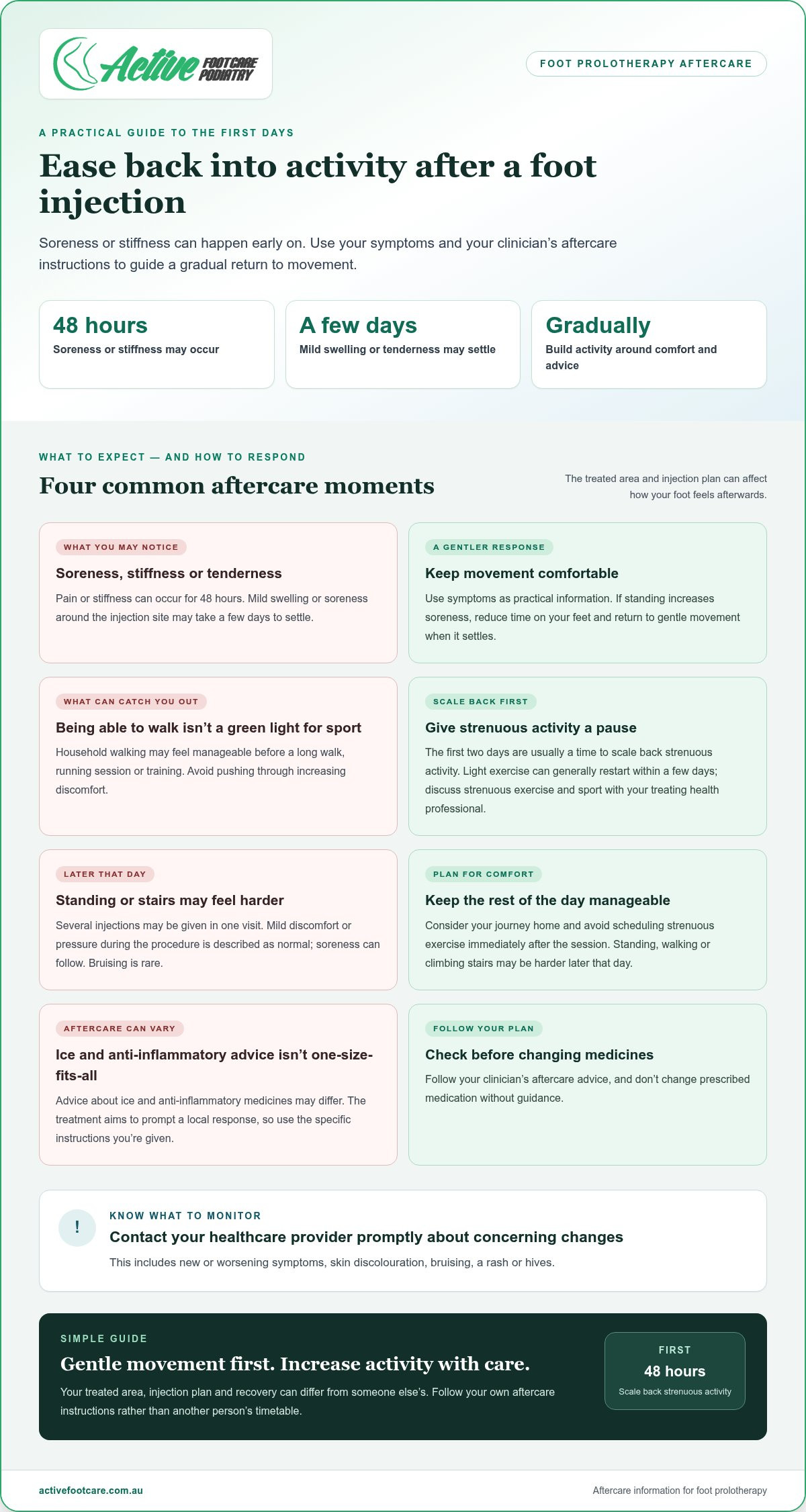
The first 48 hours after foot prolotherapy can bring soreness or stiffness, and mild swelling or tenderness at the injection site may take a few days to settle. Strenuous exercise is generally avoided for two days, so knowing what to expect after prolotherapy in the foot in Bankstown can help you plan a gentler return to activity. Advice about ice and anti-inflammatory medicines can vary, so follow the specific aftercare instructions you’re given.
It’s understandable to want to know whether discomfort is expected and when you can move normally again. If you’re considering what to expect after prolotherapy in the foot in Bankstown, it helps to know the treatment is intended to prompt a local healing response, and that the following days are part of the treatment process too.
This article explains how prolotherapy is intended to support healing, what changes you might notice, and how activity, ice and anti-inflammatory medicines may fit into aftercare. You’ll also learn what to expect after prolotherapy in the foot in Bankstown, including which symptoms warrant prompt attention.
Key Takeaways
- Plan a gradual return to activity after treatment, and distinguish gentle movement from strenuous exercise or sport.
- Understand how dextrose prolotherapy is intended to prompt a local healing response in targeted foot and ankle tissues.
- Get clear aftercare advice about ice and anti-inflammatory medicines, and don’t change prescribed medication without guidance.
- Learn why the cause and location of foot pain matter when considering prolotherapy alongside other treatment approaches.
- Know which changes after an injection are worth monitoring and when to seek prompt medical advice.
Activity after injections
After a foot prolotherapy injection, the first two days are usually a time to scale back strenuous activity. Pain or stiffness can occur for 48 hours, and mild swelling or soreness around the injection site may settle over a few days. Walking may be comfortable after treatment, but that doesn’t mean a long walk, running session or sport is appropriate straight away. Keep movement gentle and avoid pushing through increasing discomfort.
Advice on returning to activity depends on the treated area and injection plan. Some people can resume normal daily activities, while strenuous exercise and sport should wait until discussed with the treating health professional. Light exercise can generally restart within a few days. Household walking, for example, may feel manageable before a fast walk or training session. Follow your aftercare instructions rather than relying on someone else’s timetable.
A typical prolotherapy session takes 15 to 20 minutes, depending on the areas treated. The practitioner places injections into targeted painful tissues, which may include ligaments, tendons or joints. The solution may contain concentrated dextrose, a glucose-based irritant, and an anaesthetic. The anaesthetic can provide pain relief during the session, although temporary numbness doesn’t show whether the therapy has produced lasting improvement. The injection sites and the number of areas treated can affect how the foot feels afterwards.
Several injections may be given during one visit to address painful areas. Mild discomfort or pressure during the procedure is described as normal, and soreness can occur at the injection site afterwards. Bruising is rare. These effects may make standing, walking or climbing stairs harder later that day, so plan your journey home and avoid scheduling strenuous exercise immediately after the session.
Use your symptoms as practical information, not as a reason to test the foot repeatedly. If standing increases soreness, reduce the time on your feet and return to gentle movement when it settles. A day or two without strenuous exercise gives the treated area a quieter start, while normal walking may remain possible. Keep track of pain, swelling and stiffness over the first 48 hours. New or worsening symptoms, skin discolouration, bruising, a rash or hives warrant prompt contact with your healthcare provider.
How prolotherapy is intended to stimulate healing
Dextrose prolotherapy aims to prompt a local response in injured or painful tissue. A concentrated dextrose solution is injected around a targeted ligament, tendon or joint. The intended effect is a temporary inflammatory response that signals the body’s repair processes. These processes may involve collagen, a structural protein in connective tissues. The injection doesn’t physically stitch or immediately rebuild a ligament. Instead, the treatment is intended to support gradual tissue remodelling.
That proposed mechanism helps explain why relief may not be immediate or consistent. The injection can cause temporary soreness, while any improvement develops over time. The inflammatory response is part of the treatment rationale, rather than proof that healing has occurred. In an injury site, inflammatory cells are mostly gone after 10 to 18 days. This is one phase of the body’s response, not a precise timetable for full recovery or return to sport.
Progress can depend on the tissue treated, the extent and duration of the injury, and the demands placed on the foot. A ligament supporting a joint may respond differently from a tendon exposed to repeated loading. Walking, work demands and footwear can also affect strain on the area. Pain during ordinary walking, for example, presents a different functional challenge from discomfort only during running. A clinician considers these factors alongside examination findings when assessing change.
Improvement is commonly described after one to three treatments, but the same recovery period doesn’t apply to everyone. More severe cases may require six or more treatments. The timing of change also depends on the condition and whether symptoms affect daily movement. Track practical signs such as walking comfort, stiffness and your ability to complete usual activities. A short-lived change after an injection isn’t the same as sustained improvement.
Medicare and private health insurance don’t have one automatic answer for every prolotherapy appointment. Private health insurance may be difficult to claim for prolotherapy, while Medicare eligibility depends on the service and applicable benefit rules. Check your policy and the service details before relying on a rebate.
For foot pain, the aim is to connect the injection target with the tissue causing symptoms, rather than treating soreness alone. A podiatrist can explain the intended treatment and how progress will be assessed. An assessment of prolotherapy injections for foot pain can help clarify whether this approach suits the problem being treated.
Ice and anti-inflammatory medication precautions
After dextrose prolotherapy, consider ice and anti-inflammatory medicines carefully because treatment aims to prompt a local inflammatory response. Aftercare advice is especially important during the first week following an injection.
Ice precautions
Ice is generally avoided over the treated area during prolotherapy treatment. Foundation Podiatry advises against applying ice to the affected area, as reducing inflammation may work against the response the injection is intended to stimulate.
This differs from the familiar approach of icing an acute sprain or other musculoskeletal injury. After prolotherapy, the aim isn’t simply to suppress local discomfort: treatment is intended to encourage a healing response in connective tissue, including ligaments. If your foot feels sore, don’t assume an ice pack is suitable just because it helped with a previous injury. Follow the aftercare directions given for your injection.
Ice advice may also differ from general instructions to rest, ice and limit activity after an injection. These approaches aren’t interchangeable: prolotherapy aftercare depends on the treatment plan and practitioner’s instructions. If your written directions say to avoid ice, don’t apply it to the injection site. If you’re unsure how general advice applies to your treated foot, clarify it with the clinician who performed the procedure.
Anti-inflammatory medication precautions
Anti-inflammatory medicines may be discouraged around prolotherapy because they can suppress the inflammation the treatment is intended to prompt. Foundation Podiatry advises avoiding anti-inflammatory medicines and topical treatments during treatment, and avoiding anti-inflammatory medication for a week before and after injections.
This precaution may apply to more than tablets. Some topical pain-relief products also have anti-inflammatory effects, so check the active ingredient rather than relying on the brand name or how the product is applied. A cream applied to the skin, for example, can still be an anti-inflammatory treatment. If you regularly take medication for chronic pain or another condition, discuss the injection plan and medication timing with the prescriber before changing your routine.
Don’t stop or change prescribed medication on your own, especially if it manages an ongoing health condition. Tell the treating clinician which medicines and topical products you use, including regular doses and recent changes. This helps them consider your health needs alongside the intended response in the treated ligaments or other connective tissue.
For soreness after an injection, ask which pain-relief options suit your treatment plan rather than substituting an anti-inflammatory medicine or topical product. A medicine’s purpose matters: pain relief and reducing inflammation aren’t the same thing. Clear instructions help you manage discomfort without working against the treatment’s intended inflammatory response.
Prolotherapy for ankle and foot pain
Foot prolotherapy targets specific ligaments, tendons or joints, rather than treating every source of ankle or foot pain in the same way. The important first step is identifying the tissue linked to the symptoms.
Bankstown podiatry clinics offer prolotherapy for selected foot and ankle problems, and a referral isn’t always required. The referral process can depend on the clinic and payment pathway.
Prolotherapy is an injection therapy in which a solution containing dextrose or another irritant is placed into targeted tissue with a fine needle. For foot pain, the target may be a ligament supporting a joint, a tendon exposed to repeated loading, or a painful joint itself. The choice depends on the location of symptoms and examination findings, not simply whether the pain feels sharp or dull.
Dextrose is a glucose-based ingredient used in prolotherapy solutions. Concentrated dextrose commonly falls within the 15-25% range. The injection is intended to prompt a local response in the treated tissue. It doesn’t mechanically repair a torn ligament or guarantee normal movement immediately. The purpose is to support a healing response over time, with the target and condition shaping what improvement may look like.
Foot and ankle structures have different roles during movement. The plantar fascia helps support the sole, tendons transfer force as muscles work, and ligaments help stabilise joints. Pain in one area can also reflect stress on another structure. Discomfort near the ankle during push-off, for example, may involve a tendon, while pain around a joint may need a different assessment. Accurate targeting matters because injection therapy is directed at the suspected source, not the general region.
A pre-treatment assessment helps connect symptoms with the tissue being considered. The practitioner may review your medical history, examine the foot and ankle, and use imaging such as X-rays or ultrasound when appropriate. Your walking pattern, pain triggers and previous treatment also provide useful context. These details help distinguish a local ligament or tendon problem from other causes that may need a different approach.
Prolotherapy isn’t a universal option for every chronic foot complaint. The diagnosis, structure involved and effect on daily activity all matter. If pain mainly comes from footwear pressure, skin irritation or a problem unrelated to targeted connective tissue, an injection may not address the underlying cause. The key takeaway is simple: assess the cause first, then consider whether a dextrose injection fits the tissue and symptoms.
How effective is prolotherapy for foot pain compared with other treatments?
Prolotherapy’s effectiveness depends on whether the injection targets the tissue linked to the pain. It shouldn’t be ranked against every other treatment as though foot pain has just one cause. A painful tendon, ligament and joint each have different demands. Treatment comparisons are most useful when they address the same diagnosis and measure similar changes, such as walking comfort or return to usual activities.
Evidence for prolotherapy includes a 2015 systematic review of lower-limb tendinopathy and fasciopathy, which collated 203 studies. Eight were randomised controlled trials. Those figures show why study quality matters: a large total can include many kinds of evidence, while controlled trials form only part of the picture. Findings across different body areas or conditions don’t automatically predict the result for a particular foot problem.
Reported improvement should also be considered alongside follow-up length. Studies reporting benefits often haven’t followed participants for more than a few months, so how long the improvement lasts remains unclear. A reduction in pain during that period doesn’t establish that the effect will persist. For a useful comparison, consider the outcome measured, how long it was assessed, and whether participants had the same type of foot or ankle condition.
Other approaches serve different purposes. Footwear changes or custom orthotics, for example, can alter pressure and support during walking, while an injection targets selected tissue. These approaches aren’t interchangeable, and comparisons need to match the cause of pain. If symptoms relate to a tendon exposed to repeated loading, the relevant question is whether treatment addresses that tendon and the forces acting on it, not which option sounds more advanced.
Track progress using practical markers, not pain alone. Note whether standing, walking, climbing stairs or working feels easier, and compare these activities over time. A treatment that briefly reduces discomfort but doesn’t improve a meaningful task may not meet your goals. The area treated, diagnosis, daily loading and length of follow-up all shape how effectiveness should be judged.
The balanced takeaway is that prolotherapy has been studied for lower-limb tendon and fascia conditions, but the available follow-up described in those studies is limited to a few months. That evidence doesn’t establish a universal advantage over other treatments for foot pain. To explore whether an injection-based approach fits your symptoms, discuss foot pain treatment options and the outcomes you want to improve.
Active Foot Care: Podiatrist Home Visit
Active Foot Care’s Podiatrist Home Visit can help if foot pain or limited mobility makes travelling to an appointment difficult. A podiatrist can assess your foot concerns at home and discuss suitable next steps, including whether further assessment or support with movement may be helpful.
If diabetes affects your foot health, a Diabetes Foot Assessment can address specific concerns. Custom Orthotics and Gait Analysis may also be relevant when foot mechanics or walking comfort need attention. These services support broader podiatry care; they don’t replace individual aftercare instructions following an injection.
For guidance about your foot care, contact Active Foot Care or visit activefootcare.com.au.
Take your next step towards confident foot care
Knowing what to expect after prolotherapy in the foot in Bankstown can help you make an informed choice about your care. Use your everyday priorities to guide the next conversation: which movements matter most, what currently limits them, and what change would make a meaningful difference? These details keep treatment decisions focused on your needs, not pain alone.
Active Foot Care can support wider foot-health needs through a Podiatrist Home Visit, Diabetes Foot Assessment and Custom Orthotics. These options may suit you if travelling to an appointment is difficult, diabetes makes foot checks important, or you need support with foot mechanics. The right next step depends on the concern you want addressed.
Contact Active Foot Care to discuss your options and take a calm, informed step towards caring for your feet.
Frequently Asked Questions
What Is Prolotherapy?
Prolotherapy is an injection treatment intended to stimulate a local tissue-repair response. Active Foot Care describes its solution as dextrose ranging between 12.5% and 25%, combined with a local anaesthetic, usually lignocaine. For foot pain, the injection is directed towards a selected ligament, tendon or joint. It’s not the same as an injection intended only to numb pain, and the treatment plan depends on the tissue being assessed.
How Many Injections Will I Get at Any One Time?
Several injections may be given during one appointment to address targeted painful areas. The number depends on the structures being treated and how many injection sites are planned, so there’s no fixed count for every foot or ankle. A treatment targeting more than one painful area, for example, may involve multiple injection points. Discuss which areas will be treated and what to expect during the session.
How Often Will I Need to Come?
Appointments are spaced to allow the treated tissue to respond and to assess changes before another session. The interval depends on the condition, your response so far and the treatment plan. For a Bankstown appointment, record changes in walking, work tasks or exercise between visits; these details help show whether your function is changing, not just how your foot feels on treatment day. Follow your care schedule rather than arranging repeat injections yourself.
How Quickly Does it Work?
Prolotherapy isn’t expected to produce tissue repair overnight. Active Foot Care describes healing in three stages: Stage 1 – first 1 to 3 days; Stage 2 – week 2 to week 4; Stage 3 – up to 6 months. These stages describe a healing process, not a guaranteed date for pain relief. Track a practical activity, such as walking to the shops, to notice whether function changes over time.
How many treatments do I need?
The number of treatments varies with the condition and how your foot responds. A course may involve three to six treatments, while more severe cases may require six or more. Some people need fewer sessions. Whether to continue depends on changes in symptoms and function, such as standing comfortably or completing usual activities. Discuss the purpose of each planned session and how progress will be reviewed, rather than assuming every course follows the same pattern.
When should I call my healthcare provider?
Contact your healthcare provider promptly if pain or swelling is new or worsening, or if you notice skin discolouration, bruising, a rash or hives after treatment. Sudden shortness of breath, significant chest pain or major difficulty breathing requires emergency care immediately. If a symptom changes quickly or affects your ability to use your foot, explain when it began and how it has progressed when seeking advice.
Will I feel immediate pain relief after the Prolotherapy?
You may feel temporary pain relief during the session because the local anaesthetic can numb the area. That effect doesn’t show whether the longer-term treatment has worked. As the numbing wears off, the injection site can feel sore, so don’t judge the result by how your foot feels immediately afterwards. A more useful measure is whether a specific activity, such as walking or standing, becomes easier over time.
What symptoms are normal after prolotherapy in the foot?
Temporary pain, stiffness or tenderness around the injection site can occur after foot prolotherapy. Pain and stiffness may last for 48 hours, while mild soreness or swelling can take a few days to settle. Bruising is rare. Keep an eye on changes rather than repeatedly pressing the treated area. New or worsening symptoms, skin discolouration, bruising, a rash or hives need prompt medical advice.