


It is Saturday morning at the local footy oval, and while the other kids are sprinting towards the ball, you notice your child lagging behind, perhaps even tripping or complaining that their legs feel heavy. Watching them struggle to keep up can be heartbreaking, especially when you are not sure if it is a temporary phase or something that needs professional attention. It is a common sight that leaves many parents feeling torn between waiting for a growth spurt and booking an urgent appointment.
We understand that you want the best for your child’s future, and it is completely natural to feel anxious when you notice your child’s arches seem to disappear against the grass. You have likely received conflicting advice from friends saying they will just grow out of it, yet you still worry if flat feet in children are impacting their physical confidence. Our goal is to provide the clinical clarity you need to move from uncertainty to informed action.
This guide will help you distinguish between normal developmental stages and the specific signs that require a professional gait analysis. We will explore when podiatry intervention is necessary to protect your child’s long-term mobility and offer practical advice on everything from NDIS support to choosing the right school shoes. By understanding these mechanics, you can ensure your child stays active and pain-free throughout their school years.
Key Takeaways
- Learn why flat feet in children are often a normal part of growing up and when you can expect to see a natural arch begin to form.
- Recognise the key behavioural red flags, such as a child who avoids Saturday morning footy or frequently asks to be carried due to leg fatigue.
- Understand the “kinetic chain” and how proper foot alignment supports the healthy development of your child’s knees, hips, and lower back.
- Master the “Three-Point Check” for school shoes to ensure your child has the right stability and support for their daily activities.
- Discover how professional gait analysis and custom orthotics can help manage symptomatic cases and restore your child’s confidence during physical activity.
What are Flat Feet in Children? Understanding Pes Planus
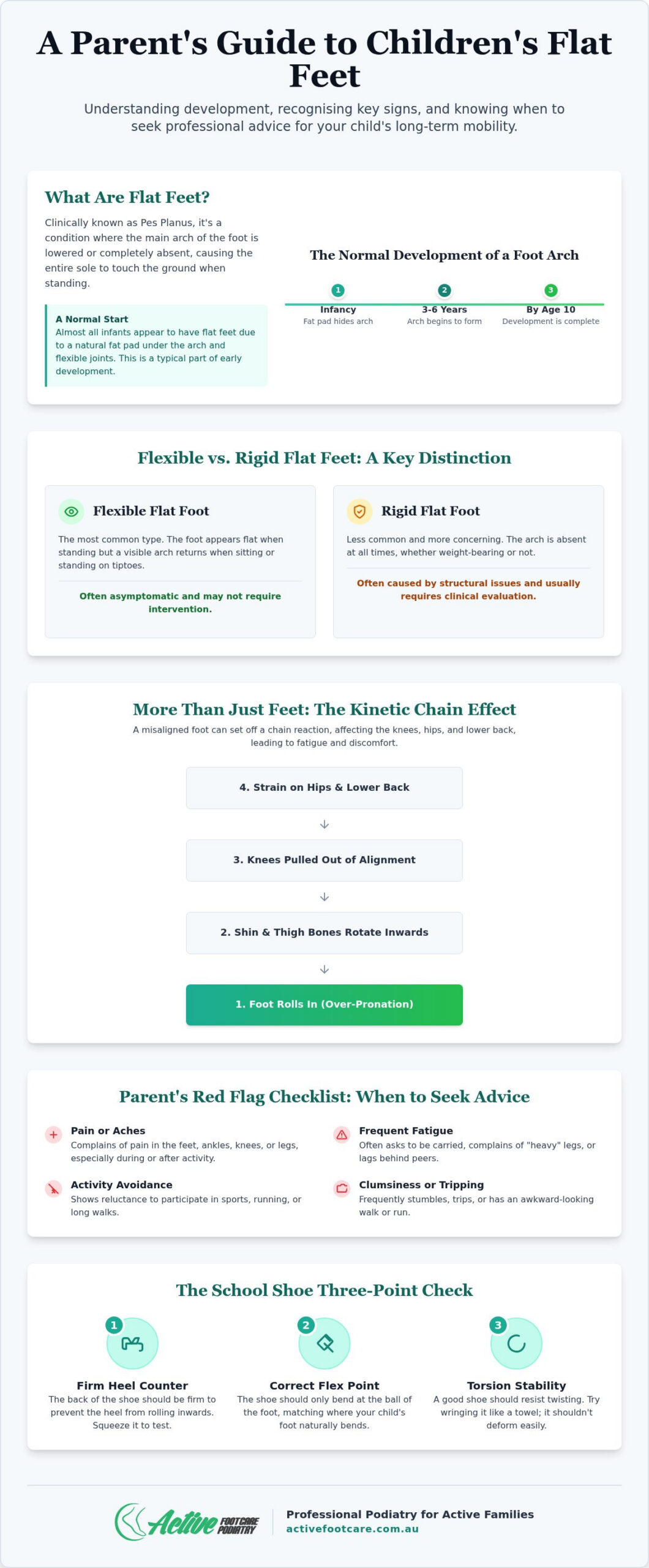
Paediatric flat feet, clinically known as pes planus, refers to a condition where the medial longitudinal arch of the foot is either significantly lowered or entirely absent. When you look at what are flat feet in a clinical context, you’ll find that the entire sole of the foot makes contact with the ground when your child stands. It is a common concern for parents, yet it is often a natural part of the body’s early structural growth.
In the earliest years of life, almost all infants appear to have flat feet. This is usually due to a thick fat pad that sits under the arch, masking its shape, combined with the natural joint laxity found in young children. As your toddler begins to walk and explore their environment, these fat pads gradually disappear and the muscles within the foot begin to strengthen. This transition from a “flat-looking” toddler foot to a more defined shape is a key milestone in their physical journey.
A key concept we use to assess foot health is the “windlass mechanism.” Think of this as a natural pulley system within the foot. When your child lifts their big toe or stands on their tiptoes, the thick band of tissue under the foot should tighten, pulling the bones together to create a visible arch. If this happens, it is a great sign that the foot structure is working as it should, even if it looks flat while they are standing still.
The Normal Development of the Foot Arch
Most children begin to develop a visible arch between the ages of three and six. During this period, the bones in the foot are still ossifying and the ligaments are tightening. While many parents are told their child will simply “grow out of it,” this is most accurate for those whose feet show healthy mechanical function despite the lack of a permanent arch. The window for normal arch development typically concludes by the time a child reaches age 10.
Flexible vs. Rigid Flat Feet: Why the Difference Matters
Understanding the type of flat feet in children is essential for determining if treatment is necessary. Flexible flat foot is the most common variety we see in our clinics. In these cases, the foot looks flat while standing, but an arch reappears when the child sits down or stands on their tiptoes. This type is often asymptomatic and may not require immediate intervention.
Rigid flat feet are less common and generally more concerning. In a rigid foot, the arch is absent regardless of whether the child is weight-bearing or not. This condition is often caused by structural issues such as a tarsal coalition, where two or more bones in the foot have fused together. Because rigid flat feet can cause significant discomfort and mobility issues, they almost always require professional clinical intervention to ensure your child can move without pain.
The Biomechanics of Flat Feet: How It Affects Your Child’s Body
When we examine flat feet in children, we focus on more than just the visual lack of an arch. We’re assessing how that foot handles the forces of movement during daily life. When an arch collapses, the foot often rolls inwards too far, a process known as over-pronation. This movement doesn’t happen in isolation; it sets off a “kinetic chain” reaction. As the foot rolls in, it forces the shin and thigh bones to rotate internally, which can pull the knees out of alignment and put unnecessary strain on the hips and lower back.
This chain reaction forces the surrounding muscles to work overtime to keep the body upright and moving forward. It’s why many children with flat feet experience muscle fatigue much earlier than their teammates. We frequently find this is linked to joint hypermobility, where the ligaments provide less natural stability. This common trait in Australian children means the muscles must compensate for the loose joints, leading to that heavy-legged feeling after a day at the park. Effectively managing flat feet in children involves addressing these efficiency gaps before they cause chronic pain.
The Impact on Sport and Physical Activity
Active kids belong on the field, but biomechanical issues can make Saturday morning soccer or netball a struggle. When the foot doesn’t provide a stable base, the impact of every stride travels directly up the leg. This often results in what parents describe as “growing pains”, those deep aches in the calves or shins that appear after a busy day. Over time, this repetitive stress increases the risk of secondary injuries like Shin Splints or Achilles Tendonitis. Providing the right support ensures your child can focus on the game rather than their discomfort.
Long-term Considerations for Adult Foot Health
The way a child walks today shapes the health of their feet in decades to come. Uncorrected symptomatic flat feet can lead to structural changes like bunions or hammertoes as the toes try to find stability. Consistently poor joint alignment also increases the likelihood of early-onset arthritis due to uneven wear on the cartilage. Using custom orthotics can help stabilise the foot and promote a healthier gait pattern. If you’re concerned about your child’s movement, a comprehensive gait analysis is a proactive step toward protecting their future mobility.
When to Worry: A Red Flag Checklist for Parents
Identifying flat feet in children is often just the first step for a concerned parent. The real challenge is determining when those flat arches transition from a normal developmental phase into a condition that requires professional correction. While many children remain asymptomatic, certain “red flags” indicate that the foot is struggling to support the body’s weight effectively during daily play.
The most significant warning sign is pain. If your child complains of aching in their feet, ankles, or legs during or after physical activity, it is a clear signal to seek advice. Pain is not a standard requirement of growing up. You should also watch for behavioural cues that suggest discomfort. A child who suddenly avoids running games or frequently asks to be carried on family walks may be experiencing physical fatigue they cannot yet put into words. According to the Children’s Hospital of Philadelphia on flat feet, persistent symptoms or a lack of flexibility in the arch are key reasons to consult a specialist.
To help you monitor your child’s development at home, keep this checklist in mind:
- The Tip-Toe Test: Ask your child to stand on their tiptoes. If a visible arch does not appear when they lift their heels, it suggests a rigid structure that needs immediate review.
- Uneven Shoe Wear: Inspect their school shoes or trainers. If the inside edge of the heel is wearing down significantly faster than the rest of the sole, it indicates excessive over-pronation.
- Asymmetry: Look at both feet together. If one foot appears significantly flatter than the other, it can lead to an uneven gait and future hip or back issues.
The “Invisible” Symptoms of Symptomatic Flat Feet
Not all symptoms are obvious at first glance. “Tired legs” at the end of a school day is often a legitimate sign of muscle fatigue caused by an inefficient gait. Similarly, frequent tripping or a general sense of “clumsiness” can actually be a biomechanical issue where the feet are not providing a stable enough base for quick movements. Some parents also report night-time leg cramps, which occur when the lower limb muscles are overused during the day to compensate for collapsed arches.
When to Book a Professional Assessment
For families in the Liverpool and Bankstown areas, we recommend a podiatry review if any of these symptoms persist for more than a few weeks. An early assessment provides peace of mind and allows us to create a proactive plan before smaller issues become chronic. At Active Footcare, we provide specialised paediatric gait analysis to identify exactly how your child’s feet are functioning. Taking action early ensures your child can return to the playground with confidence and comfort.
Practical Management: Shoes, Exercises, and Lifestyle
Managing flat feet in children is not about finding a magic cure, but rather about creating a supportive environment that allows the foot to function at its best. While the shape of the arch is largely determined by genetics and development, the right footwear and lifestyle habits can prevent the muscle fatigue and pain discussed in previous sections. We view shoes as a tool that provides the stability a flatter foot cannot yet provide on its own.
When you are shopping for new trainers or school shoes, we recommend using our “Three-Point Check” to ensure the footwear is up to the task. First, squeeze the heel counter; it should be firm and not collapse under pressure. Second, try to twist the shoe in the middle; it should resist torsion to provide mid-foot stability. Finally, check the forefoot; the shoe should only bend at the toes, where the foot naturally flexes. While thongs and ballet flats are popular in the Australian summer, they lack these three essential features and should be avoided for long walks or school days.
Alongside supportive shoes, you can help strengthen your child’s intrinsic foot muscles with simple at-home activities. Exercises like “towel scrunches,” where your child uses their toes to pull a towel toward them, or “marble pickups,” are effective ways to build functional strength. These movements engage the small muscles under the arch, improving the foot’s ability to stabilise itself during play.
Choosing the Right School Shoes in Australia
The typical Australian school day involves a mix of classroom learning and high-intensity play on hard asphalt or ovals. This environment requires a shoe with a strong, supportive midsole that can absorb impact throughout the day. Professional fitting is vital, especially if your child has a wider foot or requires extra depth to accommodate a supportive insert. Always check for a removable insole when buying new leather school shoes to ensure the footwear can accommodate a custom orthotic if required.
The Role of Barefoot Time
We often get asked if children should be barefoot. Barefoot play is actually vital for sensory and muscular development, provided it happens on the right surfaces. Encouraging your child to run on grass or sand is “productive” barefoot time because these varied surfaces challenge the muscles to adapt and grow stronger. However, for a child with symptomatic flat feet, spending hours walking on hard kitchen tiles or floorboards at home can increase discomfort. We suggest a balanced approach: use supportive footwear when they are active or on hard surfaces, and encourage barefoot play when they are in safe, natural environments. If you are unsure about the right fit for your child’s unique foot shape, our team at Active Footcare can provide a professional footwear assessment to guide your next purchase.
How a Podiatrist Can Help: Custom Solutions for Kids
When home-based strategies like supportive shoes and strengthening exercises aren’t quite enough to resolve discomfort, professional intervention becomes the most effective path forward. At Active Footcare, we take a comprehensive approach to managing flat feet in children, ensuring that every treatment plan is as unique as the child we are caring for. Our process begins with a detailed clinical history and a physical examination to understand the specific challenges your child faces during their daily activities, from the classroom to the sports field.
A central part of our care involves the use of custom orthotics. These are medical devices designed to realign the foot, reduce strain on the kinetic chain, and improve overall gait efficiency. Unlike generic off-the-shelf inserts, custom orthotics are manufactured to match your child’s specific foot structure and activity levels. For busy families in Bankstown and across Sydney, we offer the added convenience of mobile podiatry home visits. This allows us to assess your child in their own environment, making the experience less stressful for them and more manageable for you.
What to Expect During a Paediatric Gait Analysis
During a specialised gait analysis, we carefully observe your child as they walk and run. We look for specific pressure points, timing issues in their stride, and how their feet interact with different surfaces. This data is vital for designing an effective custom solution that supports their unique mechanics. We understand that a clinical setting can sometimes feel intimidating, so we ensure the process is non-invasive and engaging. Many children actually find it quite fun to show us how fast they can run or how they move during their favourite sports.
Orthotics and NDIS Support
For families navigating developmental delays or specific physical conditions, podiatry services may be eligible for coverage under the NDIS. Active Footcare has significant experience as an NDIS provider in Western Sydney, helping children reach their mobility goals through tailored clinical care. If your child has an NDIS plan, we encourage you to bring it to your consultation. We can discuss how our services, from gait analysis to custom orthotics, align with your child’s funding and long-term physical development needs. Our goal is to ensure every child has the support they need to move with ease and participate fully in school and community life.
Supporting Your Child’s Journey to Active Play
Watching your child move with confidence is one of the most rewarding parts of being a parent. We have explored how flat feet in children are often a natural developmental stage, but it’s essential to recognise when your child needs a little extra support. By prioritising the right footwear and staying alert to behavioural cues like avoiding sport or asking to be carried, you are already taking vital steps toward protecting their long-term mobility.
When professional intervention is required, our team provides the clinical expertise and empathetic care your family deserves. Led by Principal Podiatrist Dr. Maher Said, Active Footcare specialises in comprehensive gait analysis and custom orthotics tailored for young, growing bodies. We serve families across Liverpool, Bankstown, and greater Sydney, and we offer convenient mobile home visits to suit your busy lifestyle. Our goal is to ensure every child can enjoy Saturday morning footy and schoolyard games without the burden of pain.
Take a proactive step today to ensure your child stays healthy and active. Book a Paediatric Assessment with Active Footcare today and gain the peace of mind that comes from expert clinical guidance. We look forward to helping your child move toward a bright, pain-free future.
Frequently Asked Questions
Is it normal for my 3-year-old to have flat feet?
Yes, it is entirely normal for a 3-year-old to have what appears to be flat feet. At this age, most children still have a thick fat pad under the arch and very flexible ligaments, which can hide the arch structure. Arches typically begin to become more visible between the ages of three and six as these fat pads resolve and the muscles strengthen through daily movement and play.
Will my child eventually grow an arch?
Most children will naturally develop a visible arch by the time they reach age 10. This development is a gradual process that occurs as the bones in the foot fully form and the supporting ligaments tighten. While many kids will simply grow out of it, we monitor their progress to ensure their gait remains efficient. If an arch hasn’t appeared by late primary school, a professional assessment can determine if the structure requires support.
Do flat feet cause growing pains at night?
While “growing pains” is a common term, night-time leg aches are often actually caused by muscle fatigue related to flat feet in children. When the arches collapse, the muscles in the feet and calves must work significantly harder to stabilise the body during the day. This overuse leads to cramping or throbbing sensations once the child rests at night. Addressing the underlying biomechanics can often provide much-needed relief for these symptomatic children.
Can flat feet in children be corrected without surgery?
Yes, the vast majority of cases are successfully managed without surgery. In fact, fewer than 2% of symptomatic cases ever require surgical intervention. We focus on conservative treatments such as custom orthotics, targeted strengthening exercises, and gait retraining. These methods aim to realign the foot and improve efficiency, allowing your child to stay active and comfortable while their body continues to grow and develop naturally.
Are custom orthotics better than store-bought insoles for kids?
Custom orthotics provide a level of precision that store-bought insoles cannot match. While generic insoles offer basic cushioning, custom devices are manufactured based on a detailed gait analysis and 3D scans of your child’s feet. This ensures the support is placed exactly where it is needed to correct over-pronation and reduce strain on the kinetic chain. For children with specific pain or mobility issues, this personalised approach is often the key to long-term comfort.
How often should a child’s orthotics be reviewed as they grow?
We typically recommend reviewing a child’s orthotics every 12 to 18 months. Because children’s feet grow so rapidly, the device can eventually become too small or the support may no longer align with their changing bone structure. Regular check-ups allow us to adjust the prescription or manufacture new devices to keep pace with their development. This ensures your child always has the correct level of stability for their current size and activity level.
What are the best types of shoes for a child with flat feet?
The best shoes for flat feet in children are those that provide a stable, supportive base. Look for trainers or leather school shoes with a firm heel counter, a midsole that doesn’t twist easily, and flexibility only at the toe box. Avoid overly soft, “minimalist” shoes or flat-soled slip-ons for daily wear, as these don’t provide the structural environment needed to prevent the foot from rolling inwards excessively during school or sport.
Can flat feet affect my child’s ability to play sport?
Flat feet can impact sports performance by causing early fatigue or increasing the risk of injuries like shin splints. When the foot is inefficient, your child may find it harder to keep up during high-intensity games like soccer or netball. However, with proper management and the right support, most children can participate fully and excel in their chosen activities. Our goal is to ensure their foot mechanics don’t hold them back on the field.